

Overview
Researchers at the University of Wisconsin-Madison and Stanford have introduced Train-to-Test (T2) scaling laws — a unified framework that challenges a core assumption in AI development: that large models trained to standard ratios represent the most cost-effective path to strong reasoning performance.
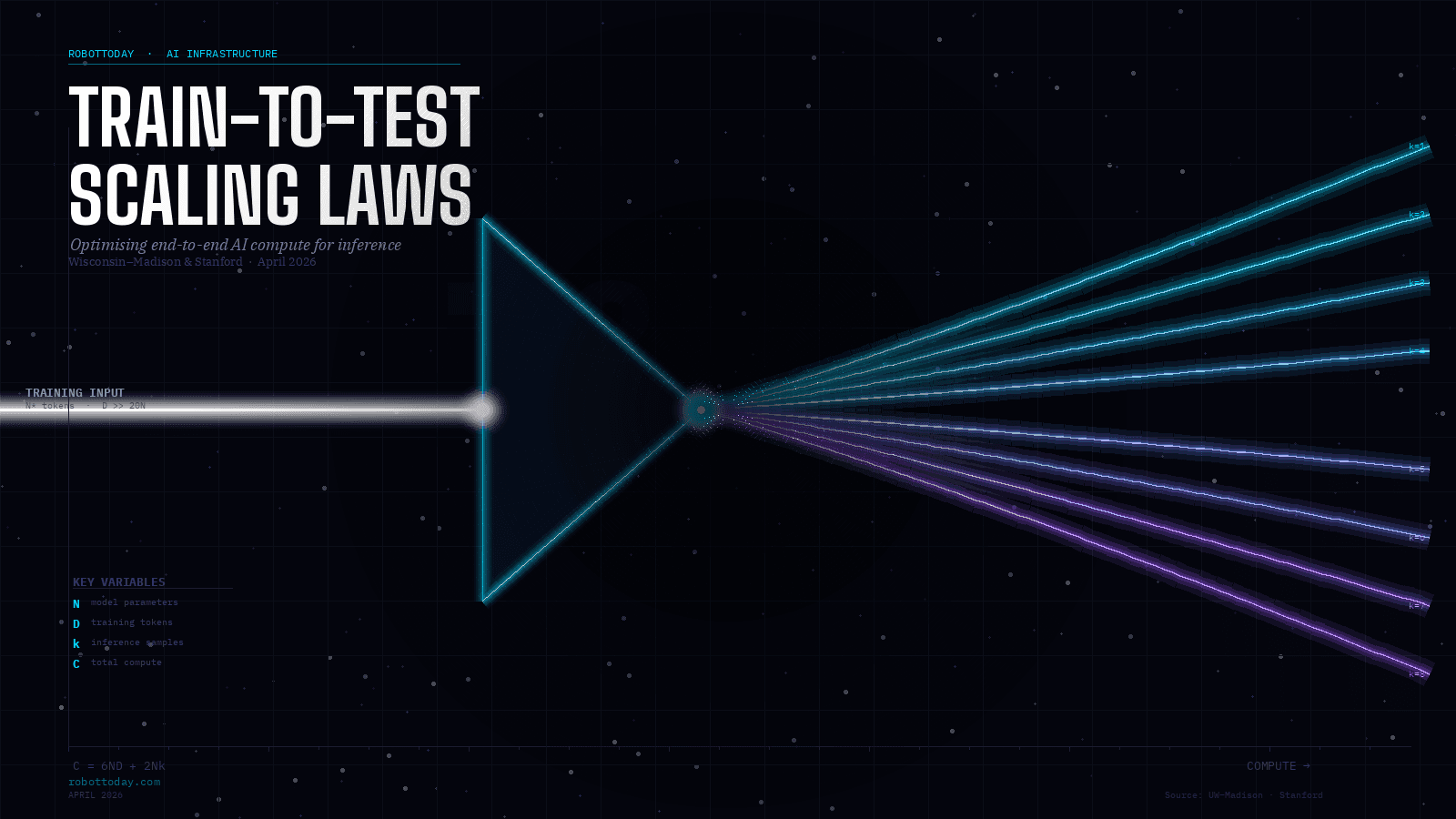
The T2 framework collapses training and inference costs into a single optimisation equation, jointly accounting for model size, training data volume, and the number of reasoning samples generated at deployment. The result is counterintuitive but well-validated: it is computationally optimal to train a significantly smaller model on far more data than current best practice prescribes, then use the compute headroom saved to run repeated inference sampling at deployment.
Key Finding
The current industry gold standard — the Chinchilla rule — recommends roughly 20 training tokens per model parameter and treats training and inference as separate problems. T2 shows this is suboptimal when inference involves repeated reasoning sampling.
Across more than 100 models ranging from 5 million to 901 million parameters — and across eight evaluation tasks — aggressively overtrained compact models consistently outperformed larger, Chinchilla-optimal models when total compute cost was held equal.
Lead researcher Nicholas Roberts: “You might not need massive compute budgets to get state-of-the-art reasoning. Instead, you need good data and smart allocation of your training and inference budget.”
Relevance for Robotics & Autonomy Developers
T2 is directly relevant to agentic workflows — the kind that underpin autonomous decision-making, multi-step task execution, and real-time reasoning in robotic systems. These are precisely the applications where repeated sampling at inference is most valuable and where frontier model costs compound fastest at scale.
Practical implications for robotics teams:
Edge and on-device inference pipelines that cannot afford repeated calls to large frontier models stand to benefit most from this approach.
Planning stacks and code-generation pipelines for robot control are among the reasoning-heavy applications T2 is explicitly designed to optimise.
Teams building inference-dependent autonomy systems on constrained infrastructure gain a principled blueprint for compute allocation across the full training-to-deployment pipeline.
The framework is not suited to knowledge-retrieval or general chat applications — its advantages are specific to reasoning and task-execution contexts.
Caveats
Heavily overtrained models can be resistant to fine-tuning, though researchers found this effect was not strong enough to negate the compute advantage.
Pushing overtraining to its limits risks hitting the “data wall” — the point at which sufficient high-quality training data is exhausted.
What to Watch
The research team plans to open-source checkpoints and code shortly, allowing teams to test T2 recommendations against their own data and deployment budgets immediately. This could become a meaningful equalising force: strong reasoning performance at a fraction of frontier model cost, accessible to organisations that cannot afford ongoing large-scale inference spend.










Leave a comment