


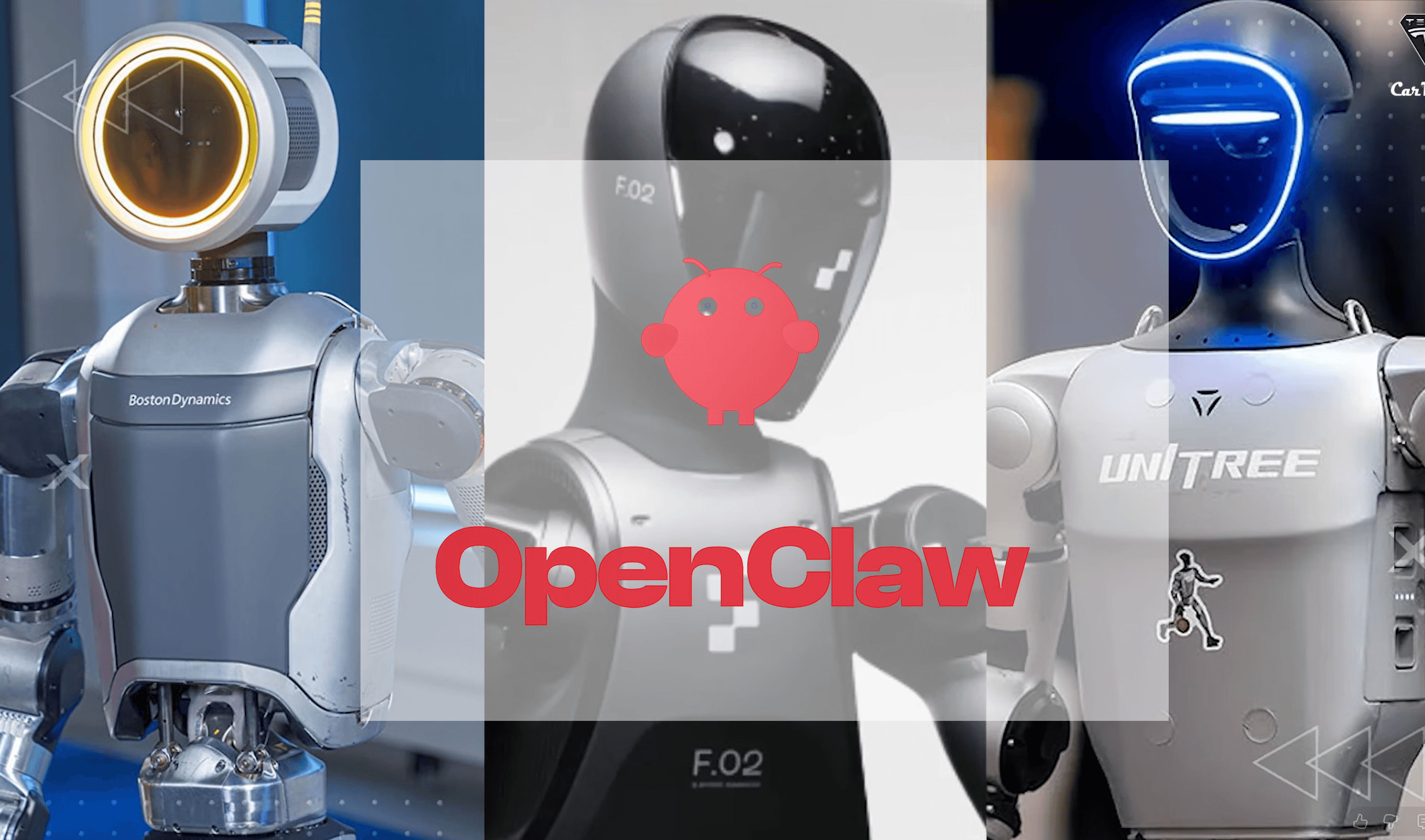
The humanoid robotics sector raised over $2 billion in 2023-2024. Figure AI hit a $2.6 billion valuation. Agility Robotics built a facility targeting 10,000 units annually. Tesla's Optimus demos went viral.
Then OpenClaw launched in January 2025, and the existential question became unavoidable: if an AI agent can orchestrate commodity robotics components through natural language, why do enterprises need $100,000 vertically integrated humanoid robots?
The answer determines which companies survive the next 24 months.
The Question OpenClaw Forces
OpenClaw isn't robotics hardware. It's a conversational AI agent that executes tasks by orchestrating existing tools through API calls. But its implications for humanoid robotics are profound.
Here's the uncomfortable math: if an enterprise can buy $40,000 in modular robotics components and coordinate them with an OpenClaw-style AI agent, what justifies paying $100,000+ for an integrated proprietary humanoid robot?
The traditional answer was: "You need vertical integration. The hardware and software must be co-designed. Our proprietary control stack is the moat."
OpenClaw challenges every part of that answer. It demonstrates that high-level task orchestration—the "intelligence" that makes robots useful—can sit in a separate layer above hardware abstraction. The robot doesn't need to know it's being coordinated by an AI agent. It just needs standard interfaces.
This unbundling accelerates a reckoning that was already coming. OpenClaw just moved up the timeline and clarified the survival criteria.
Industry Validation: The Platform Shift Is Already Happening
The OpenClaw threat isn't theoretical. Industry leaders are already positioning for the unbundling.
Wendy Tan White, CEO of Intrinsic—Google's industrial robotics software venture that launched five years ago to "make industrial robotics software smarter and more accessible"—articulates the economic driver: "It's very expensive in some places to manufacture. So the advantage of having almost software-as-a-service type of robotics solutions gives you the ability to build them in different places."
That manufacturing flexibility only works when software orchestration decouples from specific hardware. Intrinsic isn't building robots—they're building the coordination layer that works across different robots. Sound familiar?
McKinsey's November 2025 report projects $2.9 trillion in U.S. economic value unlocked by 2030 through "people, agents, and robots working together." Note the phrasing: agents as distinct from robots. The economic case assumes orchestration intelligence (agents) separate from physical execution (robots).
When Google-backed ventures and McKinsey both model the future around agent-orchestrated robotics, companies still pitching vertically integrated "our hardware + our software only" solutions face a credibility problem with sophisticated enterprise buyers.
The Historical Pattern
When Rethink Robotics shut down in 2018 after raising $150 million, founder Rodney Brooks identified the problem: "We were selling hardware when we should have been selling capabilities." Anki burned through $200 million before collapsing in 2019. Jibo raised $73 million before shuttering the same year.
The pattern isn't technology failure. It's business model failure.
Current humanoid robots cost $50,000-$150,000 per unit in hardware alone. But deployment costs often match or exceed hardware prices. One logistics VP told me: "The robot cost $80K. Getting it to work in our facility cost $120K. Nobody warned us about that part."
OpenClaw-style orchestration doesn't eliminate these costs—but it changes who captures the value. If coordination intelligence becomes a separate layer working across platforms, enterprises view robots as commodity infrastructure. And commodity infrastructure faces brutal margin compression.
Which Companies OpenClaw Threatens Most
High Risk: "Integrated Solutions" Without Hardware Differentiation
Profile:
Using commodity actuators and sensors
Differentiation primarily in software and task training
High prices justified by "proprietary stack"
Demo videos showing impressive AI but standard mechanical performance
Why OpenClaw threatens them:
Traditional procurement: $100K integrated robot, vendor lock-in, 24-month payback
Post-OpenClaw procurement: $40K modular hardware + $10K/year AI orchestration = same capability, 18-month payback, no lock-in
The math favors unbundling. Companies whose primary value is coordination software face margin compression within 12-18 months.
A former robotics executive captured it: "We optimized mechanical efficiency. Our competitors optimized software adaptability. When customers wanted new tasks, we needed 18-month hardware redesigns. They pushed 18-day software updates. We lost every deal."
Now imagine that software adaptability isn't proprietary—it's an AI agent working across multiple platforms. Those companies lose their differentiation entirely.
Medium Risk: Enterprise Anchors Without Hardware Moats
Figure AI's BMW partnership and Agility's Amazon pilots provide crucial validation. But OpenClaw introduces new questions.
The procurement conversation shifts:
Before: "Your robot costs $100K, but the ROI works"
After: "Can we achieve 80% of this with modular hardware + AI orchestration at 50% cost? Prove the performance delta justifying your premium."
Companies with genuine deployment expertise, safety certifications, and proven production reliability can justify premiums. But those selling "enterprise solutions" that are really commodity hardware plus coordination software face pricing pressure fast.
Low Risk: True Hardware Innovators
Boston Dynamics' transition from hydraulic Atlas to electric Atlas demonstrates genuine hardware innovation—the new electric actuators deliver unprecedented torque density and range of motion that commodity motors cannot match. The ability to rotate joints beyond human range, maintain dynamic balance during complex movements, and generate explosive power from electric systems represents real mechanical breakthroughs.
OpenClaw doesn't threaten companies like this. It helps them. As coordination intelligence commoditizes, differentiated hardware becomes more valuable. An AI agent can orchestrate any robot—but only make it do what the hardware physically enables.
One robotics researcher framed it: "OpenClaw could do to humanoid robotics what smartphones did to cameras. Computational photography made software matter more—but premium camera hardware became even more valuable for professionals needing capabilities beyond what software could deliver."
The Form Factor Trap OpenClaw Exposes
Companies building wheeled humanoid torsos ask: why spend resources on bipedal locomotion when wheels are more reliable, cheaper, and faster in controlled environments?
Bipedal walking requires dozens of coordinated actuators, sophisticated balance systems, constant computational overhead. Wheels need motors and steering. A wheeled torso with manipulator arms captures 80% of utility at 40% of complexity.
OpenClaw makes this visible: If an AI agent can coordinate either a $90K bipedal robot or a $35K wheeled torso, and both accomplish the same warehouse tasks, which does the enterprise choose?
The bipedal robot must justify its premium through unique capabilities. Stair climbing. Uneven terrain. Environments truly requiring bipedal locomotion. But how many enterprise deployments actually need these versus assuming they do because "humanoid robots should walk"?
The Three Survival Strategies
Strategy 1: Become the Genuine Hardware Innovator
Thesis: Double down on mechanical capabilities commodity components cannot replicate.
Novel actuators with superior power or precision. Sensor fusion commodity sensors cannot achieve. Mechanical designs enabling impossible capabilities.
Why it works: OpenClaw can orchestrate any robot—but physics still matters. If your robot lifts heavier loads, moves faster, operates in extreme environments, or achieves precision competitors cannot match, enterprises pay premiums regardless of coordination layer commoditization.
The test: Can a competitor using commodity components + OpenClaw achieve 90% of your robot's physical capabilities? If yes, you're vulnerable. If no, you're differentiated.
Strategy 2: Become the Deployment Integration Expert
Thesis: The last 20% of robotics deployment is still human expertise, not AI orchestration.
Deep vertical specialization. Safety certifications. Guaranteed uptime SLAs. Site-specific integration handling edge cases AI agents miss.
Why it works: BMW's production line cannot afford "the AI agent had a bad day." Critical operations need reliability, liability coverage, experts understanding both robots and industry context.
The test: Would your customers trust commodity hardware + OpenClaw + their internal team? If no, you have defensible expertise.
Strategy 3: Embrace the Unbundling and Compete on Services
Thesis: Accept hardware commoditization, compete on deployment scale and vertical expertise.
Robotics-as-a-Service where hardware is commodity infrastructure. Revenue from deployments, task training, continuous optimization—not hardware sales. Scale advantages from managing thousands of robots across customers.
Intrinsic's Wendy Tan White articulates why this model works: The software-as-a-service approach to robotics "gives you the ability to build them in different places"—manufacturing flexibility that only exists when orchestration decouples from hardware.
Why it works: Like AWS made servers commodity but built massive cloud services business, robotics companies can commoditize hardware but capture deployment service value.
The test: Can you profitably deploy 10,000+ robots across enterprises even if you don't manufacture hardware?
The 2026 Timeline
Q1-Q2 2025: Enterprise pilots validate OpenClaw approaches. Cost analyses show 40-60% reductions. VC investors question robotics valuations.
Q3-Q4 2025: Pricing pressure accelerates. Companies without revenue face down rounds. Those without hardware differentiation face margin compression. First "integrated solution" shutdowns.
Q1-Q2 2026: Clear bifurcation. Hardware innovators valued at premiums. Integration experts maintain margins. Agent-native service companies emerge. "Integrated solutions" largely gone.
H2 2026: New market structure solidifies across three tiers based on genuine differentiation.
What OpenClaw Really Means
OpenClaw doesn't kill humanoid robotics—it clarifies what actually matters.
For years, companies hid behind complexity. "You need our integrated solution because robotics is hard." OpenClaw forces the question: which parts are genuinely hard, and which are coordination intelligence AI agents can commoditize?
The genuinely hard parts—novel mechanical systems, extreme reliability, complex deployment integration—become more valuable. Companies excelling here thrive.
The parts that weren't hard—software coordination, task training, high-level orchestration—commoditize rapidly. Companies whose valuations depended on proprietary control face compression or extinction.
The irony: the software-defined robotics future means hardware differentiation matters more than ever. But only genuine hardware differentiation. Everything else becomes a race to the bottom that OpenClaw-style agents will accelerate mercilessly.
The 2026 survivors won't be companies with impressive demos or largest funding rounds. They'll be those who answered the OpenClaw question honestly: what do we provide that an AI agent coordinating commodity hardware cannot?
For most humanoid robotics companies currently raising capital, that's a question they haven't seriously confronted. By 2026, the market will confront them with the answer.






Leave a comment