

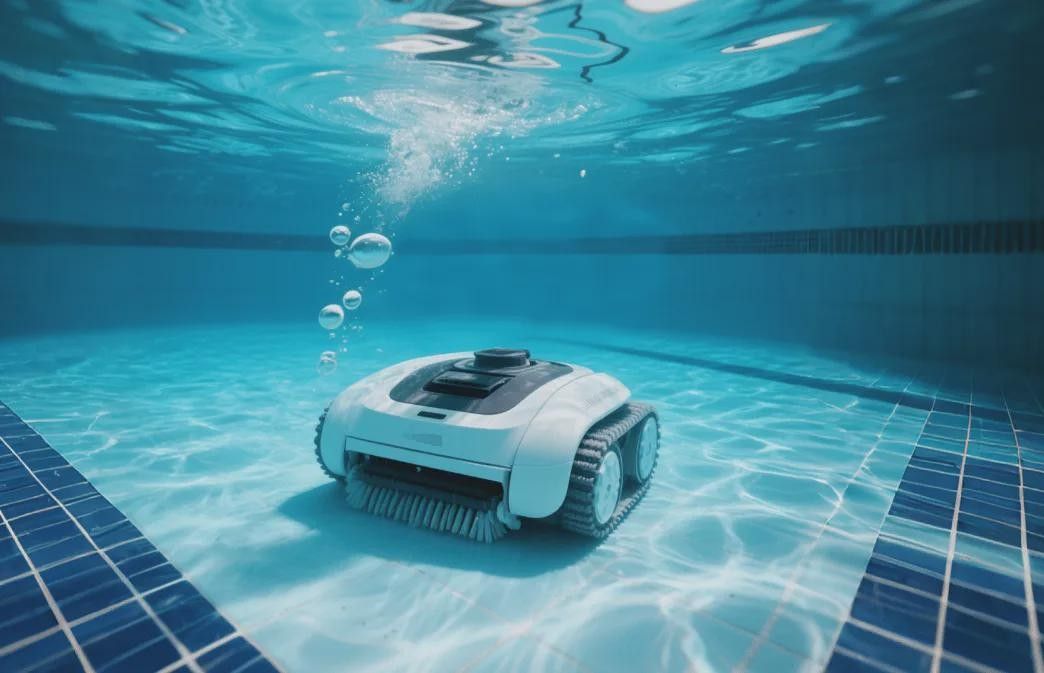
In many global households, pool maintenance is shifting from manual labor to automation. Instead of skimming leaves, vacuuming sediment, and scrubbing walls, homeowners increasingly deploy robotic cleaners that operate autonomously underwater.
What appears to be a niche category has evolved into a sizable global market. In 2024, global retail sales of pool cleaning robots reached approximately $2.5 billion, within a broader $12.9 billion pool maintenance ecosystem. Between 2019 and 2024, the segment recorded a compound annual growth rate (CAGR) of roughly 16%.
The addressable base is substantial. Global pool installations surpassed 32.9 million units in 2024, with the United States accounting for 34.3% and Europe 28.3%. Approximately 97.6% are private residential pools, where regular cleaning—often weekly during summer months—is necessary to prevent algae growth and sediment buildup. With professional cleaning services in Western markets averaging around $28 per hour, annual maintenance costs can exceed $1,000 per household, reinforcing demand for automation.
Cordless Transition Drives Structural Growth
Pool robots have existed for over a decade, but early models were tethered by power cables, limiting mobility and increasing entanglement risk. The inflection point came with the transition to cordless, battery-powered systems.
Cordless units eliminate external wiring and typically incorporate onboard navigation systems capable of mapping pool geometry, covering floors and walls, and identifying heavily soiled zones. This improvement in usability has materially shifted market demand.
Shipment data reflects this transition:
2019: ~100,000 cordless units sold globally
2024: ~2 million units
Forecast 2029: ~4.4 million units, representing 66% of total pool robot sales
Overall industry shipments are projected to rise from 4.5 million units in 2024 to 6.6 million by 2029, with retail value potentially exceeding $4.2 billion.
Technology Differentiation: Navigation and Sensing
Recent product differentiation focuses on underwater sensing and navigation. In 2025, Chinese optical technology firm Appotronics (光峰科技) introduced an underwater blue-light LiDAR system designed specifically for submerged environments. Blue wavelengths experience significantly lower absorption in water compared to red light, enabling detection ranges beyond 10 meters in suitable conditions.
Earlier-generation robots relied primarily on cameras or sonar, both susceptible to turbidity and low-light limitations. Enhanced underwater LiDAR aims to improve mapping accuracy and cleaning efficiency, raising technological barriers within the segment.
Market Structure: Chinese Firms Dominate Cordless Segment
The competitive landscape has shifted. While legacy brands from Israel and Spain historically led the category, Chinese manufacturers now dominate the cordless subsegment.
In 2024:
Global pool robot shipment concentration (CR5): ~75%
Cordless subsegment CR5: ~51.5%, all five leading companies headquartered in China
One leading manufacturer, founded in 2005 and early to commercialize cordless models in 2014, holds roughly 19–20% global market share in cordless units. The company reported revenue of approximately RMB 540 million in 2024, with cordless products accounting for nearly 89% of sales.
Notably, distribution has shifted from OEM/ODM manufacturing to direct-to-consumer branding via platforms such as Amazon, where online sales now account for the majority of revenue for some players.









Leave a comment