

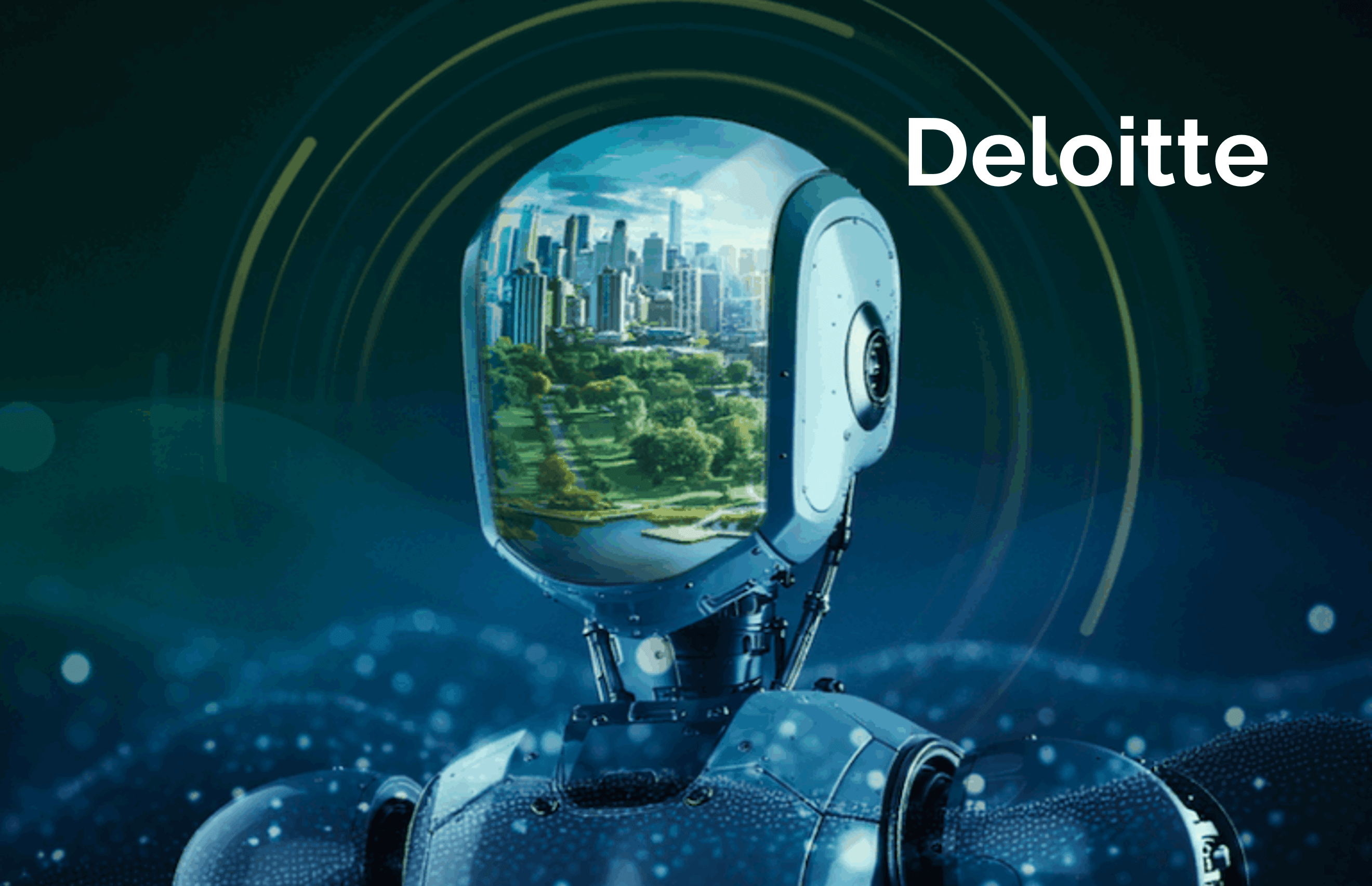
From Deloitte’s 6P Framework to a Global Divide
In its landmark 2025 report Robotics & Physical AI, Deloitte describes the rise of a new paradigm in automation—one in which artificial intelligence “crosses the boundary between the digital and the physical world.”
The report outlines a six-dimensional framework—Prepare, Perceive, Process, Perform, Proceed, and Potential—to capture how robotics evolves from programmable machines into adaptive, learning entities capable of perceiving, reasoning, and acting safely in dynamic human environments.
It also warns that this shift will not be a smooth technological upgrade but a structural transition in labor, engineering, and governance. As generative AI transforms digital work, Physical AI is poised to redefine the nature of physical work itself.
Yet, beneath the consensus on its inevitability, Deloitte’s research reveals an emerging divergence—between those who see Physical AI as a natural extension of large foundation models, and those who view it as a mechanical, materials, and safety engineering problem.
This fracture now defines one of the most fascinating debates in robotics: Should intelligence be embodied in human-like forms or optimized for specific tasks? Is the future of robots determined by neural networks, or by torque curves and compliance control? These questions are no longer academic—they divide the world’s leading experts, founders, and investors shaping the humanoid revolution.
The Shift from Virtual to Physical Intelligence
In the wake of the generative AI boom, a new frontier has emerged—Physical AI, also called Embodied Intelligence. It represents the moment when intelligence ceases to exist solely within code or cloud servers, and begins to act, move, and decide in the real world.
As Deloitte notes, this evolution moves robotics from “rule-based automation” to systems capable of autonomous perception and contextual reasoning under uncertainty. For the robotics industry, this is not just a new technology—it is the reinvention of the very concept of machine autonomy.
Consensus and Acceleration
Across the global robotics ecosystem, consensus has formed around three powerful accelerants.
First, a widening labor shortage across developed economies is forcing industries to automate not only cognitive tasks but also physical ones.
Second, AI foundation models—particularly vision-language-action (VLA) architectures—are now capable of mapping text and images directly into robotic motion planning.
Third, hardware and component costs have fallen enough to make humanoid-scale mechatronics commercially viable. From Tesla to XPeng, from Figure to Agility Robotics, every major player is racing to position itself as the embodiment layer of the AI era.
Diverging Philosophies: Two Roads of Physical AI
Still, the road to Physical AI divides sharply.
At one extreme stands Elon Musk’s Tesla Optimus, the emblem of general-purpose humanoid ambition. Musk envisions a robot that can seamlessly perform human tasks—from factory assembly to domestic chores—within spaces already designed for people. He calls it “the most valuable product ever made,” predicting it could one day generate the majority of Tesla’s revenue.
In contrast, Brett Adcock of Figure AI champions a more pragmatic path. He describes this era as a “Goldilocks moment” where robotics, AI, and economics align, yet insists that true progress depends on discipline—starting from narrow, high-value use cases like logistics and manufacturing before scaling to general intelligence.
This divide—between the universalist vision of the humanoid and the specialist approach of industrial pragmatists—encapsulates the strategic split shaping today’s Physical AI movement.
Engineering Versus Intelligence
To Marc Raibert, founder of Boston Dynamics, Physical AI is as much about physics as it is about learning. “No elegant algorithm,” he warns, “can compensate for bad hardware.” His school of thought places emphasis on actuation, compliance, balance, and dynamic control—the kinetic intelligence of motion itself.
Boston Dynamics’ Atlas and Spot embody this principle: mechanical grace first, artificial cognition later.
Meanwhile, researchers at DeepMind, ETH Zurich, and startups like Mimic Robotics argue the inverse. They believe that large-scale data, simulation, and multimodal training can endow robots with physical intuition—an understanding of force, contact, and coordination learned from experience rather than designed by engineers. This end-to-end learning paradigm sees the robot’s body not as a constraint but as part of the neural network—a feedback system that continuously refines itself through motion.
The tension between these two schools—mechanical determinism versus data-driven emergence—lies at the heart of the Physical AI debate.
The Academic Skeptics
Not everyone shares the industry’s optimism. Ken Goldberg of UC Berkeley cautions that physical reality is infinitely more complex than the digital world that nurtured ChatGPT. “Robots cannot hallucinate safely,” he notes; a single misjudged trajectory can damage property, or worse, human lives.
Goldberg argues that humanoid robotics is overhyped and under-engineered: its promise of generality masks unsolved problems in perception, dexterous manipulation, and reliability.
Similarly, Yann LeCun, Chief AI Scientist at Meta, remains skeptical of anthropomorphic illusions.
He famously dismissed Hanson Robotics’ Sophia as “a puppet,” arguing that real embodied intelligence requires world models and predictive control—not smiling faces or scripted dialogue.
For LeCun, the challenge is not how to make robots look human, but how to make them understand and anticipate the physical consequences of their actions.
The Emotional Frontier
Still, pioneers like David Hanson see a different truth. They argue that the path to Physical AI also runs through emotional connection and social acceptance. By giving robots humanlike expressions and empathy cues, Hanson Robotics hopes to make coexistence more natural—a necessary step for robots to enter caregiving, education, and customer-facing roles.
Though often criticized as theatrical, this approach reframes robotics as a cultural technology, not just an engineering pursuit. As the Deloitte report subtly implies, “social interoperability” may prove as critical as mechanical reliability.
Five Frictions Shaping the Debate
Despite the enthusiasm, five unresolved tensions dominate the Physical AI conversation.
- First, the form factor dilemma—should we design robots to resemble humans, or purely around functional optimization?
- Second, the AI control paradox—can large language models truly handle the timing and precision of motor control?
- Third, the commercialization path—will humanoids be sold as consumer hardware, or deployed via Robotics-as-a-Service models?
- Fourth, the safety and liability challenge, as regulators grapple with assigning responsibility for autonomous actions.
- And fifth, the maturity gap—between the soaring expectations of capital markets and the slow, meticulous pace of engineering reality.
Converging on a Cautious Consensus
Amidst disagreement, a subtle convergence is taking shape. Most leaders now accept that Physical AI will not leap fully formed into the market—it will evolve in stages: from task-specific robots to adaptive humanoids, and eventually, to autonomous physical agents.
Simulation-to-reality transfer (Sim2Real) is emerging as the decisive bridge, and safety-by-design as the foundational ethic. Even Musk acknowledges that Optimus will spend its early years working inside Tesla’s controlled environments before venturing into homes. Such pragmatism reflects a broader maturity: Physical AI is shifting from spectacle to systems engineering.
RobotToday Editorial View
Physical AI represents both a technological and philosophical inflection point. It compels the robotics community to integrate perception, reasoning, and action into a unified, feedback-driven continuum.
It challenges investors to distinguish hype from hardware, and policymakers to design ethical frameworks that evolve as fast as the machines they regulate. But most of all, it forces humanity to ask what intelligence means once it inhabits metal, motors, and motion.
As Deloitte’s report concludes, the future of automation is no longer about replacing human labor—it is about reimagining what it means for intelligence to exist in the physical world. And that, perhaps, is the truest definition of Physical AI.






Leave a comment