

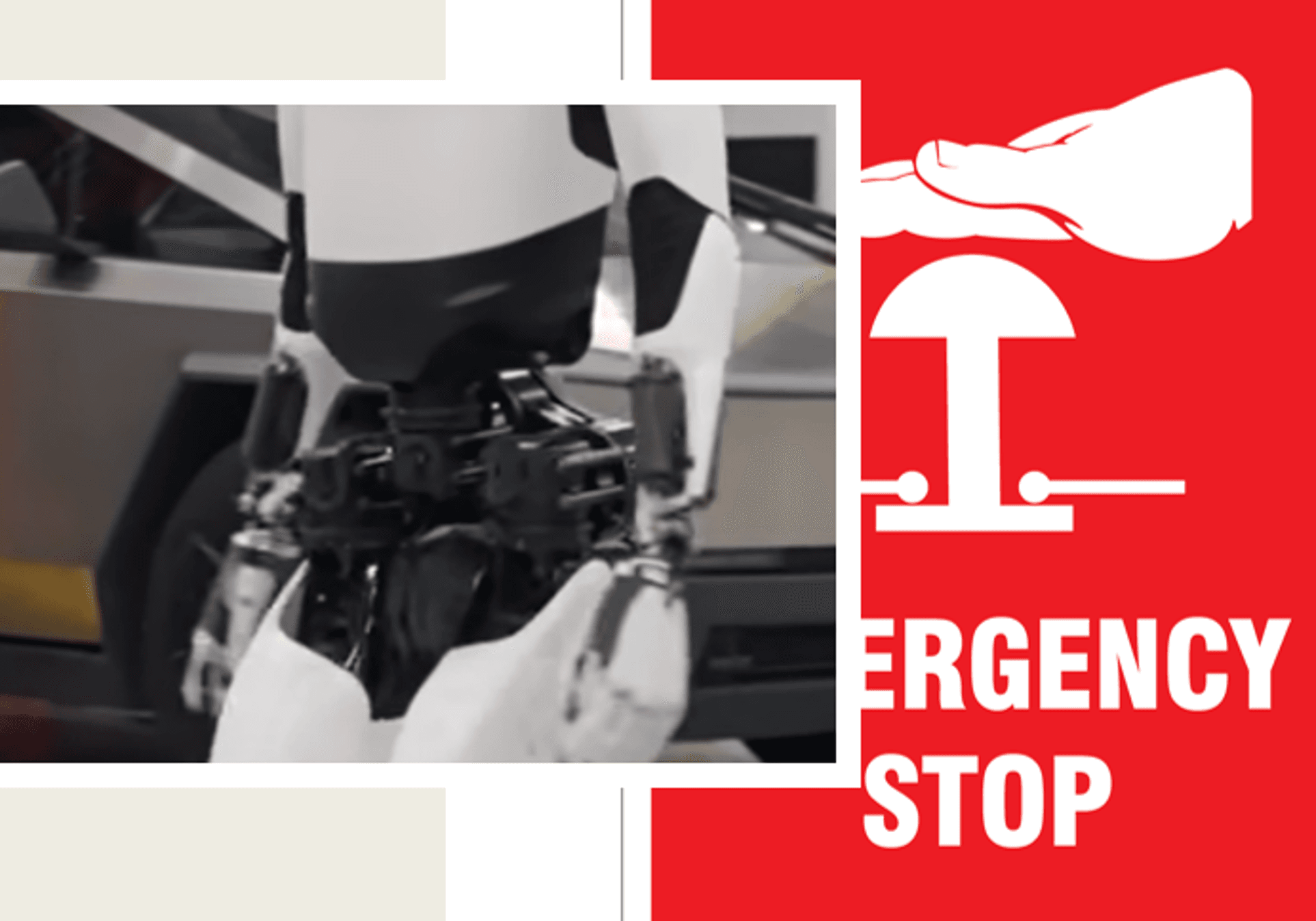
A Critical Look at E-Stop Requirements as Humanoids Step into Our Factories and Homes
The Emergency Stop (E-Stop) button — the bright red, mushroom-shaped sentinel of industrial safety — has saved countless lives on manufacturing floors, from halting a spinning CNC machine to stopping an entire conveyor belt.
But as sophisticated, dynamically stable humanoid robots move into shared human workspaces and, eventually, our homes, a fierce debate is brewing among safety experts:
Is the traditional hard-stop button still the most reliable safety measure, or does it introduce a new kind of danger?
1. The Core Conflict: Hard Stop vs. Safe Deceleration
In traditional manufacturing, safety is paramount. Workers can punch the E-Stop button (or pull a line stop) to execute a Category 0 Stop — the immediate and uncontrolled removal of power.
For traditional machines, this is the safest default state.
The Danger of the Fall
A heavy, multi-jointed robot losing power instantaneously will inevitably fall.
This creates a massive, uncontrolled hazard — potentially crushing or trapping a human worker or destroying equipment.
The New Requirement
The industry is moving toward a Safety-Rated Monitored Stop (SRMS) or Emergent Stop.
This requires the robot’s control system to remain powered for milliseconds — long enough to execute a controlled, stable deceleration, find a safe posture, or drop to its knees without losing balance.
The key question: How do we ensure a rapid, human-initiated stop while preventing the new hazard created by a falling bipedal platform?
2. Global Standards: The Roadmap to Robot Safety
The movement of humanoids into both factories and family environments forces compliance with a complex set of global safety standards.
The fundamental requirement for a manual stop device is defined by ISO 13850:2015.
However, the operational requirements for a mobile, dynamic system draw upon several complementary standards:
| Standard / Body | Focus | E-Stop / Stop Requirement Relevance |
|---|---|---|
| ISO 10218-1 & -2 | Industrial Robot Safety (Cobots) | Defines requirements for safety functions in collaborative scenarios (e.g., speed / separation monitoring). |
| ISO 3691-4:2023 | Driverless Industrial Trucks (AMRs / AGVs) | Highly relevant for mobility: specifies safety functions (like personnel detection) to meet Performance Level d (PLd). |
| ISO 13482:2014 | Personal Care and Service Robots | Addresses non-industrial applications (homes, hospitals), focusing on stability and collision avoidance in uncontrolled environments. |
How Fast Is the Stop?
The time requirement is mathematically defined through the Protective Separation Distance, which determines how far a human must remain from the robot to ensure it can stop in time:
To reduce this distance and increase productivity, the Safety System Response Time must be extremely low.
Modern safety systems are being developed to detect a breach and initiate a protective stop in under 10–20 milliseconds.
3. Industry Leaders and Expert Points of View
The most compelling arguments come from the experts actively solving the "fall hazard" problem:
Rob Gruendel (Ex-Head of Robotics Safety, Figure AI)
Gruendel's experience at the forefront of humanoid development highlights the standards gap:
"The core problem... is that bipedal robots are 'dynamically stable,' meaning they require active control just to stand up. Proving their safety is 'an order of magnitude more difficult' than for traditional, statically stable robots."
He stresses that the immediate reaction to a fault cannot be a power shutdown, but an intelligent safety system capable of overriding high-level autonomy to execute a controlled maneuver. His work, often cited in the industry, underscores why a software-controlled safe stop is essential.
Melonee Wise (Chief Product Officer, Agility Robotics)
As a leader whose company is commercializing bipedal robots, Wise offers a clear-eyed assessment of the current safety state:
"There are zero 'cooperatively safe' humanoid robots."
She clarifies that the safety principle of humanoids—unlike Autonomous Mobile Robots (AMRs) that prioritize avoiding contact through separation monitoring—is to interact with and touch things in the world. This fundamental difference makes the safety certification process, including the E-Stop logic, exponentially more complex.
Key Industry Drivers
Standards Bodies:
The Association for Advancing Automation (A3) and its leaders (e.g., Carole Franklin) push for harmonization of U.S. standards (ANSI / RIA R15.06 & R15.08) with global frameworks.Safety Manufacturers:
Companies like FORT Robotics and SICK are providing wireless E-Stops and LiDAR-based detection systems enabling ultra-fast, responsive stops.The Move to PLd:
There is consensus that critical safety functions — such as human detection and stop initiation — must meet Performance Level d (PLd) per ISO 13849, ensuring reliability even in fault conditions.
4. The Engineering Imperative: Redundancy Is Not Optional
The engineering solution to the E-Stop paradox is not a simple software patch — it demands a redundant safety architecture.
When the human hits the red button, the signal must bypass the robot’s main AI system and trigger a physically separate safety processor.
This certified hardware operates independently to:
Maintain Stability: keep joints minimally powered for balance.
Control Deceleration: brake each joint along a validated profile.
Achieve a Safe State: bring the robot to a controlled, static posture.
This loop must achieve high fault tolerance, driving up cost and complexity — but ensuring that the E-Stop initiates not chaos, but a certified stability-recovery protocol.
The Humanoid's Bottleneck and the Regulatory Race
The E-Stop button on a humanoid is not a simple switch; it is the bottleneck for commercial viability and legal compliance.
The future of humanoid deployment—and the potential for massive economic returns—hinges on which standards body (ISO, ASTM, or a new consortium) successfully publishes the first globally recognized, testable protocol for certifying an emergent, stable stop for a bipedal system.
Until this "controlled fall prevention" standard is codified and certified, every deployment carries significant liability risk. The E-Stop is therefore a catalyst for a paradigm shift: it forces engineers to design systems where the safest state is not "power-off," but a stable, monitored stop that is demonstrably safer than a catastrophic collapse. The race to define that standard is on.










Leave a comment