


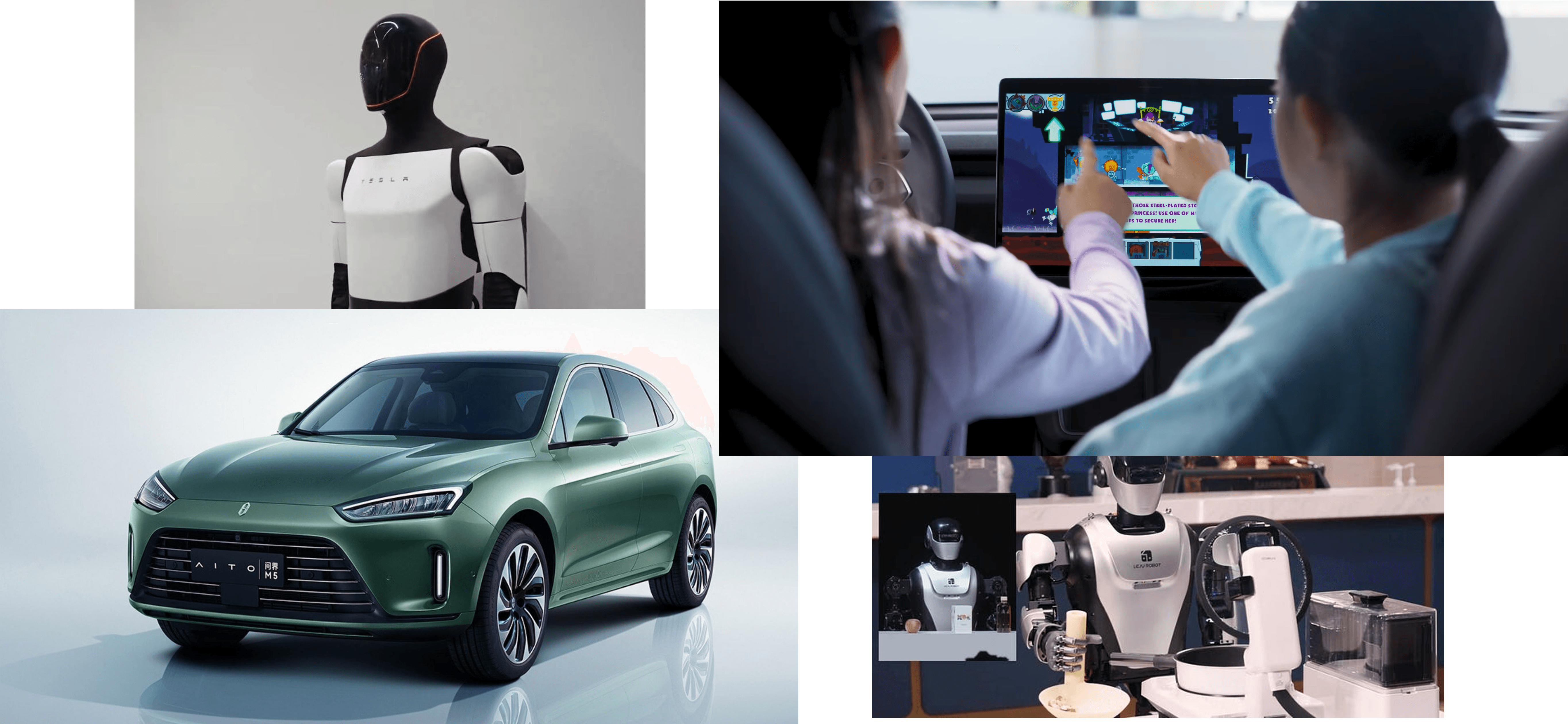
Humanoid robots—where artificial intelligence meets embodied intelligence—are now entering a decisive phase, transitioning from experimental technology to industrial-scale production. In recent years, electric vehicle (EV) makers have emerged as unexpected but powerful contenders in this field, leveraging their overlapping technologies and supply chains.
By 2025, two names dominate this race: Huawei and Tesla. Their rivalry—spanning R&D, manufacturing, and ecosystem strategy—has evolved into a head-to-head competition that mirrors the broader U.S.–China technology showdown. Yet, the battlefield is far from exclusive: China’s UBTech and Agibot, along with global players like Figure, Apptronik, and Boston Dynamics, are also vying for their share.
Below, we analyze the competitive landscape across four dimensions: current progress, core battlegrounds, challenges, and future outlook.
1. Current Progress: EV Makers Lead the Charge — 2025 Marks the First Mass-Production Year
EV makers’ foray into humanoid robotics is no fad—it’s a logical extension of shared technologies and a quest for new growth. Autonomous vehicles and humanoid robots share three core competencies: perception, decision-making, and execution. The autonomous driving system serves as the robot’s “brain” and “eyes,” while EV control and mechanical systems form its “body.”
According to Morgan Stanley, over 60% of the humanoid robot supply chain overlaps with that of smart vehicles, giving EV manufacturers a huge cost and efficiency advantage. China’s Academy of Information and Communications Technology projects that by 2045, the country will have over 100 million humanoid robots in service, creating a ¥10 trillion (≈$1.4 trillion) market.
- Tesla (Optimus): Since its debut in 2022, Tesla’s Optimus has advanced to its Gen 2 prototype, applying the company’s Full Self-Driving (FSD) neural networks to enable high-precision movement and task learning. In Tesla’s April 2025 earnings call, Elon Musk called Optimus “the world’s most advanced humanoid robot”, projecting it to become a trillion-dollar business. Tesla plans to deploy Optimus across its own factories this year before external rollout, targeting large-scale production. Its pure-vision system, powered by just three cameras and a neural network, delivers efficient real-time navigation and environmental awareness.
- Huawei (Kua Fu Project): Huawei officially entered the humanoid robot race at the end of 2024, led by its subsidiary Dongguan Jimu. The “Kua Fu” robot targets 2025 for mass production, leveraging Huawei’s Ascend AI chips and HarmonyOS ecosystem. In partnership with UBTech, Huawei is developing “humanoid robot + smart factory” solutions, with a planned capacity of over 1,000 units in 2025. During the 2025 Huawei Connect conference, Huawei and automaker GAC Group unveiled a cross-industry AI initiative aimed at breakthroughs in robot “brains, cerebellums, and limbs.”
Social media chatter, especially on X (formerly Twitter), reflects growing momentum among Chinese tech giants—Huawei, Xiaomi, and Baidu—to counter Tesla’s Optimus with strong domestic R&D and government backing. Huawei’s collaboration with UBTech is seen as a “killer combo” for both factory and household use. Meanwhile, automakers like Seres are partnering with Volcano Engine to power robot decision-making with multimodal AI models.
2. Competitive Battleground: Technology Migration, Ecosystem Power, and Geopolitics
The Huawei–Tesla rivalry transcends technology—it’s an ecosystem and geopolitical contest.
- Technology Transfer and Core Capabilities:
Tesla leads in AI algorithms through its FSD experience, allowing Optimus to interpret and act on complex instructions via end-to-end neural networks. Its hardware design—batteries, sensors, actuators—derives directly from EV platforms.
Huawei, by contrast, leverages its strengths in 5G connectivity, edge computing, and domestic supply chains. Its HarmonyOS and Ascend chips build a unified ecosystem, while China’s first “Humanoid Robot Intelligence Classification Standard” provides a framework spanning four dimensions—perception, cognition, decision-making, and execution—where both firms are investing heavily.
| Dimension | Tesla (Optimus) | Huawei (Kua Fu) |
| Core Tech | Neural networks + FSD algorithms | HarmonyOS + Ascend AI chips |
| Hardware Migration | EV batteries, sensors, mechanics | 5G integration, local supply chain |
| Software | Autonomous perception, path planning | Multimodal AI, edge computing |
| 2025 Goal | Factory deployment, mass production | 1,000+ units, smart factory rollout |
| Strength | Global brand, autonomous driving ecosystem | Domestic ecosystem, policy support |
| Challenge | Intense local competition | Export restrictions, global market barriers |
The shared supply chain intensifies the rivalry: from actuators and precision gearboxes to motors and sensors, key suppliers like Top Group, Sanhua Intelligent Controls, Green Harmonic, and Inovance are pivoting from EVs to robots. Domestic sourcing could halve component costs compared to imports.
- Market and Geopolitics:
Global humanoid robot shipments are expected to surge in 2025, with China accounting for over 50%—driven by government policy and labor shortages. Agibot aims to produce 5,000 units next year, challenging Tesla’s scale. Yet, U.S.–China tensions could reshape the field: Tesla faces aggressive “value-for-performance” competition in China, while Huawei grapples with export controls and international skepticism.
On social media, users question whether Tesla is falling behind Chinese innovation across batteries (CATL), autonomous driving (Huawei), and robotics (Unitree), as related concept stocks soar amid Huawei–Tesla speculation.
3. Investment Opportunities: Betting on the “Embodied AI” Boom
Humanoid robots are rapidly evolving from science fiction to industrial reality—creating a new “Embodied AI” investment theme that bridges robotics, automotive, and AI semiconductors.
Analysts describe 2025 as the “mass-production inflection point.” Tesla’s Optimus and Huawei’s Kua Fu both target commercial deployment this year, sparking capital inflows into upstream suppliers and ecosystem enablers.
High-Exposure Sectors & Tickers (Illustrative):
- Actuators & Motion Systems: Top Group, Inovance, Estun, and Green Harmonic—Chinese-listed suppliers with exposure to both EVs and robots. Analysts expect margins to double as demand shifts from automotive to humanoids.
- AI Chips & Embedded Systems: Huawei’s Ascend and Nvidia’s Jetson platforms dominate edge AI computing. Expect rising competition from China’s Cambricon and Horizon Robotics as domestic substitution accelerates.
- Precision Components: Sanhua Intelligent Controls, Nidec, and NSK—key in electric drives and torque sensors—are seeing order volumes rise by 20–30% YoY.
- Software & Perception AI: Firms specializing in visual SLAM, multimodal models, and 3D reconstruction—such as Horizon Robotics and SLAMTEC—are likely to benefit as robotics ecosystems open to third-party developers.
Venture capital has already pivoted: in China alone, humanoid and embodied intelligence startups raised ¥78 billion ($10.7 billion) in 2025 YTD, up 40% month-on-month. Hot targets include Agibot, Leju Robotics, and Linker Hand, which focus on industrial robots with human-like dexterity.
Institutional investors are framing humanoid robotics as the “next electric vehicle moment.” Just as EV penetration jumped from 3% to 30% in five years, analysts forecast a similar adoption curve once production costs fall below ¥200,000
4. Supplier Exposure: The Quiet Winners of the New Supply Chain
The humanoid robot supply chain overlaps heavily with the EV industry—by as much as 60%, according to Morgan Stanley. That means many traditional automotive component makers are now stealth beneficiaries of the robotics boom.
- Cross-Over Synergies:
- EV-grade battery packs and motor drives now power humanoids.
- LIDAR, radar, and camera sensors from autonomous driving systems are repurposed for robotic perception.
- CNC and actuator manufacturers are seeing a second growth curve as robots move from labs to assembly lines.
Top-performing segments include harmonic reducers, servo drives, and lightweight composite materials—critical to reducing weight and improving efficiency. Analysts note that cost parity with EV components could be achieved by 2027, accelerating mass adoption.
The biggest supply risk? Rare-earth materials and high-precision reducers remain bottlenecks. China currently controls over 80% of the world’s rare-earth refining capacity, giving domestic firms like Huawei a structural cost advantage but exposing Tesla to geopolitical volatility.
5. Policy Implications: The Tech Rivalry Rewired
The humanoid race has also become a policy theater—a proxy for AI sovereignty and industrial renewal.
- China: The Ministry of Industry and Information Technology (MIIT) has listed humanoid robots as a “strategic emerging industry.” Local governments in Shenzhen, Dongguan, and Hefei are offering subsidies and factory space for humanoid R&D. Pilot programs for “robot workers” in logistics and precision manufacturing are expanding rapidly.
- United States: The Department of Commerce’s export restrictions on AI chips and precision servos could constrain Tesla’s global manufacturing network if key Chinese partners are blacklisted. Meanwhile, Washington is expected to promote domestic embodied AI development under the CHIPS and Science Act, potentially channeling funding through DARPA and the NSF.
- Europe & Japan: Regulators are focusing on safety and liability frameworks—how humanoids interact with humans in public or workplace settings. The EU’s draft Artificial Intelligence Act explicitly lists “high-risk embodied systems,” which could slow deployment timelines but create clearer compliance rules.
6. The Bottom Line: A New Frontier for AI Capital
The humanoid robot sector sits at the intersection of AI compute, industrial automation, and human–machine collaboration—a rare trifecta for long-term investors.
While Tesla’s Optimus sets the pace for Western markets, Huawei’s Kua Fu could dominate emerging economies with cost-efficient, locally sourced designs. The next 24 months will determine whether humanoid robots remain a futuristic niche—or become the next trillion-dollar ecosystem after EVs and smartphones.
“The real race isn’t about who builds the first robot,” says a senior analyst at GF Securities. “It’s about who builds the platform everyone else plugs into.”





Leave a comment