


Section 1 — A New Phase for Heavy Unmanned Cargo Aviation
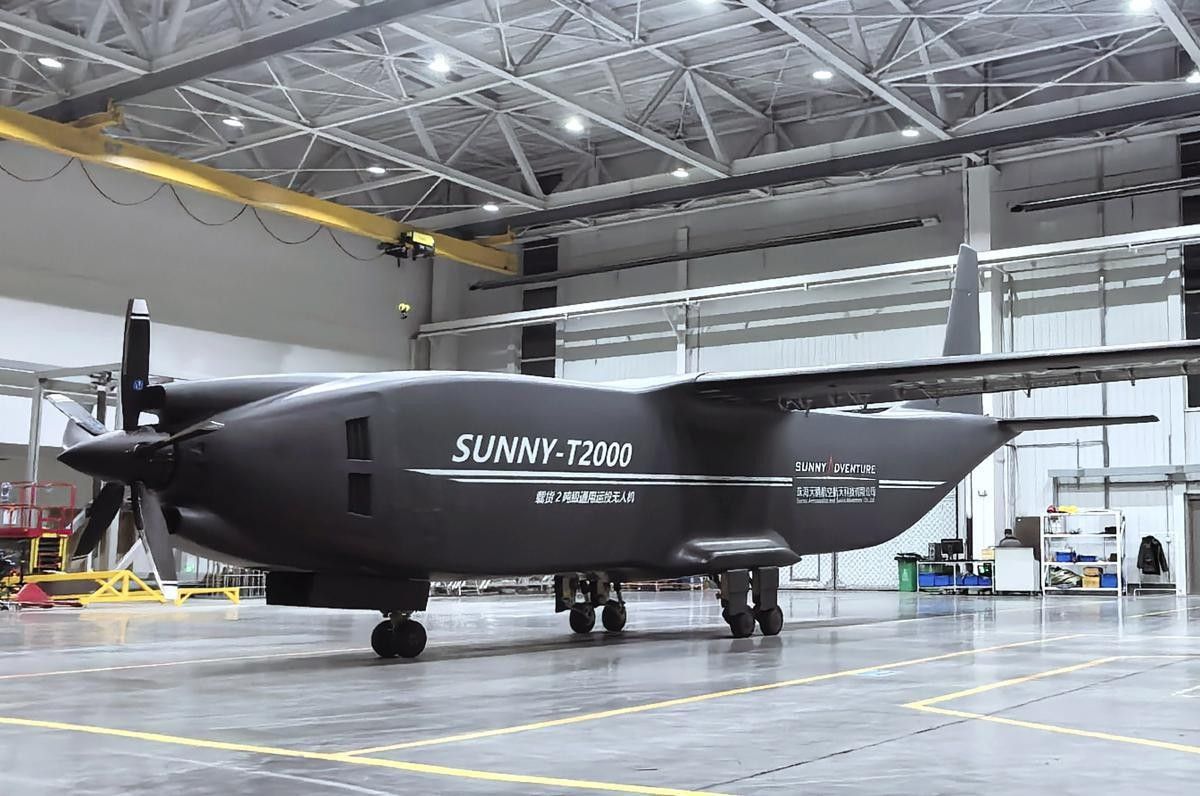
The SUNNY-T2000 marks a turning point in the slow-moving segment of heavy unmanned cargo aviation. Unlike the many small logistics drones now common in pilot projects, the aircraft in this hangar photograph is closer to a regional freighter than a parcel quadcopter. Developed by Shenyang Sunny Aeronautics and Space Adventure Co. in Liaoning, China, the T2000 is a two-ton-class unmanned cargo aircraft powered by a TP800 turboprop engine. It is designed to operate from short runways in difficult environments and to carry industrial cargo that previously required manned turboprops or helicopters. Its rollout at the end of 2025 signals that heavy cargo UAVs are finally moving from concept studies into hardware that can be produced on a line and integrated into real logistics networks.
Section 2 — Why the Two-Ton Class Matters
In industrial logistics, the two-ton payload class is a genuine boundary. Below this threshold, the market is crowded with platforms designed for medical deliveries, e-commerce parcels, or light components, often limited to tens or hundreds of kilograms. Above it, the domain has long been dominated by conventional aircraft and rotary-wing assets whose operating costs and crew requirements make high-frequency regional missions expensive. The SUNNY-T2000 sits precisely in this gap. With a maximum payload of 2,000 kilograms and a rectangular cargo hold of 15 cubic metres, it can carry palletised loads, machinery parts, relief supplies, or modular shelters in a single flight, connecting highways, depots, and remote facilities without requiring full airport infrastructure.
Section 3 — Technical Architecture and Operational Philosophy
Technically, the T2000 is a fixed-wing, turboprop UAV with short-takeoff capability rather than a pure electric eVTOL. The TP800 engine provides the power density and reliability needed for sustained operations with heavy loads over regional distances. An 800-metre runway requirement keeps infrastructure demands low, while unmanned operation reduces crew cost and enables more flexible deployment patterns. In practice, this combination makes it an “air truck” for the last few hundred to thousand kilometres, particularly in mountainous regions or underdeveloped transport corridors where ground routes are slow or vulnerable to disruption.
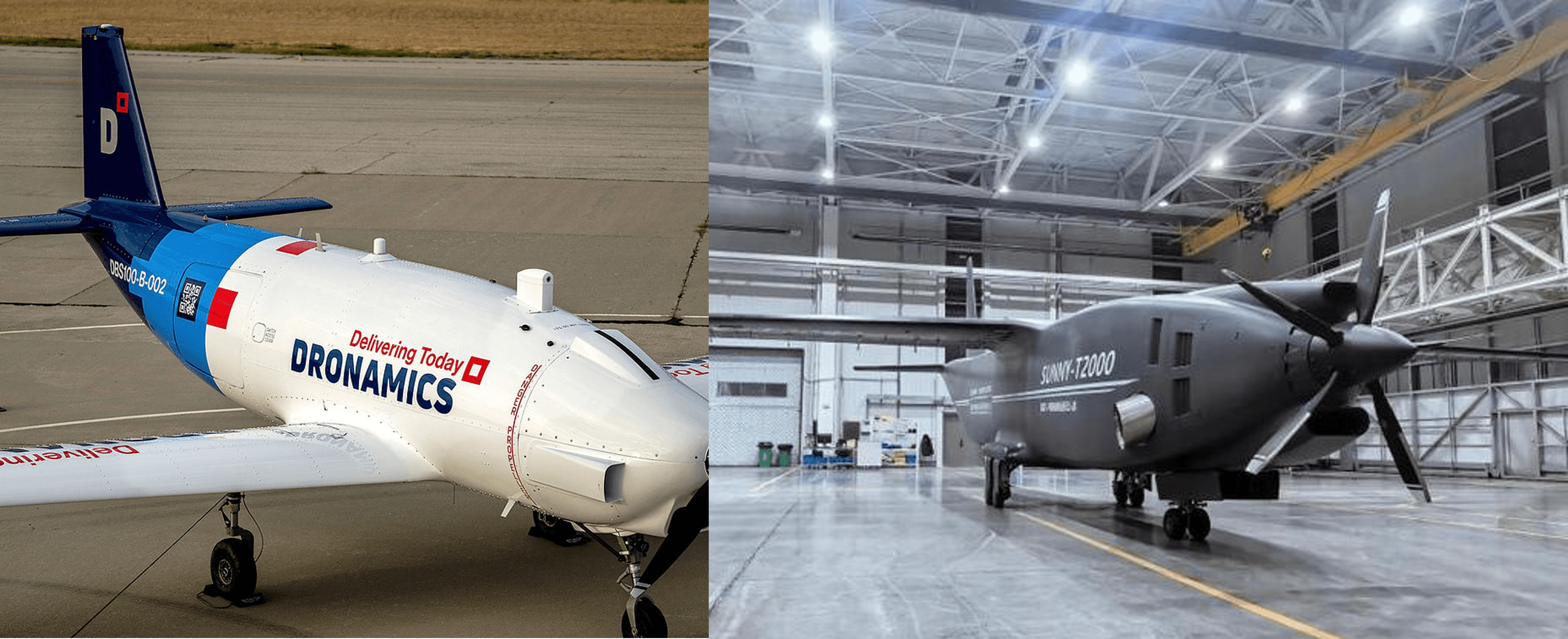
To understand its position, it is useful to compare the SUNNY-T2000 with one of the most visible Western heavy-cargo drones, the Dronamics Black Swan.
Section 4 — Technical Comparison
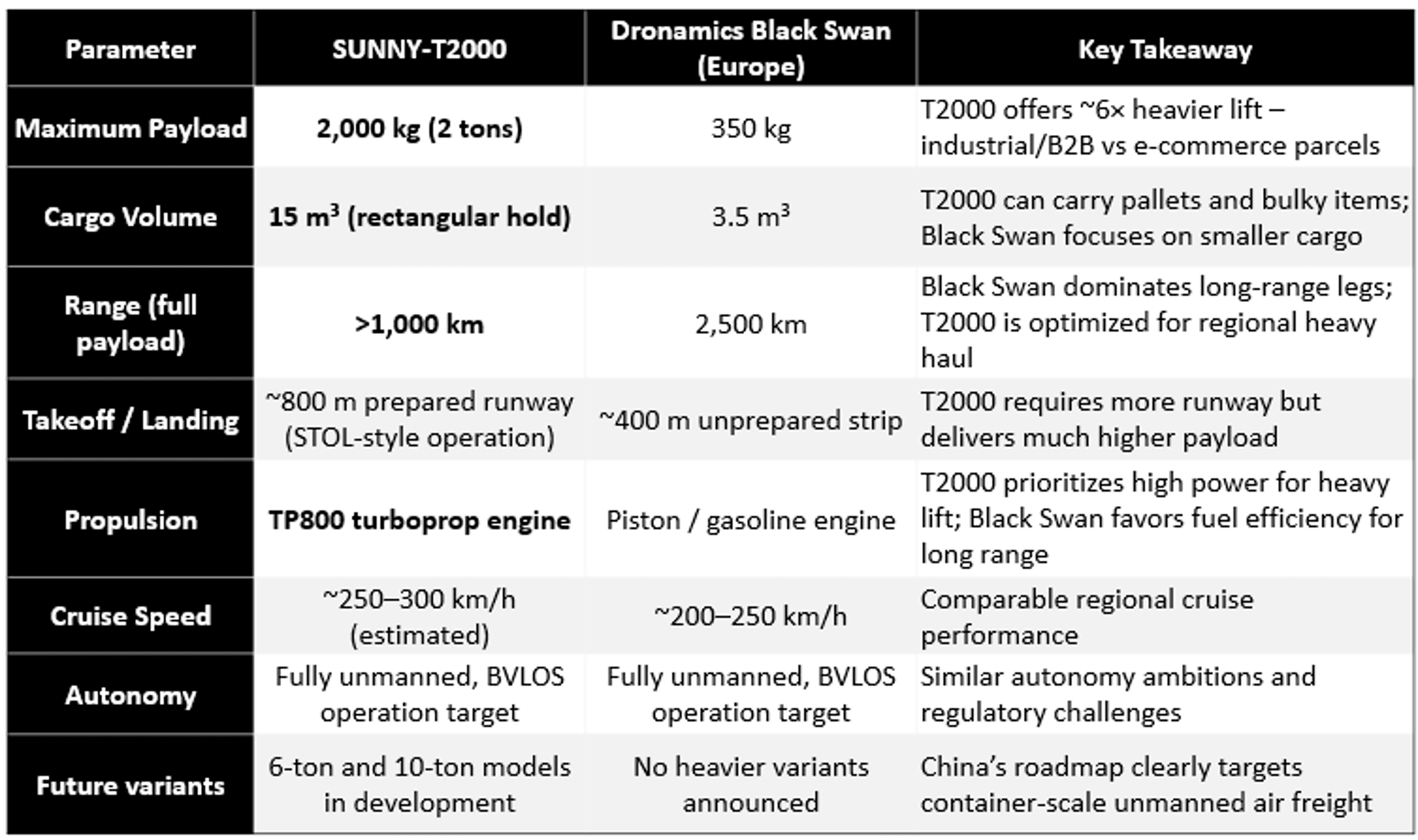
The table highlights how different strategic choices are shaping the heavy-cargo UAV landscape. Black Swan pursues long-range, mid-payload operations with a lighter airframe and highly efficient gasoline powerplant, aiming to undercut traditional airfreight on cost per kilogram over thousands of kilometres. The SUNNY-T2000, by contrast, sacrifices ultimate range in favour of payload and volume, positioning itself as the first credible unmanned “air truck” for heavy, time-critical transport missions.
Section 5 — Why Heavy Cargo UAVs Have Taken So Long
The development of the T2000 also illustrates why heavy cargo UAVs have progressed slowly until now. Turboprop propulsion, large composite structures, robust landing gear and redundant flight-control systems all demand significant upfront investment and long testing cycles. Certification for beyond-visual-line-of-sight operations with multi-ton payloads is stricter and more complex than for light drones. Furthermore, operators need a credible business case: aircraft of this size only make sense where there is consistent industrial demand, such as spare parts for energy projects, high-value agricultural outputs, mining logistics, or government emergency stockpiles.
Section 6 — China’s Low-Altitude Economy as an Accelerator
China’s “low-altitude economy” policy framework provides a partial answer to this problem. By building dedicated test routes, controlled airspace and a cluster of supporting companies in Shenbei New District, regulators and industry are attempting to compress the time between prototype and scalable deployment. If this ecosystem succeeds, the SUNNY-T2000 could become a reference model for how heavy cargo UAVs are industrialised, not only in China but across Asia–Pacific. For global incumbents in logistics and express delivery, this raises strategic questions. Once a two-ton unmanned platform proves it can reliably move industrial freight on regional routes, it becomes harder to justify using manned aircraft or long truck hauls for the same missions.
Section 7 — A Glimpse of What Comes Next
Looking ahead, the planned 6-ton and 10-ton variants are particularly important. A 6-ton aircraft with a cargo hold roughly equivalent to a 40-foot container would push unmanned logistics into the domain currently served by small freighters and, in some regions, even coastal shipping. A 10-ton model would move the discussion into cross-regional heavy transport, potentially reshaping how ports, inland terminals, and factories think about buffer inventory and just-in-time supply.
Section 8 — Conclusion
In summary, the SUNNY-T2000 does not resolve all the open questions around regulation, safety, and economics in heavy unmanned cargo aviation. It does, however, provide a concrete demonstration that a two-ton, turboprop-powered UAV can be designed, built, and prepared for serial production with a clear industrial use case. For RobotToday’s readers, the key signal is that heavy cargo UAVs are finally escaping the “PowerPoint and prototype” phase. The T2000 is an early but significant indicator of how the next decade of logistics innovation may unfold: not only with small drones over cities, but with turboprop “air trucks” linking highways, factories, and remote regions in three dimensions.




Leave a comment