


Filing Status
SpaceX confidentially submitted a Form S-1 registration statement to the U.S. Securities and Exchange Commission on 1 April 2026, initiating what could become the largest technology IPO in history. The company is targeting a valuation of approximately USD 1.75 trillion, with up to USD 75 billion in gross proceeds and a tentative listing window in June 2026.
Because the filing used the SEC's confidential submission process, the complete document is not yet publicly available on EDGAR. The passages cited in this briefing are sourced from Reuters' 21 April 2026 exclusive report, which quoted directly from the Risk Factors section. Full public disclosure is expected at least fifteen days before SpaceX's investor roadshow — anticipated no earlier than late May or early June 2026.
Core Framing: Strategic but Unproven
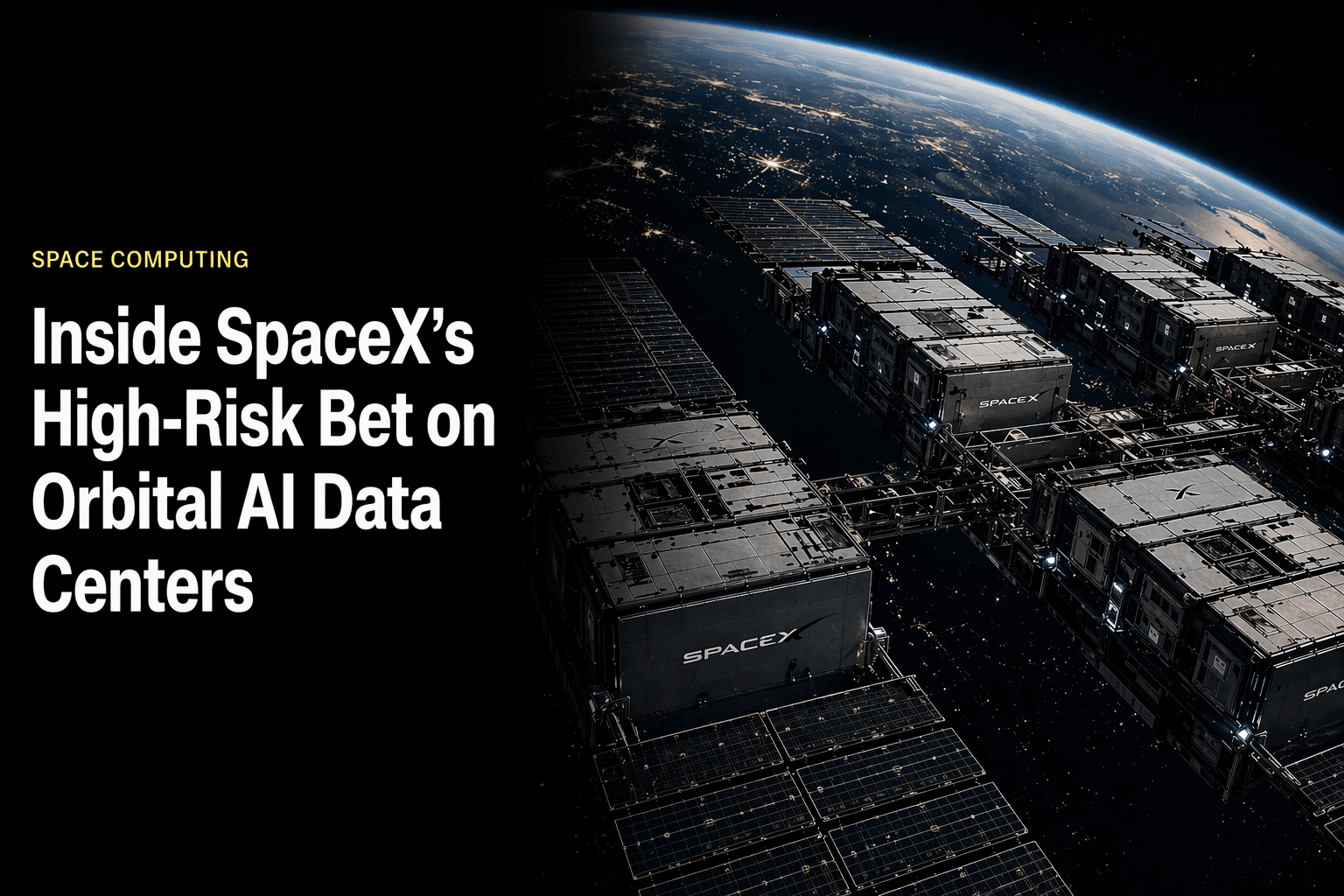
Within the Risk Factors section, SpaceX characterises its orbital AI compute initiative — referred to in some reporting as the 'Space DataCenter' concept — using language that is deliberately cautious. The filing describes the programme as early-stage, technically complex, reliant on unproven technologies, and potentially non-viable commercially.
"Our initiatives to develop orbital AI compute and in-orbit, lunar, and interplanetary industrialization are in early stages, involve significant technical complexity and unproven technologies, and may not achieve commercial viability." — SpaceX S-1 Risk Factors (via Reuters)
This framing is standard IPO practice: U.S. securities law requires issuers to disclose all material risks comprehensively, creating an incentive for conservative language. However, the explicitness of the disclaimer — given the scale of Elon Musk's public statements on orbital compute — is commercially significant. The filing offers no deployment timeline, no revenue guidance, and no assurance that the initiative will reach commercial scale.
Technical Risk Profile: Space Is Not a Free Data Centre
The S-1 directly addresses the environmental challenges that distinguish orbital infrastructure from terrestrial hyperscale deployments. Unlike conventional data centres, orbital systems face a set of physical constraints that have no terrestrial equivalent:
| Risk Vector | Engineering Challenge | Mitigation Complexity |
| Radiation exposure | Semiconductor degradation; soft errors in memory and logic | Radiation-hardened components; ECC memory; shielding mass |
| Micrometeoroid & debris impacts | Physical damage to compute modules and solar arrays | Orbital avoidance manoeuvres; shielding; limited repair options |
| Thermal extremes | Cycling between -150°C and +120°C per orbit | High-mass radiator arrays; heat pipes; materials qualification |
| Vacuum environment | No convective cooling; outgassing risk from electronics | Fully passive or radiative thermal architecture required |
The filing acknowledges that these factors could cause orbital data centres to malfunction or fail entirely. This is a direct challenge to the frequently cited narrative that space provides 'free cooling' via vacuum radiation and 'free power' via uninterrupted solar exposure — both advantages are real in principle, but neither eliminates the engineering complexity of operating compute hardware in a hostile environment.
Starship Dependency: The Single-Point Enabling Layer
The viability of the entire orbital compute architecture rests on Starship. The S-1 is explicit on this dependency:
"Any failure or delay in the development of Starship at scale or in achieving the required launch cadence, reusability and capabilities thereof would delay or limit our ability to execute our growth strategy."
This dependency operates across four dimensions simultaneously:
Launch cadence: deploying and replenishing modular compute clusters in orbit requires high launch frequency — a capability Starship has not yet demonstrated at operational scale
Payload cost reduction: the economic case for orbital compute depends on launch costs falling well below USD 1,000/kg; current Starship economics remain unvalidated at commercial volume
Reusability: full and rapid reuse of both Super Heavy and Starship upper stages is required to achieve cost targets
Heavy-lift capacity: large-scale orbital assembly of compute modules requires the full payload-to-orbit capability Starship is designed to provide
In infrastructure terms, Starship is not merely a transport mechanism — it is the enabling layer without which the compute thesis cannot be tested, let alone validated.
Narrative Divergence: S-1 vs. Public Positioning
The gap between the S-1's risk language and Elon Musk's public statements is notable. Musk has previously characterised orbital compute as a near-term cost advantage over terrestrial infrastructure, pointing to continuous solar energy and vacuum-radiative cooling as structural benefits. He has also promoted the merger of SpaceX and xAI as a mechanism for integrating AI workloads directly with orbital compute capacity, and has pursued FCC filings to authorise large-scale satellite compute constellations.
| Public Narrative | S-1 Disclosure |
| Transformational near-term potential | Early-stage; timeline undefined |
| Cost advantage over terrestrial DC | Commercial viability uncertain |
| Scalable via solar energy + vacuum cooling | Harsh environment; multiple failure modes |
| xAI integration as demand anchor | Unproven; no revenue linkage disclosed |
| FCC filings for large constellations | Dependent on Starship execution |
This divergence is not unusual for IPO-stage companies with moonshot programmes. The public narrative is vision-led and investor-facing; the S-1 is liability-controlled and regulator-facing. Both can be simultaneously true. The important read-across for the industry is that SpaceX's own legal disclosures do not support any near-term commercial assumption about orbital AI compute.
Strategic Logic: Why the Thesis Still Exists
Despite the cautious S-1 language, the structural rationale behind orbital compute remains intact. Three macro-level constraints on terrestrial AI infrastructure are driving interest in alternatives:
Power grid limits: large-scale AI training clusters are encountering grid interconnection queues measured in years across the United States, United Kingdom, and EU
Water scarcity: evaporative cooling at hyperscale data centres is coming under regulatory scrutiny in several jurisdictions, increasing the cost and complexity of siting
Land availability: zoning and community opposition are adding friction to greenfield data centre development in major metropolitan regions
Space, in theory, sidesteps all three constraints. The question the S-1 correctly raises is not whether the thesis is intellectually coherent, but whether it can be made economically and technically viable within the timescales relevant to investors.
Within the SpaceX ecosystem, orbital compute is positioned as the intersection of Starlink (data relay), Starship (deployment vehicle), and xAI (AI workload demand). The vision is vertically integrated; the execution risk is correspondingly high.
Robotics Industry Implications
For the robotics and autonomous systems sector, the SpaceX orbital compute disclosure carries two distinct implications.
First, if orbital AI data centres do scale — even on a ten-year horizon — the enabling infrastructure will be heavily robotic. In-orbit assembly, module servicing, fault detection, and hardware replacement cannot be performed by human crews at the cadence required. This positions in-space robotics and autonomous orbital servicing as a growth vector that does not yet have a commercial market, but whose prerequisites are beginning to be articulated in regulatory and capital markets filings.
Second, and more immediately relevant: near-term AI inference and training workloads for terrestrial robotics applications will continue to run on ground-based hyperscale and edge infrastructure. Orbital compute does not change the near-term supply picture for industrial, humanoid, or autonomous vehicle AI workloads. Any procurement or architecture decisions premised on near-term orbital compute availability would be premature.
Key Takeaways
SpaceX's S-1 frames orbital AI data centres as strategically important but commercially unproven and technically high-risk
The initiative is explicitly dependent on Starship achieving a level of reliability and cost reduction that has not yet been demonstrated
Environmental risks in orbit — radiation, debris, thermal cycling — introduce failure modes absent from terrestrial infrastructure
The S-1 does not invalidate the long-term vision; it removes near-term commercial certainty
For the robotics sector, orbital compute remains a future demand vector for in-space robotics, not a near-term infrastructure shift
MONITOR FOR SIGNAL UPDATES
Public release of full S-1 on SEC EDGAR (expected late May – June 2026)
Starship launch cadence and reliability milestones through H2 2026
FCC regulatory outcomes for large-scale compute satellite constellation approvals
Integration signals and AI workload migration between xAI and SpaceX infrastructure
Any prototype or demonstration of orbital compute hardware in a flight environment

Leave a comment