

Executive Summary
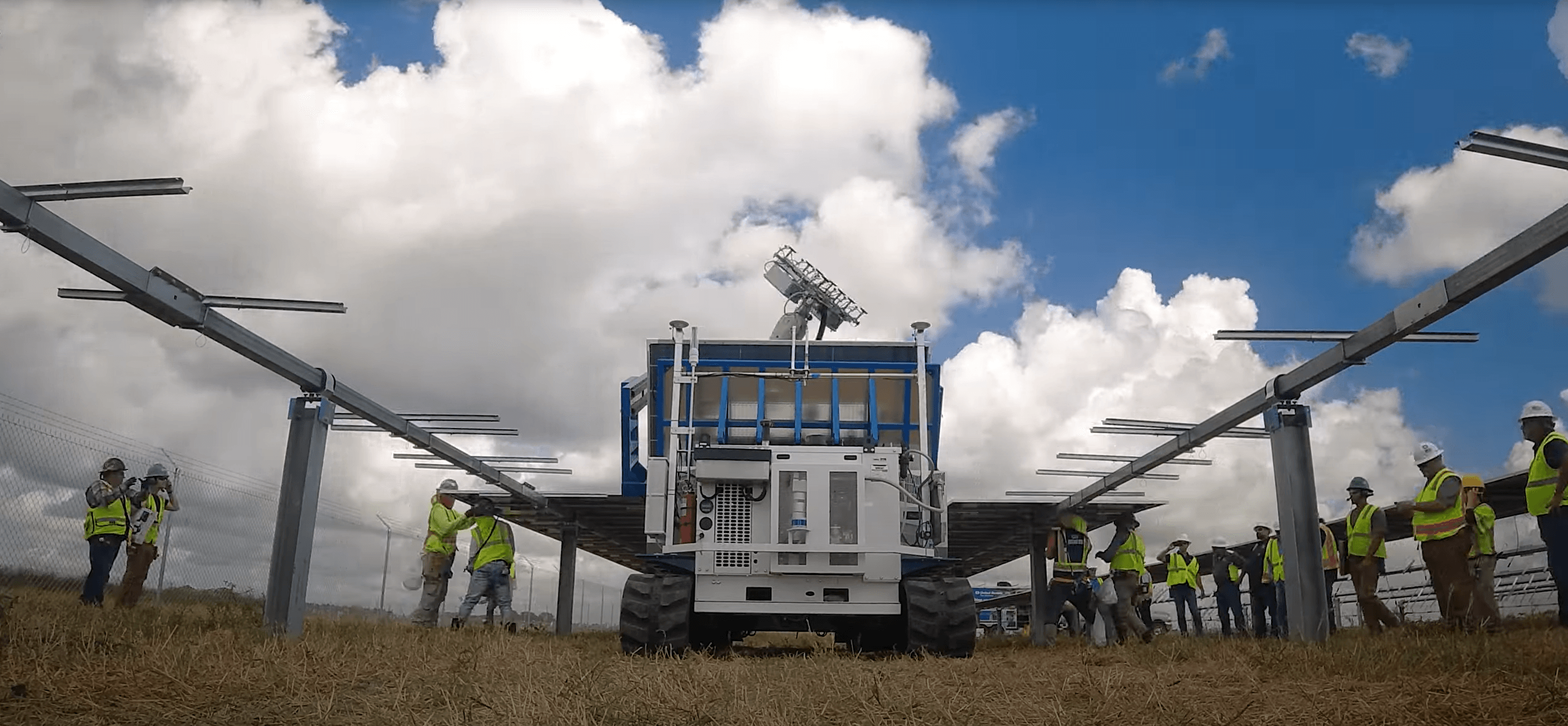
By the end of 2025, solar panel installation robots have crossed a critical threshold: they are no longer experimental construction tools, but emerging infrastructure-scale automation systems. What began as isolated pilots for pile driving or panel lifting has evolved into semi- and fully automated workflows capable of supporting gigawatt-level solar deployment.
This transition is driven by three converging pressures: accelerating global solar build-out, acute skilled labor shortages, and rising safety and productivity requirements in extreme environments. As a result, robotics is increasingly positioned not as a labor replacement, but as a force multiplier for EPC execution.
1. Core Capabilities: What Solar Installation Robots Can Actually Do in 2025
Solar installation robots today focus on the most labor-intensive and risk-prone stages of utility-scale photovoltaic (PV) construction:
- Pile driving
- Panel transport and placement
- Assisted alignment and fastening
- Early-stage quality inspection
Technically, leading systems now combine:
- High-precision autonomous navigation using RTK GPS fused with AI vision
- Complex terrain adaptability, via tracked or hybrid chassis with automatic leveling
- Millimeter-level placement accuracy under outdoor conditions
- 24/7 continuous operation, enabling schedule compression
Emerging technical trends in 2025
Hybrid automation dominates.
Rather than a single winning model, the market is bifurcating between:
- Fully autonomous systems, including mobile “field factories” that assemble and place panels end-to-end
- Semi-autonomous cobots and assistive tools that amplify human labor productivity without full site automation
End-to-end integration is expanding. Some platforms now combine placement and fastening, with early extensions into computer-vision-based quality inspection and workflow orchestration.
Extreme-environment optimization is no longer optional. Desert heat, wind exposure, remote terrain, and steep slopes have become primary use cases rather than edge cases, particularly in Australia, the U.S. Southwest, and the Middle East.
2. Vendor Landscape: Deployment Reality Over Product Claims
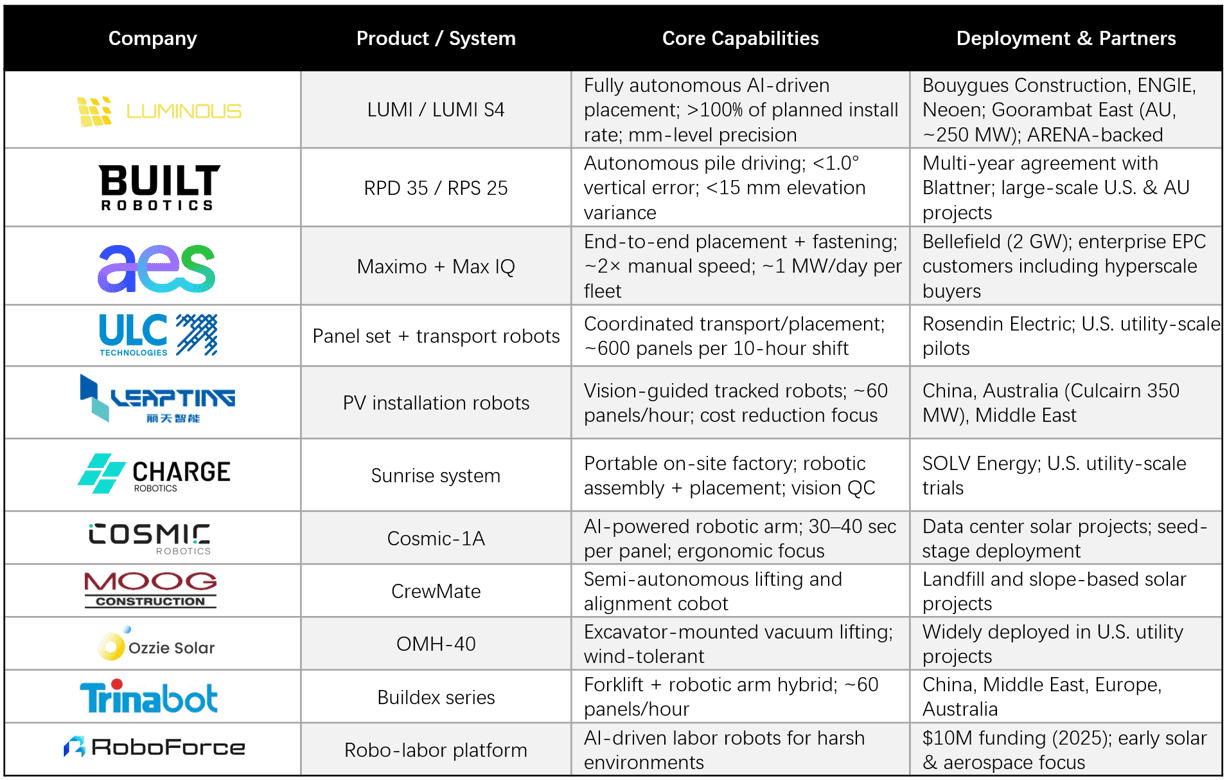
Based on verified deployments and public disclosures as of December 2025, the following companies represent the most active and differentiated approaches in solar installation robotics.
3. Industry Direction: What Experts Agree On
From labor replacement to labor amplification
The dominant design philosophy has shifted. Robots increasingly handle heavy lifting, repetitive placement, and exposure-prone tasks, while humans retain precision fastening, supervision, and exception handling. Productivity gains of 2–4× are now common without eliminating human crews.
Labor scarcity is the structural driver
Global solar capacity additions must triple by the mid-2030s. Skilled construction labor is not scaling at the same pace. Robotics is becoming a capacity unlock, not a cost experiment.
Data openness is emerging as a competitive lever
Programs supported by Australia’s ARENA, including Luminous deployments, are moving toward open performance datasets, accelerating learning curves and lowering barriers for system integrators.
Automation is extending beyond installation
Cleaning, inspection, and lifecycle O&M automation are converging with installation robotics, pointing toward full-site robotic ecosystems rather than isolated machines.
Modular tools matter as much as full autonomy
As panels grow heavier (thicker glass, hail resistance), lower-cost assistive tools and modular cobots are gaining adoption among mid-sized EPCs unwilling to commit to full autonomy upfront.
4. Economics: Why Adoption Is Now Rational, Not Speculative
Cost structure context (2025, utility-scale PV)
- Hardware (modules, inverters, racking): 60–70%
- Soft costs (labor, permitting, safety, delays): 30–40%
- Installation labor is the largest variable component
Quantified impact of robotics adoption
Metric | Observed Range | Notes |
Installation time reduction | 20–50% | Faster energization improves IRR |
Labor cost reduction | 30–88% | Pile driving shows highest impact |
Total project cost reduction | 6–30% | Project- and region-dependent |
LCOE improvement | ≥6.2% | Target validated by ARENA |
Payback period | 6–9 months | In large-scale deployments |
In high-labor-cost regions such as the U.S. and Australia, ROI thresholds are already met at scale. In China, where labor costs are lower, robots compete primarily on schedule certainty and safety rather than direct cost savings.
The global solar installation robotics market is projected to grow from approximately $317 million in 2024 to over $630 million by 2031, reflecting steady but infrastructure-driven adoption rather than speculative hype.
5. Constraints That Still Matter
- Full autonomy remains elusive. Electrical connections and fine fastening still rely on human intervention.
- Capital intensity is non-trivial. Fully autonomous systems favor gigawatt-scale portfolios.
- Regional economics vary widely. What works in the U.S. Southwest may not immediately translate to Southeast Asia.
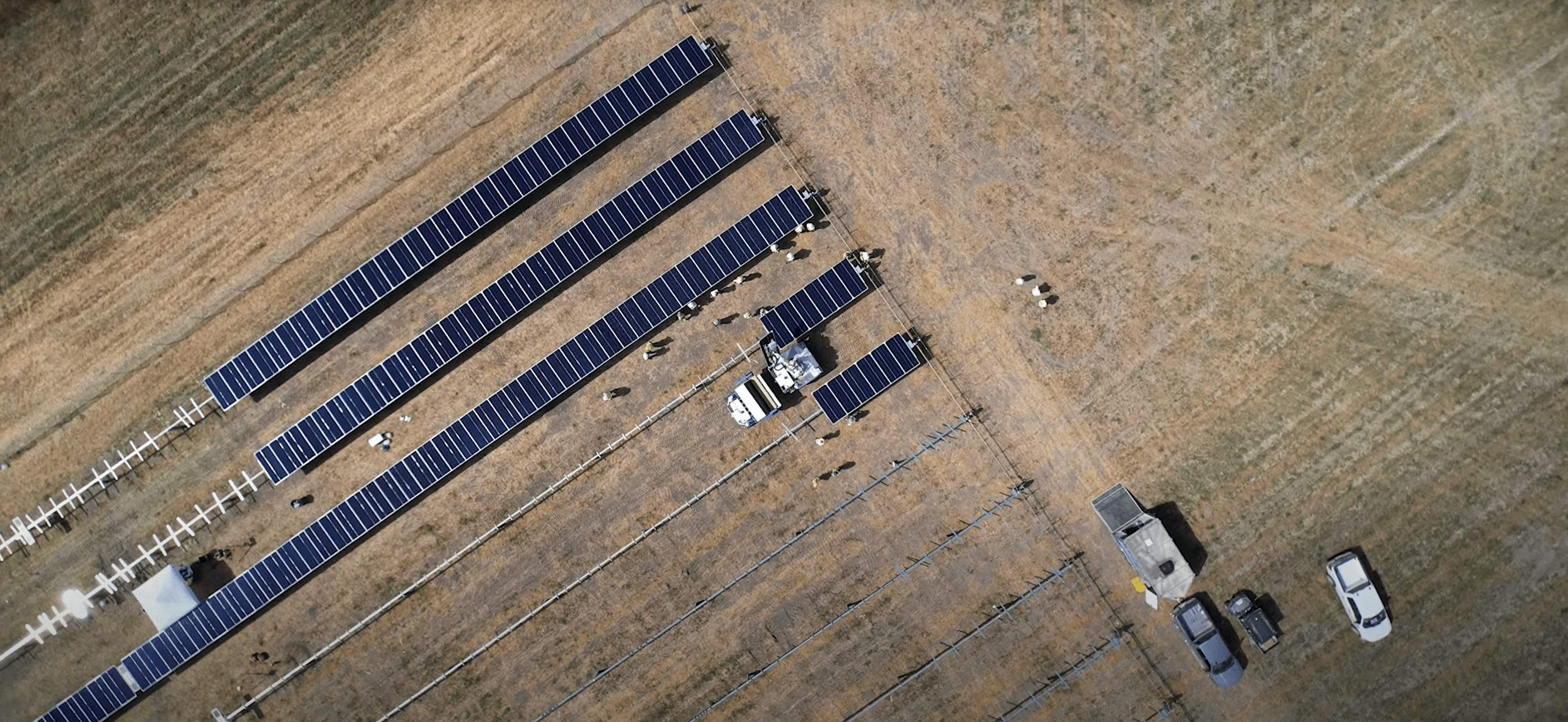
Outlook By 2025, solar installation robotics has entered a phase best described as commercially viable, operationally proven, and economically selective. The question for EPCs and asset owners is no longer whether robots work, but where and how deeply to deploy them.
As data transparency improves and fleet-scale deployments expand, solar construction is likely to become one of the earliest examples of field robotics achieving true infrastructure impact—well before many factory-bound humanoid systems reach comparable scale.
RobotToday will continue tracking solar, wind, and energy-infrastructure robotics as part of its broader coverage of real-world automation deployment.










Leave a comment