


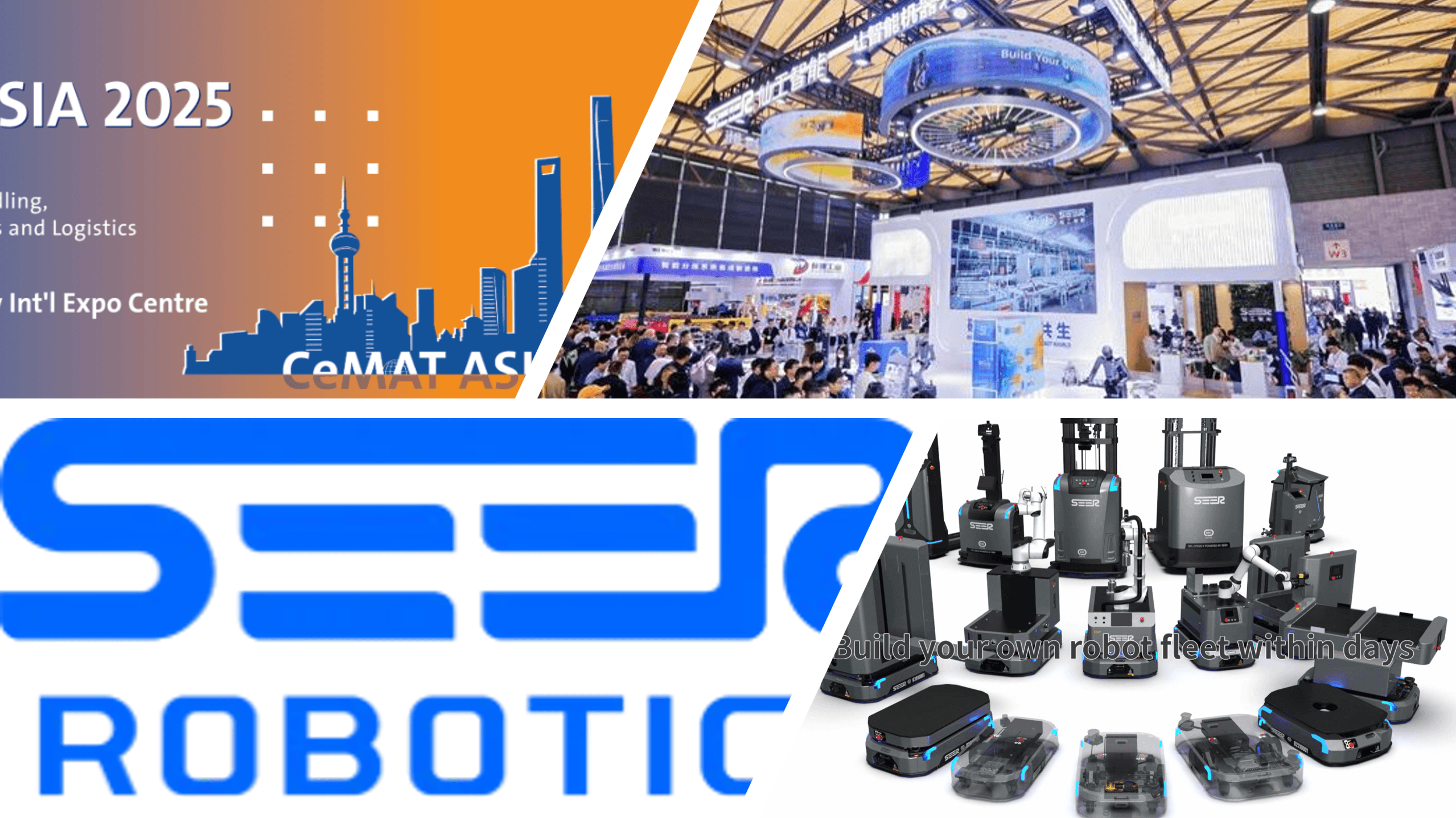
When visitors entered Hall W2 at the Shanghai New International Expo Centre this week, they were greeted by something that looked less like a product showcase and more like a live-action experiment in the future of industry. Under the theme “Collision • Boundary-Breaking • Symbiosis,” SEER Robotics staged a bold demonstration of embodied intelligence—robots that perceive, decide, and act with human-like flexibility.
For SEER, this moment was not simply about new hardware, but about convergence. After years of refining robot control systems for autonomous mobile robots (AMRs) and logistics platforms, the company is now applying that deep industrial experience to humanoid and quadruped forms—machines capable of physically adapting to complex, changing environments.
From Industrial Arms to Human-Level Dexterity
SEER’s humanoid lineup, led by the X1-PRO and X2-PRO, shows how embodied AI can take root in real industrial workflows. The X1-PRO’s upgraded 40-degree-of-freedom structure, 7-DoF bionic arms, and 45-degree bending motion enable nuanced material handling and inspection. Equipped with SEER’s next-generation control system and large-model reasoning engine, it can understand natural-language commands and quickly learn new tasks with minimal training data.
The X2-PRO, co-developed with partner Stardust AI, merges a rope-driven upper body with SEER’s omnidirectional mobile base. This modular design lets users mix and match limbs and mobility units, reducing R&D cost and simplifying maintenance. The result is a robot that can be rapidly customized for warehouses, factories, or logistics centers—an essential step toward mass-deployable humanoid systems.
Quadrupeds Built for the Real World
Beside the humanoids, SEER’s four-legged “dog team” drew crowds for its agility. The D1-W and D2-W models feature hybrid wheel-and-leg locomotion, IP54 protection, and AI-based navigation and reinforcement-learning motion control. The D2-W even integrates heat imaging, acoustic sensors, and strobe modules for 24/7 security and inspection tasks—turning the robot into an intelligent patrol unit that blends mechanical endurance with situational awareness.
Nebula 2.0 and the Rise of Modular Intelligence
At the heart of this showcase was the upgraded Nebula 2.0 platform—a full-stack robotics ecosystem uniting hardware, simulation, and marketplace services.
Users can visually configure robots through 3D rendering, simulate digital-twin environments, and purchase peripheral modules from SEER’s online store. By shifting robotics from “custom project” to “product configuration,” SEER aims to erase barriers to industrial deployment and standardize intelligent automation.
The company’s SRC-5000 controller, its so-called “super brain,” further exemplifies this philosophy. Built on fully self-developed architecture, it integrates AGI-level algorithms to enhance spatial perception and reasoning under complex conditions. By late 2024, the SRC line had already supported over 300 component types—allowing developers to build robots like stacking blocks.
AI at the Core: M4 AI and Meta-Map Pro
SEER also reintroduced its M4 AI system, transforming how robots are managed and coordinated. The new version combines a logistics large-model foundation, an interactive M4 AI Agent, and MCP services that let external models like DeepSeek or OpenAI connect directly to logistics and scheduling systems. Together, they redefine robot-to-system collaboration and unlock cross-domain intelligence within industrial operations.
Paired with Meta-map Pro, SEER’s 3D visualization engine, users can mirror real-world factories in digital space—tracking robot movements, analyzing performance data, and even interacting with live fleets via game-controller interfaces.
Toward a New Industrial Intelligence
The implications go beyond a single product line. By uniting embodied design, AGI-driven control, and cloud-native coordination, SEER is laying the groundwork for an industrial ecosystem where robots are not just tools but adaptive co-workers. The company’s recent TÜV Rheinland certifications for CE-MD, CE-RED, TUVus, and FCC compliance also clear the path for international expansion, signaling readiness for the stringent U.S. and EU markets. Already serving clients in over 65 countries, SEER is positioning its open platform as a catalyst for the next phase of intelligent manufacturing—where embodied intelligence becomes the new industrial standard.









Leave a comment