

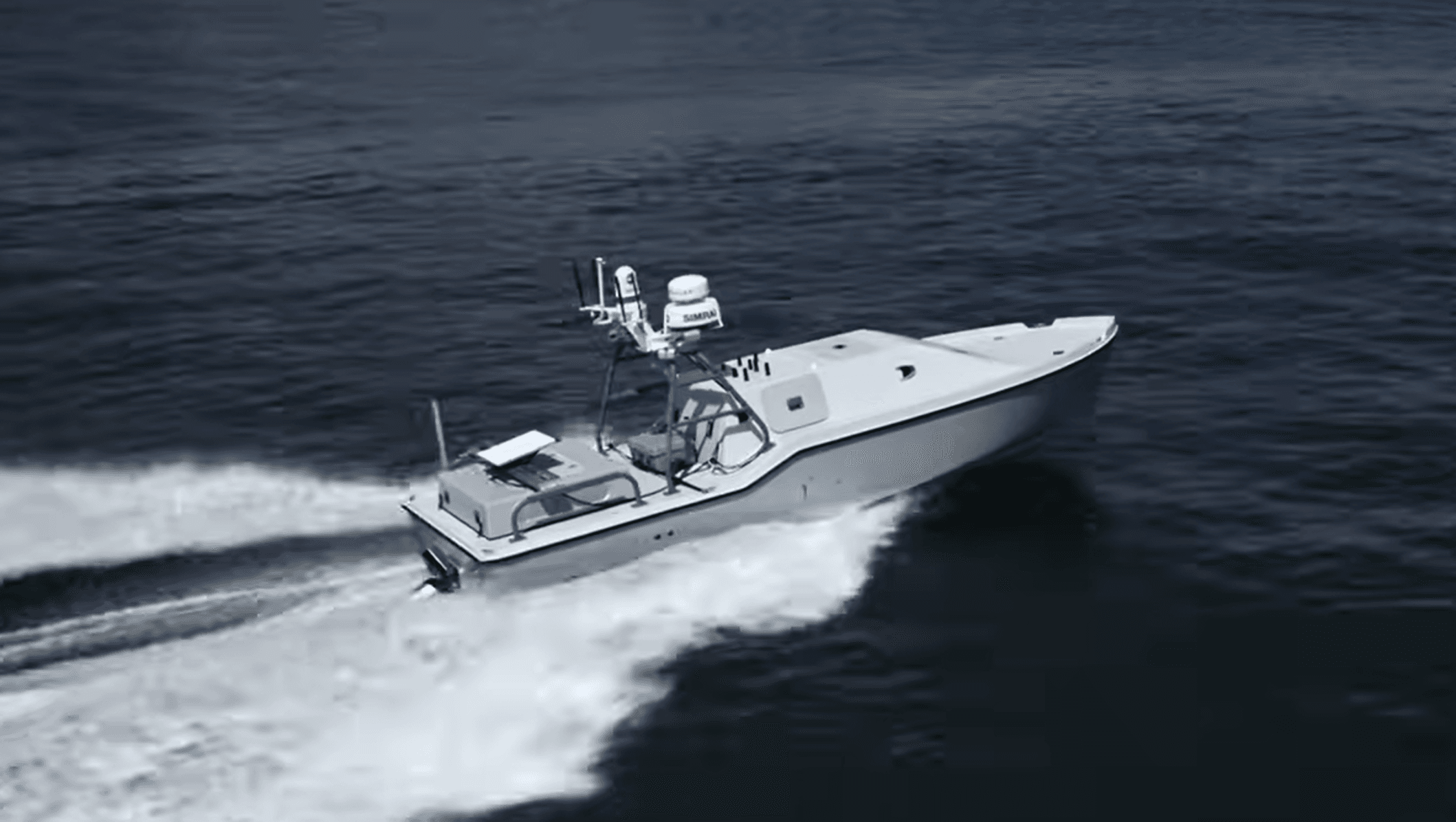
Austin-based defense tech company more than doubles its valuation as investor appetite for maritime autonomy surges
Austin, Texas — March 31, 2026 — Saronic Technologies has closed $1.75 billion in Series D funding to advance its mission of delivering autonomous maritime platforms at scale across defense and commercial sectors. The round was led by Kleiner Perkins and values the company at $9.25 billion.
New investors Advent International, Bessemer Venture Partners, DFJ Growth, and BAM Elevate joined the round alongside existing backers including 8VC, Caffeinated Capital, Andreessen Horowitz, Elad Gil, and Franklin Templeton.
The raise more than doubles Saronic's valuation from $4 billion in early 2025, when the company secured $600 million in Series C financing.
Technology Focus: Software-Defined Ships Built for Scale
Saronic's core proposition is rebuilding American shipbuilding capacity through an autonomy-first design philosophy. The company combines software-defined systems with vertically integrated manufacturing to produce unmanned ships deployable in distributed maritime environments. Its onboard autonomy stack integrates sensors, navigation controls, and mission software to enable vessels to operate without human crews — supporting autonomous navigation, mission planning, fleet coordination, and remote supervision across multiple vessels simultaneously.
The vessel lineup currently spans from the 24-foot Corsair — already in active water operations — to the 180-foot Marauder, whose first prototype hull was completed in under six months , a pace Saronic's leadership describes as a benchmark for the company's manufacturing model. The company makes six autonomous surface vessel variants in total, including the compact six-foot Spyglass reconnaissance platform and the 40-metric-ton Marauder.
Beyond the surface layer, Saronic plans to explore solutions addressing the full spectrum of maritime domain challenges, including those at the intersection of surface and subsurface operations.
Addressing America's Shipbuilding Deficit
The funding arrives against a backdrop of acute strategic urgency. The Pentagon and allied navies are increasingly focused on countering China's shipbuilding surge and the lessons of Russia's Black Sea fleet attrition — dynamics that have accelerated demand for cost-efficient, scalable unmanned naval platforms.
CEO Dino Mavrookas framed the company's mission in terms of industrial revitalization. "Over the past decades, the U.S. has experienced a steady erosion of its ability to build ships and manufacture critical maritime infrastructure," he said. "We are confronting this challenge with a fundamentally new model of American shipbuilding, one that integrates first-principles engineering, advanced manufacturing, and software-defined production."
Use of Proceeds and Expansion Plans
Saronic plans to use the funding to scale its supply chain and shipyards, targeting a production rate of more than 20 ships per year by 2027.
A central piece of that infrastructure buildout is Port Alpha, a next-generation shipyard concept. Saronic has committed $300 million to a 300,000 sq. ft. expansion of its Louisiana facility, a move expected to create 1,500 new jobs in the region. The company has also expanded its Austin headquarters, opened new hubs in San Diego and Washington, D.C., and launched operations in the UK and Australia, with headcount now surpassing 1,300.
Investor Confidence and Contract Momentum
Kleiner Perkins partner Ilya Fushman highlighted the rare convergence of technical leadership and manufacturing scale: "What makes Saronic special is that they're building both — autonomous ships designed from day one to push the boundaries of what's possible, and the manufacturing infrastructure to produce them consistently. That's what turns a technical breakthrough into an enduring platform advantage."
On the government customer side, traction has been equally strong. In 2025, Saronic secured a $392 million production contract with the U.S. Navy and was selected by DARPA to support the Pulling Guard program, aimed at building semi-autonomous escort systems to enhance the survivability of unarmed logistics vessels.










Leave a comment