Shanghai · November 27, 2026 · Robbyant / Ant Group
Robbyant, the embodied AI company within Ant Group, has open-sourced two models: LingBot-Map 2.0, a streaming 3D reconstruction model, and LingBot-Navi, a spatial-memory navigation model. The pair targets two long-standing problems in robot mobility: mapping drift over long distances, and "cross-task amnesia", where robots forget a space as soon as a task ends.
Key takeaways
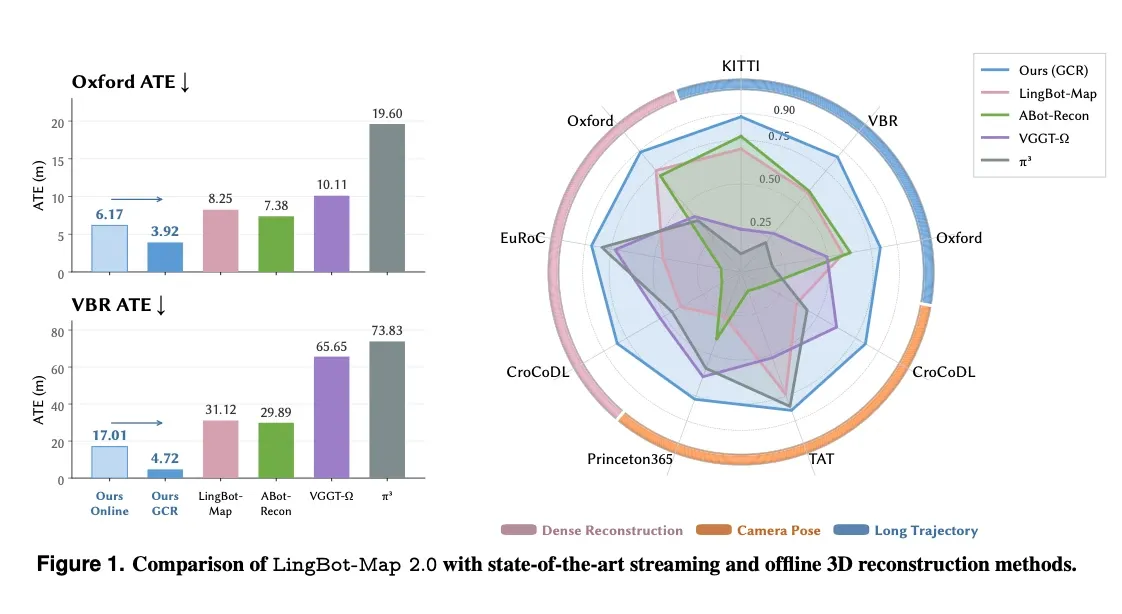
Drift is corrected inside the model. Map 2.0 fixes errors in its own internal memory during inference, with no external place-recognition module or pose-graph backend. Error on a 5.2 km urban route fell from 31.12 m to 4.72 m, a reduction of nearly 85%.
Robots stop re-exploring. Navi keeps object and location data between missions, so a robot can plan direct routes through spaces it already knows.
Better maps lift navigation without retraining. Swapping Map 1.0 for 2.0 raised Navi's success rate with no change to the navigation model.
Fully open. Technical reports, code, model weights and a 511-scene real-world dataset are on GitHub and Hugging Face.
The problem: drift and amnesia
Autonomous mobility is essential for physical AI, from warehouse logistics to last-mile delivery. Robbyant points to two bottlenecks. First, long-distance mapping accumulates drift, and external correction tools fix the output trajectory without feeding the correction back into the model's internal memory. Second, isolated navigation models force robots to re-explore familiar spaces from scratch for every new task.
LingBot-Map 2.0: correcting memory, not just trajectories
Map 2.0 builds on LingBot-Map 1.0, released in April 2026. Its core mechanism, Geometric Context Reshaping (GCR), is inspired by memory reconsolidation in the human brain. GCR reuses local geometry the model has already extracted and realigns its historical memory without re-encoding images. Because each correction updates the internal memory layer rather than only the output trajectory, it becomes a reliable reference point for later movement. Robbyant's visual foundation model, LingBot-Vision, adds sub-pixel boundary detection to reduce geometric error at the source.
| Benchmark | LingBot-Map 2.0 result |
|---|---|
| VBR urban route (5.2 km, ~19,000 frames), ATE | 4.72 m (v1.0: 31.12 m; best external loop-closure: 9.98 m) |
| Inference speed | 27.51 FPS on a single NVIDIA RTX 5090 |
| Oxford Spires, ATE | 3.92 m |
| KITTI, ATE | 9.42 m |
| Dense 3D reconstruction | 1st on CroCoDL, EuRoC and Oxford |
Company-reported. ATE = Average Trajectory Error, lower is better. Robbyant says the model leads on the VBR long-trajectory test and across nine public benchmark evaluations.
LingBot-Navi: memory that carries across missions
Navi runs on Map 2.0's 3D perception and adds persistent spatial memory. Instead of wiping its map after a task, it keeps object and location data. When given a natural-language command, it retrieves the relevant context and plans a direct route. Robbyant says execution gets faster with every operation as the robot's understanding of the environment improves. Navi also supports on-device deployment, keeping user commands and scene data local for low latency and data privacy.
| Metric | GOAT-Bench | Robbyant evaluation set* |
|---|---|---|
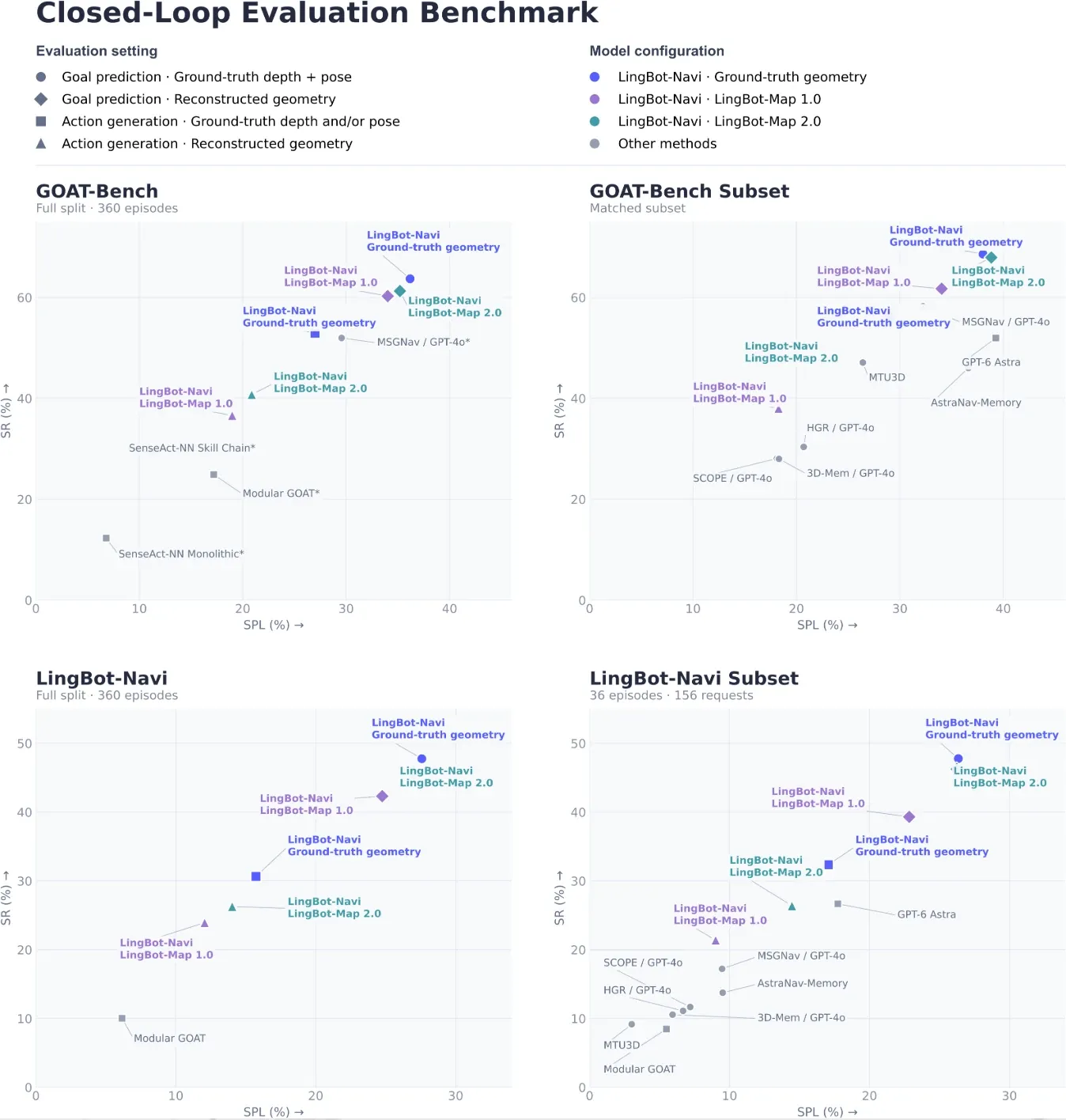
| Success rate, goal selection (simulator executes navigation) | 68.60% (subset) | — |
| Success rate, fully end-to-end | 56.09% | 32.36% |
| SPL (success weighted by path length) | 38.04% | 26.35% |
| SPL gain over best control | +1.42 pts | +16.84 pts |
*Proprietary dataset reconstructed from 36 real-world captured sites. All results are from closed-loop simulation. On the GOAT-Bench subset, LingBot-Navi beats the best of six comparison methods by 10.36 percentage points.
The most telling result: upgrading only the mapping engine from Map 1.0 to 2.0, without retraining Navi, raised navigation success by 4.15 and 2.35 percentage points across the two evaluation sets, with SPL gains of 1.89 and 1.97 points. Higher-precision reconstruction alone improved task completion.
Why it matters for robotics
Simpler navigation stacks. Mapping pipelines have long relied on separate loop-closure and pose-graph modules. Moving the correction inside the network removes a component that often fails on long routes, provided the results hold up in real deployments.
Lower operating cost for fleets. In warehouses, hospitals and homes, re-exploring known spaces costs time, battery and throughput. A map that persists between missions addresses this directly.
A broader Robbyant stack. Together, the two models extend what Robbyant calls its universal embodied AI brain, from spatial perception to efficient navigation.
RobotToday view: Open weights and a 511-scene dataset make LingBot a likely reference baseline for robot spatial memory. The limits matter, though: all figures are self-reported, the navigation results come from simulation, and end-to-end success on real-site reconstructions is 32.36%. Field results on physical robots are the next thing to watch.
Reference
LingBot-Map 2.0: Project page · GitHub · Hugging Face
LingBot-Navi: Project page · GitHub · Hugging Face · Dataset
Robbyant: www.robbyant.com