


The Big Picture
For years, the robotics industry has tried to win public trust through passive exposure — YouTube videos, museum exhibits, news articles. A new study from the Robotics and AI Institute (RAI Institute) and MIT Media Lab suggests that approach may be leaving a lot on the table. Their key finding: letting ordinary people operate a robot, even for just a few minutes, produces measurable and consistent attitude shifts that images and videos alone cannot replicate.
The research is timely. As legged robots move from factory floors toward homes, hospitals, and offices, public acceptance is no longer a soft concern — it’s an engineering constraint. Understanding what moves the needle on comfort and trust is increasingly practical work.
What They Did
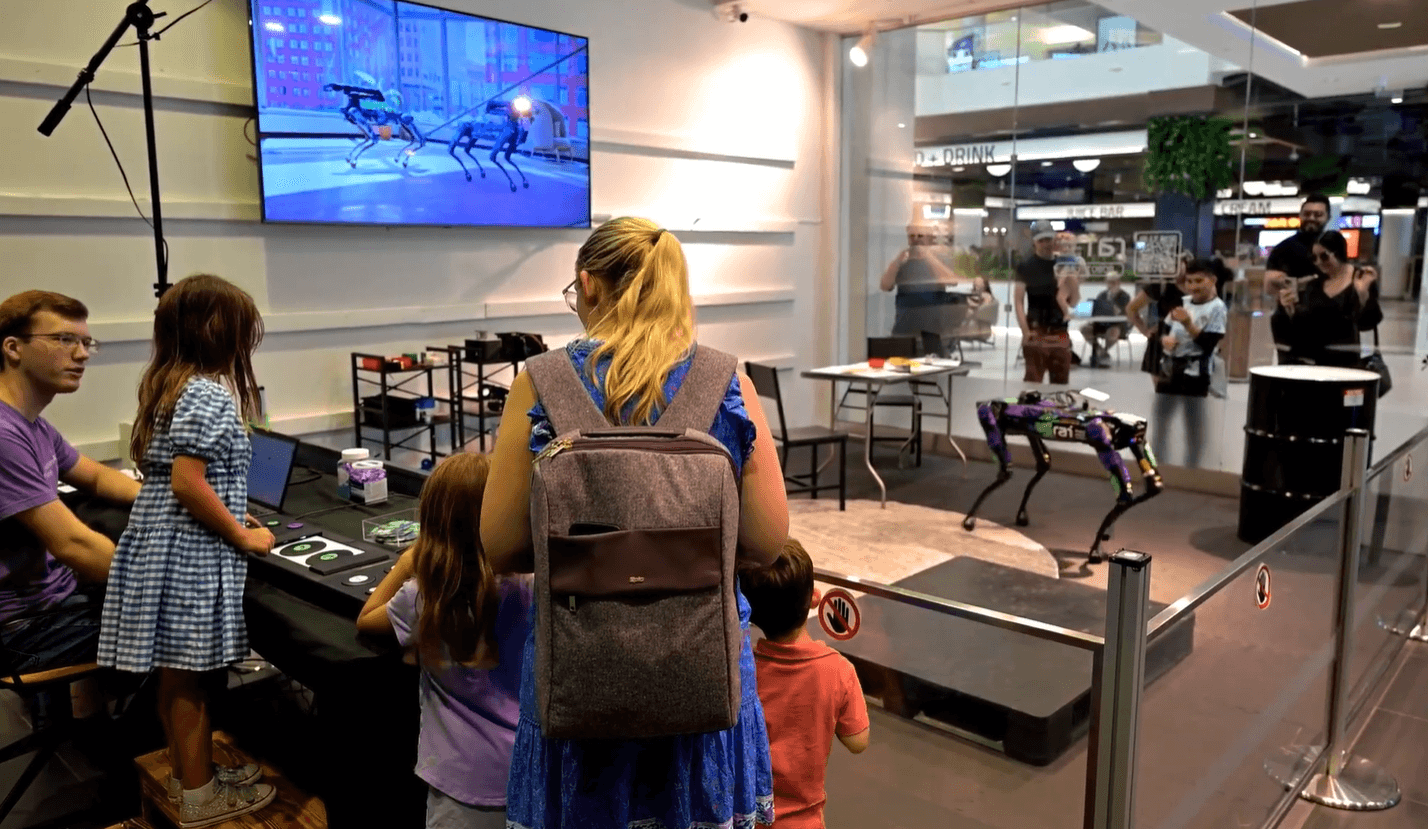
Over ten weeks in summer 2025, the RAI Institute ran a free pop-up robot lab inside the CambridgeSide mall in Cambridge, Massachusetts. The centrepiece was “Drive-a-Spot”: a hands-on driving arena where anyone could take the controls of a Boston Dynamics Spot quadruped using a custom-built adaptive controller — large buttons, simple commands (forward, back, left, right, sit, stand, tilt) — designed to be usable by anyone from toddlers to nonagenarians. Participants ranged in age from 2 to over 90.
The arena’s theme rotated every few weeks through four scenarios: factory, home, hospital, and outdoor/disaster — a deliberate pairing of environments where robots are already widely accepted against those where public ambivalence is highest.
Of roughly 10,000 visitors to the space, 753 opted in to pre/post surveys measuring two things: comfort (how at ease would you feel encountering a robot in a given setting?) and suitability (how well would this robot perform in that setting?). Crucially, the environment participants drove through was tracked separately from the scenarios they rated — allowing researchers to identify generalisation effects.
What They Found
Comfort went up across the board. After a single driving session, comfort scores rose significantly across all five rated contexts: factory, home, hospital, office, and outdoor/disaster. The gains were modest in size but statistically robust across children through older adults.
The most notable jump came in outdoor/disaster scenarios. People already believed Spot would be useful in search-and-rescue settings — suitability scores were already high — but they were uneasy about it. Researchers attribute this to media portrayals of quadruped robots in military contexts. A few minutes at the controls appears to soften that apprehension considerably.
The home and hospital findings are arguably more important. These are the environments where baseline scepticism is highest and where future consumer and healthcare deployments will live or die. Participants who drove Spot through a home-themed arena didn’t just become more comfortable with robots in homes — they also rated hospitals and offices as more suitable for robots. The effect transferred across contexts, suggesting the experience changed something more fundamental: people’s underlying model of what these machines can actually do.
Demographics: Men began with higher baseline comfort than women across all five contexts, but all genders improved at similar rates. Most strikingly, participants with no prior exposure to Spot caught up with experienced robotics professionals after a single session — something the researchers flag as difficult to replicate with any amount of video content.
Emotional response: Post-session emotional data skewed heavily positive. 74% of participants reported excitement, 50% reported happiness, and just 12% reported nervousness. Over 55% rated the experience “brilliant” and 62% said they’d very likely recommend it.
A revealing shift in imagination: Before driving, answers to “what tasks would you want a robot to do?” clustered around domestic help and hazardous labour. After driving, entertainment and play jumped from 7.5% to 19.4%, and companionship appeared as a new category at 5%. People who had operated Spot started imagining it as a companion, not just a tool.
Why It Matters
The robotics industry’s standard playbook for building public acceptance is passive. This study is a rare empirical argument for an active alternative: pop-up, agency-granting, hands-on encounters as a scalable and effective public engagement strategy.
There’s an obvious caveat. Whether the attitude shifts observed in this study hold over time remains an open question the researchers acknowledge directly. A few minutes driving a robot in a mall is not the same as living alongside one. But the consistency of effects across ages, genders, and settings — and the fact that novices caught up with experts after a single session — is hard to dismiss.
For industry, the implication is practical: getting robots in front of people, and putting the controls in their hands, may be as important as improving the robots themselves.
Source: Pop-Up Encounters with Spot — Park et al., RAI Institute / MIT Media Lab. HRI 2026, Edinburgh.
Coverage: IEEE Spectrum







Leave a comment