

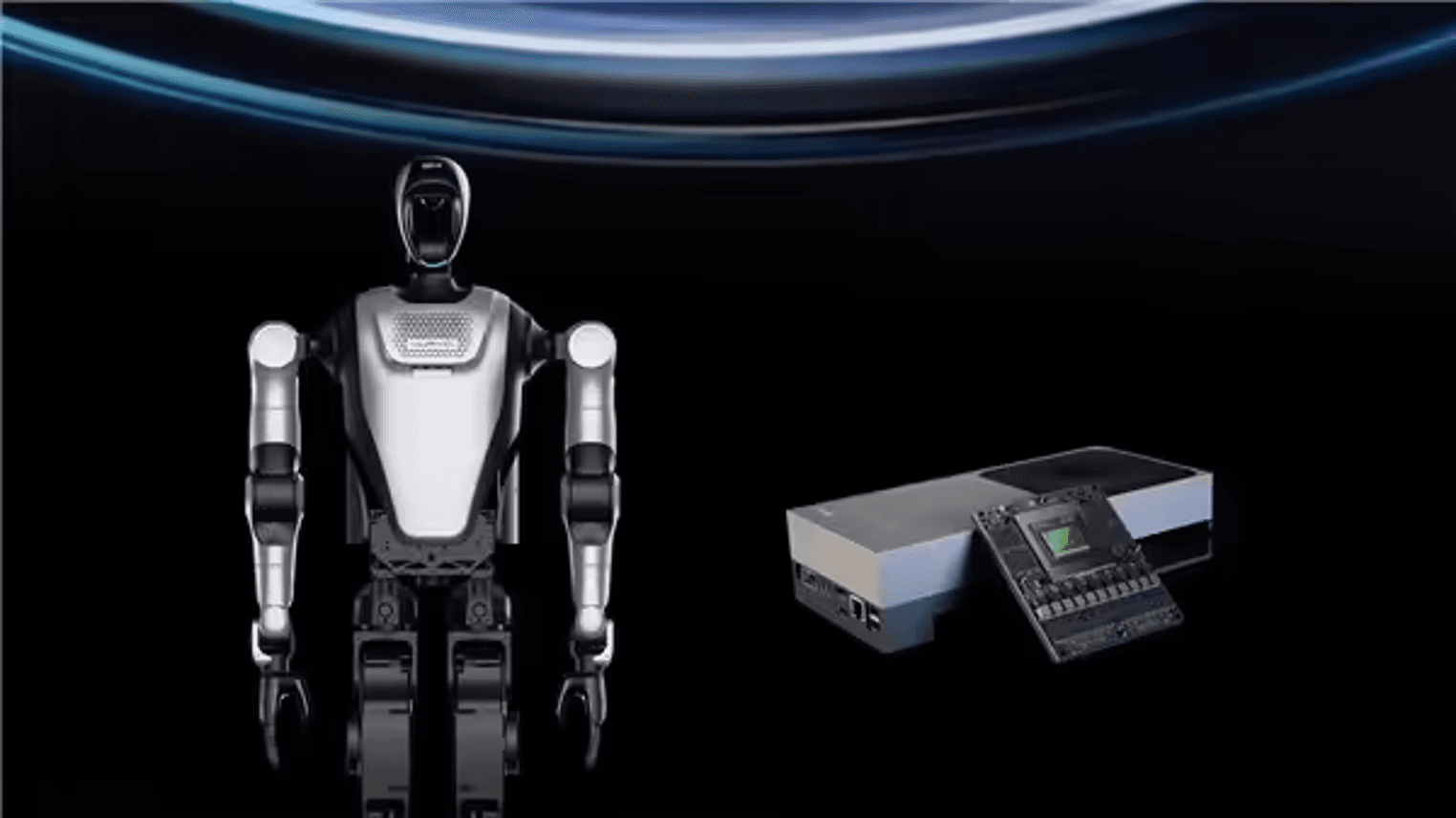
Leju Robotics’ full-size humanoid robot Kuafu has integrated NVIDIA Jetson Thor to enable on-device deployment of embodied AI models across multiple industrial scenarios. The company reports pilot validation in five standardized environments: logistics, smart manufacturing (SMT), 3C electronics, automotive assembly, and daily chemical production.
System Architecture: High-DoF Body Meets Edge AI Compute
Kuafu features over 40 high-degree-of-freedom (DoF) joints in a full anthropomorphic configuration. This kinematic complexity increases control and perception bandwidth requirements: whole-body balance, coordinated arm–torso motion, and millisecond-level sensor fusion must be maintained during task execution.
Jetson Thor provides up to 2070 FP4 TFLOPS of AI compute, with support for multimodal perception and edge inference. According to Leju, the platform runs embodied model stacks including ACT, diffusion policy (DP), vision-language-action (VLA), and related policy architectures directly on-device. This reduces latency and supports continuous closed-loop control without reliance on cloud inference.
1) Logistics: Parcel Sorting Under Long-Duration Load
Logistics environments involve variable object geometry, labels, and materials. Sustained throughput requires stable perception and control performance over extended operating cycles.
Leju states that Jetson Thor’s increased memory bandwidth (reported +35%) improves handling of high-volume multimodal streams (vision, proprioception, force). The robot maintains stable inference for optimization and iterative learning control, limiting accuracy drift over time. The focus is on consistent pick accuracy and error correction during continuous sorting.
2) Smart Manufacturing (SMT): Tray Retrieval and Line Integration
SMT tray handling requires coordinated whole-body motion and precise manipulation to avoid material damage. Kuafu performs tray identification, classification, and retrieval while synchronizing with production-line data systems.
With low-latency inference and high compute density, Jetson Thor supports fine-grained joint control and multi-step task sequencing. The implementation emphasizes:
High-precision placement (“light-touch” handling)
Barcode/ID verification
Data handshake with MES/production systems
The technical objective is deterministic execution across full workflow chains rather than isolated grasp success.
3) 3C Electronics: High-Speed Conveyor Sorting
In electronics assembly, items move at high speed, requiring millisecond-level perception-action loops. The challenge includes dynamic visual tracking, rapid motion planning, and coordinated arm-hand control.
Leju reports that Kuafu achieves real-time recognition and response under specified belt speeds when powered by Jetson Thor, with emphasis on control frequency and hand–eye coordination in dynamic environments.
4) Automotive Assembly: Empty Bin Collection
Automotive plants require mobile manipulation of empty containers with varying pose, size, and mass. This scenario shifts from fixed-position reasoning to spatially adaptive task execution.
Kuafu uses multimodal sensing to estimate object pose and adjust grasp strategy. Edge-deployed embodied models support:
Pose estimation in unstructured layouts
Adaptive grasp planning
Whole-body posture adjustment
The system is designed to operate without pre-aligned fixtures.
5) Daily Chemical Production: Oriented Placement of Irregular Objects
Packaging tasks in daily chemical production involve diverse surface geometries and non-rigid object handling. Successful execution requires tactile/force feedback, dual-arm coordination, and smooth multi-stage transitions.
Leju indicates that Jetson Thor supports 7B+ VLA real-time inference with increased parameter capacity (3–4×). This allows more complex language-conditioned task planning, multi-step sequencing, and interactive adjustment during execution.
Industrial Implications
The integration of Jetson Thor shifts Kuafu’s architecture toward fully edge-resident embodied intelligence, targeting:
Higher control frequency under high-DoF kinematics
Reduced latency for perception–action loops
Stable multimodal processing over long-duration tasks
Standardized workflow integration in industrial settings
Rather than positioning humanoids as general-purpose replacements, Leju’s current deployment strategy focuses on structured industrial scenarios where task repeatability, system integration, and deterministic control are measurable.
Further expansion toward semi-structured or non-standard environments will depend on model generalization, reliability under edge constraints, and long-cycle operational validation.









Leave a comment