


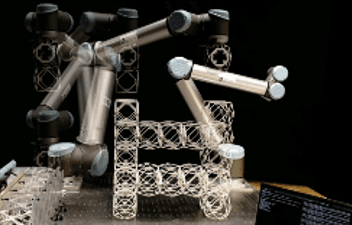
MIT researchers have demonstrated an early but complete pipeline that turns spoken language into physical objects by linking LLMs, text-to-3D generative models, geometric constraint processing, and a UR10 robotic assembly system. The system discretizes AI-generated meshes into 10 cm modular voxels, automatically checks fabrication constraints (component count, overhangs, vertical stability, connectivity), then produces an ordered assembly sequence.
A UR10 arm executes the build using a magnetic end-effector and a conveyor system that recirculates the same 40 components, enabling rapid reuse. Objects such as stools, shelves, tables, and simple shapes are assembled in 1–5 minutes, a significant contrast to multi-hour 3D-printing equivalents.
Pros
- End-to-end automation: The pipeline removes nearly all human steps between imagination and physical artifact—speech → 3D → fabrication.
- Robust constraint handling: Auto-rescaling, overhang detection, and connectivity-aware sequencing address the typical failures of naïve AI-generated geometry.
- Circular material flow: Reusing voxel components demonstrates a sustainable alternative to single-use prototyping.
- Fast iteration: Supports human–AI co-creation loops at near-interactive speeds.
Cons / Limitations
- Low fidelity due to coarse voxel resolution; unsuitable for engineering-grade parts.
- Manual disassembly still required; loop not fully automated.
- No physics simulation—rescaling handles stability heuristically.
- Complex geometries cannot yet be built; system depends on simple cubic discretization.
How far from reality?
As a research prototype, the system is feasible today for conceptual prototyping, adaptive furniture, education, and human–robot interaction research. For industrial use—manufacturing, construction, or humanoid on-demand tooling—major advances are still needed: finer modular systems, hybrid fabrication (assembly + 3D printing), better robot compliance, and autonomous disassembly.
Still, MIT’s work is one of the clearest demonstrations that AI-generated objects can be immediately realized by robots, pointing toward future AI-powered microfactories and real-time physical computing.









Leave a comment