


As drone warfare scales from tactical nuisance to strategic threat, a Silicon Valley–backed platform is upending the cost calculus of air defence.
The arithmetic of modern air defence has become untenable. When a $4 million Patriot missile is fired to destroy a $35,000 drone, the attacker wins economically even in defeat. That asymmetry has handed cheap, mass-produced unmanned aerial vehicles (UAVs) a structural advantage over the nations that oppose them — and it is precisely the problem Merops was built to solve.
Developed under Project Eagle, a California-based defence initiative funded by former Google chief executive Eric Schmidt, Merops is a counter-UAS system that deploys low-cost AI-guided interceptor drones against threats such as the Iranian-designed Shahed loitering munition. After extensive operational use in Ukraine, the system is now expanding to NATO's eastern flank and, from 2026, to the Middle East.
"Future air defence may be decided less by the most advanced missile — and more by the most scalable algorithm."
From Silicon Valley to the Battlefield
Project Eagle functions less like a traditional defence contractor and more like a rapid-iteration technology incubator, recruiting engineers from Big Tech and the defence sector to build deployable systems at startup speed. The goal is battlefield relevance measured in months, not the decade-long procurement cycles that define legacy arms programmes.
Merops is the platform's flagship product. It has logged more than 1,000 confirmed interceptions in Ukraine — with some operational estimates reaching as high as 1,900 — the majority against Shahed-class loitering munitions. Those results have drawn attention from allied military planners looking for scalable alternatives to missile-based point defence.
System Architecture: Modular, Mobile, Software-Defined
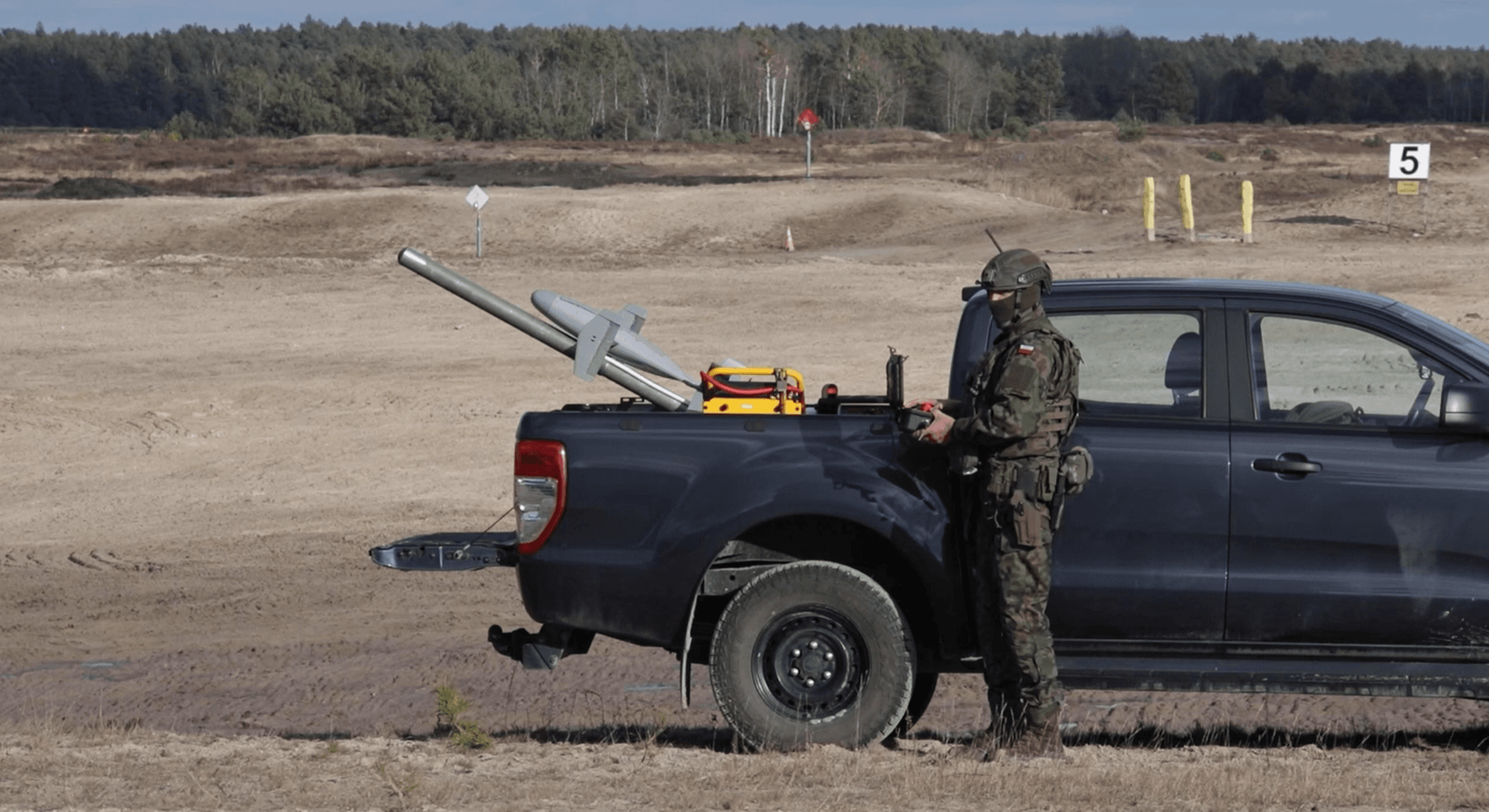
Merops is not a single device but an integrated counter-drone stack composed of four elements: a ground control station, a multi-mode sensor suite (radar, electro-optical, infrared, and radio-frequency), a vehicle-mounted launch platform, and the Surveyor interceptor drone. The modular design allows the entire system to be deployed from a pickup truck, enabling rapid repositioning along frontlines or border corridors.
A standard unit requires only four operators and can be brought to operational readiness in approximately two weeks — a training burden that compares favourably with the months-long certification required for conventional air-defence systems such as the Patriot or NASAMS.
The Surveyor Interceptor: Drone-on-Drone Combat
At the core of Merops is the Surveyor, a fixed-wing UAV purpose-built for aerial interception. Unlike jamming systems that seek to disable a threat electronically, or missiles that destroy it at high cost, the Surveyor closes on its target and eliminates it either through direct kinetic collision or proximity detonation via a small onboard warhead.
| Surveyor Interceptor — Key Specifications | |
|---|---|
| Top speed | ≈ 280 km/h (175 mph) |
| Engagement range | ≈ 20 km (12.5 miles) |
| Engagement modes | Direct kinetic / proximity detonation |
| Launch method | Pneumatic launcher (vehicle-mounted) |
| Recovery | Parachute-enabled — reusable |
| Unit cost | ≈ US$15,000 |
| Operational modes | Remotely piloted or fully autonomous |
The parachute-recovery system is a notable design choice: it allows the interceptor to be retrieved and reused after engagements that do not require the drone to self-destruct, extending its effective lifespan and reducing per-engagement cost further.
AI at the Edge: Operating Under Electronic Warfare Conditions
Modern contested environments routinely feature heavy electronic warfare (EW), with GPS signals jammed and communications disrupted across wide areas. Merops is designed to operate in precisely these conditions. Rather than relying on a continuous data link, the Surveyor fuses inputs from its onboard radar, electro-optical, infrared, and radio-frequency sensors to maintain target track autonomously.
An onboard AI classifies detected objects, distinguishes threats from friendly or civilian assets, and guides the interceptor through its terminal approach — all without a live connection to the operator. In effect, Merops pushes the decision boundary from the ground station to the interceptor itself, a capability that becomes critical precisely when jamming is most intense.
Cost Disruption: Reversing the Deficit
The economic argument for Merops is straightforward. A Patriot missile costs up to $4 million per shot. A NASAMS-compatible AIM-120 runs to roughly $1 million. The Shahed-136, the primary threat Merops was designed to counter, costs Iran an estimated $35,000 to produce. Using any traditional interceptor against it is a losing trade at scale.
| System | Approximate unit cost |
|---|---|
| Patriot PAC-3 interceptor missile | Up to US$4,000,000 |
| AIM-120 (NASAMS-compatible) | ≈ US$1,000,000 |
| Shahed-136 loitering munition (Iranian) | ≈ US$35,000 |
| Surveyor interceptor (Merops) | ≈ US$15,000 |
At $15,000 per Surveyor, Merops costs less than half the price of the threat it is designed to destroy. Western militaries have already experienced the attritional logic of this disparity — incidents in which NATO aircraft fired high-value missiles at cheap commercial-grade drones provide a vivid illustration. Merops is designed explicitly to invert that equation.
Operational Expansion: NATO and the Middle East
Following its Ukrainian combat record, Merops is entering service across additional theatres. Poland and Romania are deploying units along NATO's eastern flank as part of a layered airspace-defence posture. The system is also scheduled for US deployment to the Middle East in 2026, where it will be tasked with countering the Iranian drone threat in the Gulf region.
This geographic expansion signals more than commercial success. It reflects a doctrinal shift among allied planners: that low-cost interceptor drones are not a niche supplement to missile-based systems but an essential tier in any credible layered-defence architecture, particularly against mass or swarm attacks.
Limitations: Not a Universal Solution
Merops is optimised for medium-altitude threats in the Shahed class. It is less effective against small, low-flying first-person-view (FPV) drones, which are manoeuvrable, numerous, and difficult to track with conventional sensors at short range. The system also remains dependent on integration with a broader air-defence stack and does not replace higher-tier missile interceptors for ballistic or cruise-missile threats.
Operators should regard Merops as a mid-tier layer within a multi-tiered defence architecture — a cost-effective solution for a specific and increasingly prevalent class of threat, rather than a comprehensive air-defence solution.
Strategic Implication: Towards Attritable Air Defence
Merops represents a broader doctrinal transition that is still working its way through Western defence establishments. The legacy model — a small number of high-performance, high-cost interceptors optimised for precision — struggles against adversaries that can field cheap UAVs by the hundred. The emerging model, which Merops exemplifies, prioritises scalability, autonomy, and cost efficiency over per-unit capability.
This shift is sometimes described as "attritable" air defence: the deliberate use of expendable or recoverable platforms at volume, rather than irreplaceable assets at rarity. In that framing, Merops is less a piece of kit than a proof of concept — evidence that a Silicon Valley development cadence can produce battlefield-ready hardware on timelines the traditional procurement system cannot match.
Conclusion
Merops is not simply another counter-drone system added to an already crowded market. It is an early, concrete demonstration of how artificial intelligence, autonomy, and cost engineering are converging to reshape air defence at a structural level.
Backed by Eric Schmidt's Project Eagle, and tested in one of the most demanding operational environments of the contemporary period, it shows what becomes possible when the development model of the technology industry is applied to a defence problem that traditional institutions have been slow to address. Whether Merops itself becomes the dominant platform in this category remains to be seen. What is not in doubt is the direction of travel.
"The wars of the future will not be won by the nation with the most expensive missile — but by the one with the most scalable algorithm."







Leave a comment