

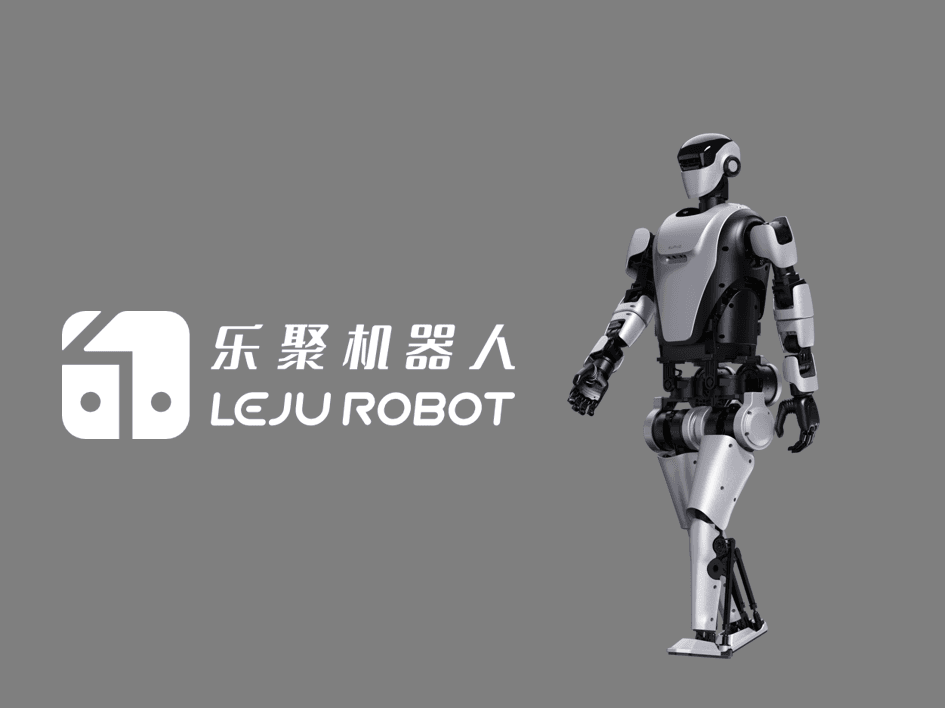
Chinese humanoid robotics company Leju Robot (Shenzhen) Technology Co. has rebranded itself as Leju Intelligence (Shenzhen) Co., Ltd., signaling a broader transformation ahead of a potential initial public offering. The company said the change reflects both operational needs and long-term strategy.
While a name change may look cosmetic, shifting to a joint-stock structure is often a prerequisite for listing. It also typically indicates deeper reforms in governance, equity structure, and financing strategy. For Leju, a government-recognized “Little Giant” enterprise in advanced manufacturing, this marks the completion of a corporate restructuring and the beginning of a new growth phase.
Strategic Realignment
Founded in 2016, Leju Intelligence develops humanoid robots and related core technologies. It has raised funding from Tencent, Shenzhen Capital Group, and Hongtai Fund, while forging partnerships with Huawei Cloud, Haier, and China Mobile.
The founding team hails from Harbin Institute of Technology. CTO and chairman Leng Xiaokun holds a PhD in computer science and serves as associate director of the school’s Intelligent Robotics Research Center. CEO Chang Lin and COO An Ziwei are also HIT graduates, with expertise spanning AI, engineering, and commercialization.
Leju owns proprietary hardware and control systems covering robot design, component manufacturing, and AI algorithms. Its flagship humanoid robot, Kuafu, launched in late 2023, has since undergone multiple upgrades and is moving steadily from research labs into real-world applications.
The company has mapped out a three-stage roadmap:
- Education and research markets
- Specialized use cases such as factories, healthcare, and defense
- Mass adoption in households and consumer markets
In early September, Leju signed an agreement with Peking University’s Wuhan AI Research Institute to establish a joint humanoid robotics lab. The lab will focus on breaking key technical bottlenecks and accelerating the industrialization of embodied intelligence. The following day, the two parties convened a workshop on embodied AI education and applications across industry, healthcare, and elder care.
From “Robotics” to “Intelligence”
The decision to drop “robotics technology” from its name in favor of “intelligence” suggests a strategic shift. Leju appears intent on positioning itself not just as a robotics company, but as a broader intelligent-technology player.
The move comes as the company scales delivery. In January, Leju shipped its 100th full-size humanoid robot; by year’s end, it expects deliveries in the thousands. Its systems are being upgraded through collaborations with Huawei’s Pangu large model and Alibaba’s Tongyi large model, strengthening AI capabilities at the core of its robots.
For supply chain and ecosystem partners, the restructuring signals both opportunity and disruption. As Leju Intelligence broadens its scope beyond robotics into intelligent systems, the ripple effects are likely to be felt across China’s emerging humanoid robotics sector.






Leave a comment