

Company: Kunwei (Beijing) Technology Co., Ltd.
Financing: B+ round, ~RMB 100 million
Investors: Beijing Guorui Investment, BOC Asset Management, E-Town Capital, Cornerstone Capital, TCL, and existing shareholder Shenzhen Capital Group
Overview
Kunwei Technology has completed a RMB 100 million B+ financing round, with proceeds allocated to capacity expansion, continued R&D, and international market development. The syndicate combines state-backed industrial funds, financial investors, and strategic corporate capital, indicating alignment with upstream and downstream robotics supply chains.
Product and Technology
Core focus: multi-axis force sensing for robotics
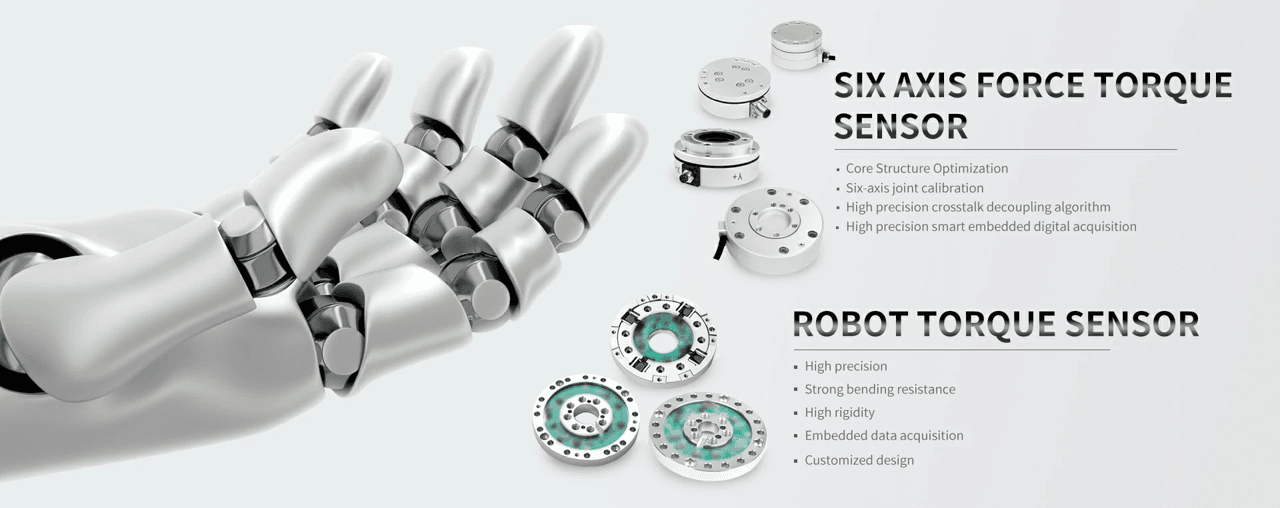
Six-axis force/torque sensors (HRS series)
Designed for humanoid robot joints (e.g., wrist, ankle), emphasizing compact form factor with high load capacity. Reported performance includes repeatability <0.1% FS and accuracy <0.5% FS, targeting stable force control in constrained mechanical spaces.High-performance series (titanium-based)
Uses proprietary alloy structures to reduce weight while maintaining stiffness. Sampling rates up to ~30 kHz position the products for high-dynamics applications such as medical robotics and research platforms.MEMS strain gauge architecture
Semiconductor-based strain sensing improves sensitivity (claimed 15–20× vs. traditional foil gauges) and supports automated manufacturing, addressing consistency and scaling constraints typical in precision sensor production.Cost-optimized CSR series
Positioned for broader industrial adoption, offering performance parity with imported alternatives while enabling limited customization without significant cost overhead.Joint torque sensors (extension since 2023)
Expands from end-effector sensing into embedded joint-level feedback. The company reports delivery across multiple actuator/module configurations, with volume shipments beginning in 2026.
Standards and infrastructure
Contributor to China’s national standard GB/T 43199-2023 for multi-axis force/torque sensor testing.
Early establishment of an in-house multi-axis calibration lab, supporting repeatability and traceability at scale.
Manufacturing and Delivery
Current calibration capacity: ~30,000 units/year; target expansion to ~120,000 units/year.
Demonstrated short-cycle delivery (e.g., hundreds of units within weeks), suggesting progress in process standardization and supply chain coordination.
Market Positioning
Kunwei operates at the component layer of the humanoid robotics stack, where force sensing is critical for compliant control and safe interaction. The company reports supply relationships with several domestic humanoid robot developers, indicating early integration into emerging platform architectures.
The product roadmap—spanning six-axis sensors, joint torque sensing, and industrial load measurement—suggests a strategy to cover both high-end robotics and broader automation markets, with partial overlap into motion analysis and rehabilitation applications.
Outlook
Near-term execution will depend on:
Scaling MEMS-based manufacturing without degrading calibration accuracy
Integration depth with humanoid OEMs at the joint/control level
Cost reduction sufficient to support volume deployment beyond pilot phases
If these conditions are met, force sensing—particularly at joint level—could become a standard configuration in next-generation humanoid platforms, positioning Kunwei within a critical subsystem of the robotics value chain.











Leave a comment