


Executive Summary
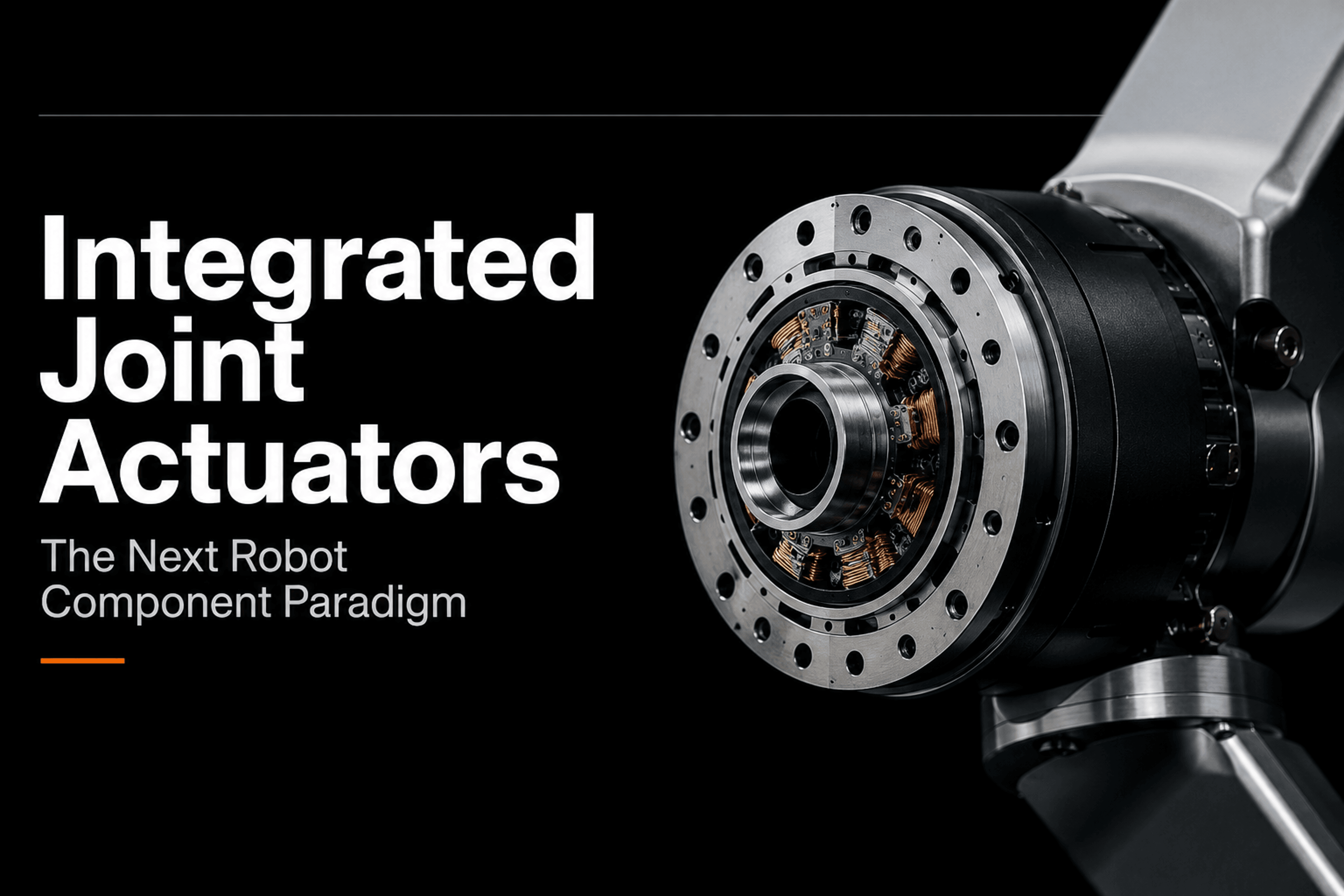
The integrated joint actuator — a sealed module combining frameless torque motor, precision reducer, torque sensor, dual encoder, and drive electronics — is the core power unit of the modern robot. It directly determines a robot's payload capacity, motion accuracy, and dynamic response. For three decades, this capability was assembled from five separately sourced components. That assembly model is being displaced by single-module architectures that embed all five functions in a package the size of a human fist.
The global integrated joint actuator market was valued at approximately $67 million in 2025 and is projected to reach $1.28 billion by 2034 at a CAGR of 52%. China's Ministry of Industry and Information Technology (MIIT) has explicitly designated integrated joints as a priority breakthrough direction. In 2025, China's humanoid robot sector alone encompasses more than 140 complete-machine companies and more than 330 product releases — every one of them a customer for integrated joint modules. The industry is crossing the threshold from 'functional but expensive' to 'capable and affordable,' driven by domestic Chinese suppliers compressing joint module prices from multi-thousand-dollar precision instruments to sub-1,000-RMB standard components.
1. Two Mechanical Architectures: Rotary and Linear Joints
Integrated joint actuators divide into two fundamental mechanical architectures serving different motion requirements in robot design.
| Type | Core Components | Technical Characteristics | Typical Applications |
| Rotary Joint | Frameless torque motor + harmonic or cycloidal reducer + torque sensor + dual encoder + drive electronics | High torque density; hollow cable routing through center bore; zero backlash; rotational DOF | Shoulder, hip, knee, elbow — any rotational degree of freedom |
| Linear Joint | Frameless torque motor + planetary roller screw + torque sensor + encoder + drive electronics | High thrust force; high precision; high stiffness; translational DOF | Leg extension/retraction; linear push-rods; vertical lift axes |
The rotary joint dominates current integrated actuator production — approximately 85–90% of modules shipped today are rotary — because the majority of robot joints (shoulder, hip, knee, elbow, wrist) require rotation. Linear joints are emerging as a critical second architecture for humanoid legs and parallel-mechanism arms, where prismatic motion is mechanically more efficient than rotary-to-linear conversion. China's Wuhan Municipal Government 2025 Key R&D Program has published explicit performance targets that define the industry benchmark:
| Joint Type | Peak Torque / Thrust | Torque-Weight / Thrust-Weight Ratio | Control Precision |
| Rotary Joint (target) | >500 N·m peak torque | >120 N·m/kg torque-to-weight ratio | Position tracking error ≤0.01 rad; contact force detection ±1 N |
| Linear Joint (target) | >10,000 N peak thrust | >5,800 N/kg thrust-to-weight ratio | Sub-millimeter stroke accuracy; high-stiffness anti-backlash design |
Source: Wuhan Municipal 2025 Key R&D Program specifications for integrated joint modules. These represent government-funded performance targets, not current commercial product specs.
2. Three Drive Architectures: QDD, SEA, and High-Reduction Hybrid
Within the rotary joint category, three drivetrain philosophies define the competitive and application landscape.
| Architecture | Gear Ratio | Backdrivability | Peak Torque Density | Primary Use | Key Players |
| QDD Quasi-Direct Drive | 5:1–25:1 | High — inherent compliance | High (large motor required) | Dynamic locomotion; agile humanoid lower body | Unitree, Agibot, MIT Cheetah lineage |
| SEA Series Elastic | 50:1–150:1 | Medium — spring-limited | Medium | Human collaboration; impact-rich environments | Boston Dynamics Atlas, ANYmal |
| Harmonic/Planetary Hybrid | 80:1–160:1 | Low — high stiffness | Very high in compact form | Precision assembly; upper-body manipulation; industrial cobot | Schaeffler, maxon HEJ, Tihu, PhyArc |
3. Industrial Applications: Cobots, Modular Arms, Reconfigurable Cells
Collaborative robots remain the largest downstream application for integrated joint actuators, accounting for approximately 70% of current module consumption. China's collaborative robot market reached 40,000 units in 2024, growing 27.4% year-over-year. The integration trend in cobots is structural: as joint module costs fall and plug-and-play standardization advances, the bill-of-materials argument for pre-integrated modules versus discrete three-part assembly becomes unambiguous.
Beckhoff's ATRO modular robot system exemplifies the industrial endpoint of this integration logic: each ATRO joint module contains a complete EtherCAT servo drive, motor, encoder, brake, and precision gearbox connected by a single hollow-axis cable. Robot configuration — axis count, kinematic topology, payload — is determined at cell setup by module selection, not at factory order time. A 3-axis cell can be reconfigured into a 6-axis welding system by adding modules and updating TwinCAT software configuration. For high-mix, variable-volume production environments, this reconfigurability changes the fundamental economics of robot asset deployment.
The supply-chain implication is equally significant: when a joint module becomes the unit of supply, a factory running 100 robots needs to stock one module family in three torque classes — not 300 reducer SKUs plus 300 servo SKUs plus 100 controller variants. This SKU compression is not a marginal efficiency gain; it fundamentally alters how robot assets are qualified, maintained, and replaced across a production facility's lifecycle.
4. Humanoid Robots: The Demand Equation That Reshapes the Supply Chain
China's humanoid robot sector reached a structural inflection in 2026: more than 140 complete-machine companies active, more than 330 products released, and the industry entering what analysts are calling the 'mass production inaugural year.' Forecast humanoid unit shipments in China reach 62,500 units in 2026. At 25–30 actuated joints per humanoid, this implies approximately 1.6–1.9 million integrated joint modules required for China's humanoid market alone in 2026 — a demand volume that exceeds the entire current production capacity of China's dedicated joint module suppliers.
The cost trajectory mirrors the supply-demand urgency. Unitree's product sequence tells the story: H1 launched at $90,000 (2023), G1 at $16,000 (2024), R1 at $5,900 (July 2025). Each price step was achieved primarily through actuator cost reduction at scale. Boston Dynamics' electric Atlas uses 40 electromechanical actuators. Tesla's Optimus Gen 2 uses approximately 28. The humanoid sector is not a future demand event to model — it is an active procurement crisis that every joint module supplier is racing to address in 2025.
| Platform | Origin | Joint Count | Architecture | 2025 Status |
| Atlas (Electric) | Boston Dynamics / USA | 40 electromechanical | SEA + rigid hybrid | Industrial lease deployments |
| Optimus Gen 2 | Tesla / USA | ~28 actuators | QDD + strain wave mix | Internal Tesla production use |
| Figure 02 | Figure AI / USA | ~30 actuators | QDD dominant | BMW pilot; commercial ramp ongoing |
| Unitree G1 | Unitree / China | 23 DOF QDD | QDD frameless; <10:1 ratio | $16,000; commercial availability |
| Unitree R1 | Unitree / China | ~30 DOF | QDD optimized BOM | $5,900 (Jul 2025); mass production |
| Agibot A2 / A2-W | Zhiyuan / China | ~30 DOF | 8:1 planetary + frameless; 52 Nm/kg | Mass production; 3C/semiconductor deployment |
| Walker S1 | UBTECH / China | Full-stack self-developed | High-perf. integrated joints | BYD factory training deployment |
| IRON | Xpeng / China | Custom | Turing chip + joint structure | 2025 release; automotive scenario focus |
5. Global Supplier Ecosystem: Europe, Japan, and China's Expanding Landscape
5.1 European Suppliers: Platform Architecture and Precision Integration
Europe's integrated actuator suppliers have staked their position on system-level optimization and premium precision. Schaeffler's planetary gear actuator platform (60–250 N·m, CES 2026) combines two-stage planetary gearbox, motor, encoder, and controller in a sealed unit with deliberately low back-driveability — holding position against gravity without power, critical for humanoid standing stability. The strategic partnership with Hexagon Robotics targets volume supply for at least 1,000 humanoid deployments by 2032.
maxon's HEJ (High Efficiency Joint) series represents the broadest European product line: HEJ 50 (soon to launch), HEJ 70 at 62 N·m, HEJ 90 at 140 N·m, and the HEJ 'Hercules' variant exceeding 250 N·m. All HEJ modules feature IP67 sealing, EtherCAT CiA 402 communication, and embedded thermal monitoring. maxon's proprietary rhombic winding technique achieves higher copper fill factors than standard round-wire windings, improving continuous torque density and reducing heat per Newton-meter — critical for continuous-duty industrial cobot applications.
Germany's SENSODRIVE brings a specialized architecture: the SensoJoint series integrates a Harmonic Drive strain wave gearbox with a non-contact torque sensor, BLDC motor, and EtherCAT communication in a single assembly. The non-contact torque sensor design eliminates the wear and hysteresis issues associated with strain-gauge torque sensors, providing high-bandwidth force feedback suitable for precision assembly and collaborative manipulation. WITTENSTEIN's mechatronic planetary modules and Beckhoff's ATRO joint modules complete Europe's integrated actuator offering across the precision and modular segments.
| Supplier | Country | Key Product | Torque Range | Differentiator |
| Schaeffler | Germany | Planetary gear actuator platform | 60–250 N·m | Two-stage planetary; position-hold without power; humanoid supply partnership |
| maxon | Swiss | HEJ 50 / 70 / 90 / Hercules | 62–250+ N·m | Rhombic winding; IP67; EtherCAT; thermal monitoring; widest EU product line |
| SENSODRIVE | Germany | SensoJoint series | Custom range | Harmonic Drive + non-contact torque sensor + EtherCAT; no-wear force sensing |
| WITTENSTEIN | Germany | alpha mechatronic modules | Custom range | Precision planetary; thermal stability; delta/SCARA specialty |
| Beckhoff | Germany | ATRO joint modules | Up to 16 Nm | Full TwinCAT/EtherCAT integration; modular robot config; industrial standard |
5.2 Japanese Suppliers: Captive Ecosystems with Selective Openness
Japan's traditional component makers — Nabtesco, Harmonic Drive Systems, Yaskawa — have been slower to embrace the integrated module architecture, constrained by business models optimized for high-margin discrete component supply to large OEMs. Harmonic Drive Systems' RSF and RSB compact actuator series represent the most significant Japanese integrated actuator product, combining hollow-shaft strain wave gearboxes with motors for use in surgical robots and high-precision cobots. HONPINE's harmonic robot joint executor adopts a drive-control integrated architecture with an embedded non-contact torque sensor (±0.5% FS accuracy) and IP50+ protection — a mid-market product positioned between Japanese precision and Chinese cost.
5.3 China: Specialized Suppliers Driving Cost-Performance Frontier
China's dedicated integrated joint actuator supplier ecosystem has reached critical mass in 2025, with a clear stratification emerging between performance-frontier players, cost-frontier players, and vertically integrated OEMs.
Tihu Robotics has established one of the highest torque-density benchmarks in the global market. Its T170A rotary joint module delivers a hip-joint peak torque of 490 N·m at a torque-to-weight ratio of 222 N·m/kg — in a 120 mm outer diameter package with a 31.5 mm hollow center bore for cable routing. This torque density exceeds most European products at equivalent package sizes. Tihu raised a Pre-A round from Matrix Partners, signaling institutional confidence in its technology positioning.
PhyArc has taken the cycloidal reducer integration path, producing the PhyArc series cycloidal joint modules where a single joint achieves maximum torque exceeding 530 N·m. The company has applied this technology to its own humanoid robot platform, PHYBOT M1 and C1, with 32 or more degrees of freedom — making it both a component supplier and a systems integrator testing its own modules in the most demanding possible validation environment.
| Company | Product | Peak Torque / Density | Architecture | Stage / Notable |
| Tihu Robotics | T170A rotary joint | 490 N·m peak; 222 N·m/kg; OD 120mm; bore 31.5mm | Frameless motor + harmonic + dual encoder | Pre-A from Matrix Partners; highest density benchmark |
| PhyArc | PhyArc cycloidal joint | 530+ N·m single joint; 32+ DOF system | Frameless motor + cycloidal reducer | Own humanoid PHYBOT M1/C1; component + system dual role |
| Tianlink | Ultra-light integrated joints + harmonic reducers | Ultra-light; cobot and humanoid focus | Harmonic Drive heritage from SW Univ. of Science & Tech | Academic spinout; cobot + humanoid supply |
| Haozhi | Harmonic + planetary reducer modules | Small batch supply to humanoid OEMs | Harmonic / planetary; joint module line | Sampling to humanoid makers; forming batch orders |
| RobStride | RobStride 00–06 series | 1.5 Nm to 120 Nm across 7 SKUs | QDD + planetary; modular family | 48.6% humanoid OEM partnerships; >RMB 100M orders 2025 |
| Gaoqing | Cost-optimized joint modules | Rated 4 Nm / peak 16 Nm; ~1,000 RMB/unit | Standardized integration | Developer + education market; 2025 WRC debut; commodity pricing |
| Qianghe Motor | Frameless torque motor + motor-driver-encoder module | Torque ripple <0.5%; ms response; OD 16–200mm | Motor + drive + encoder stack | Shenzhen; 50,000 units/yr capacity; cobot + humanoid supply |
| Laifual | Harmonic reducer + cross-roller bearing integration | High torque; high load; high stiffness | Harmonic + cross-roller bearing | Zhejiang; adapts to cobot and humanoid |
| Yiyou | Integrated joint modules | Mainstream market player | Modular joint architecture | Active supply to multiple humanoid OEMs |
| RealMan | Cobot integrated joints | Leading cobot joint specialist | Cobot-grade integration | Established cobot customer base; expanding humanoid supply |
5.4 Chinese Humanoid OEM Self-Developed Joints
A parallel ecosystem of vertically integrated actuator development exists within China's humanoid OEM companies. Unlike pure-play component suppliers, these OEMs develop joints specifically for their own platforms — creating the world's most demanding real-world validation environments for integrated actuator performance.
| OEM Company | Joint Strategy | Key Achievement / Application |
| UBTECH | Full-stack self-developed; all joints proprietary | Walker S1 deployed in BYD automotive factory training; highest-profile industrial humanoid deployment in China |
| Unitree | QDD joints with frameless motors; proprietary driver | H1 performs standing backflip; G1 at $16K; R1 at $5,900 — fastest cost compression curve in humanoid history |
| Agibot/Zhiyuan | G1–G5 joint module technology roadmap; 8:1 planetary + frameless | A2-W deployed in 3C and semiconductor factories; 52 Nm/kg torque density achieved |
| Xpeng | Turing chip + custom joint structure; vertical AI-hardware integration | IRON humanoid released 2025; automotive scenario and home deployment focus |
| Midea | Custom actuators for 6-arm wheeled configuration | Meilo U humanoid — first-in-industry 6-arm wheeled-legged configuration; factory pilot deployments |
| Lingyi iTech | Servo motor + reducer + driver + joint module; full component-to-system vertical | RMB 1.37B total investment in components-to-modules-to-complete-machine supply chain |
6. Supply Chain Bottlenecks: Where the Hard Problems Remain
Despite the rapid progress across the Chinese integrated actuator ecosystem, four component-level bottlenecks continue to constrain performance and cost trajectories, representing the active engineering frontier of the industry.
| Bottleneck | Current Constraint | Key Players Addressing It |
| Precision reducer machining | Harmonic reducer flexspline and circular spline grinding requires surface finish Ra<0.2μm and ISO Grade 4 tooth accuracy. RV reducer cycloidal tooth profile grinding at equivalent tolerance. Both require multi-decade process refinement and ultra-precision grinding equipment not yet widely available domestically. | Leaderdrive, Laifual (harmonic); Zhongda Leva (RV); Tianlink; government-funded precision machine tool programs |
| Planetary roller screws (linear joints) | Planetary roller screws for linear joints have been long dominated by European specialists GSA and Rollvis. The precision thread-rolling and hardening process for sub-100 micron lead error at high load cycles is not yet mastered at scale domestically. | Shuanglin Co., Wuzhou Xinchun leading domestic development; still 2–3 years from full parity |
| High-precision miniature bearings | Cross-roller bearings and thin-wall bearings for joint modules face a tension between miniaturization (fitting inside 120mm OD packages) and high dynamic load rating. Domestic bearing manufacturers serve mid-range specifications but struggle with the combined small-size and high-load requirements of peak-performance joints. | NSK, THK (Japan) still dominant in ultra-precision segment; LYC, C&U (China) developing; 3–5 year gap |
| Torque sensors | Miniaturized torque sensors with high linearity, fast bandwidth (>1 kHz), and overload resistance (>500% rated torque without damage) are required for compliant force control. Current domestic sensors achieve adequate static accuracy but show nonlinearity and bandwidth limitations under dynamic loading. | ATI (USA) and Kistler (CH) dominate high-end; domestic startups ROKAE, Changsha sensor labs developing; SENSODRIVE non-contact approach avoids wear issue |
Sources: Chinese Academy of Sciences; MIIT 2025 industry reports; company technical publications; independent supply-chain analyst assessments.
7. Technology Development Trends: Four Vectors Reshaping the Industry
7.1 Torque Density: Setting New Benchmarks
The torque-density race has become the primary technical differentiator in the high-performance segment. Tihu Robotics' 222 N·m/kg and PhyArc's 530+ N·m maximum torque in a single module have set new Chinese industry benchmarks that approach or match European counterparts at equivalent package sizes. The next-generation product roadmaps from leading Chinese suppliers point toward 250–300 N·m/kg torque density as the 2026–2027 target — achievable through combinations of higher-energy-density rare-earth permanent magnets, thinner-lamination stator cores reducing eddy current losses, and tighter mechanical tolerance control reducing air-gap variations.
7.2 Sensing Integration: From Position to Force Intelligence
The integration of high-accuracy force-torque sensors directly into joint modules — rather than mounting external sensors at the wrist or end-effector — is the defining capability upgrade of 2024–2025. Six-axis force/torque sensors and single-axis torque sensors embedded at joint level enable true compliant control: the robot senses and regulates the force it applies at every joint, not just at the tool center point. This is critical for grasping, assembly insertion, and human-robot physical interaction tasks where force at intermediate joints determines whether a task succeeds or fails. SENSODRIVE's non-contact torque sensor approach (±0.5% FS accuracy, no wear mechanism) and HONPINE's embedded non-contact sensing represent the premium end of this trend; Chinese suppliers are rapidly closing the gap with strain-gauge-based embedded sensors achieving ±1 N contact force detection as per the Wuhan 2025 government benchmark.
7.3 Cost Compression: From Custom Instrument to Standard Component
The most strategically significant trend in the Chinese market is the deliberate commoditization of integrated joint modules. Gaoqing Electromechanical (高擎机电) has compressed joint module pricing to approximately 1,000 RMB per unit for development-grade modules (rated 4 N·m, peak 16 N·m) — a price point that makes integrated joints accessible to university robotics labs, developer communities, and educational platforms. This pricing signals a structural market segmentation: premium joints for industrial and humanoid production (Tihu, PhyArc, RobStride high-end SKUs) and commodity joints for development, prototyping, and lower-tier applications (Gaoqing, entry-level RobStride). The commodity tier does for joint actuators what Arduino did for microcontrollers — it expands the developer ecosystem, accelerates application innovation, and builds the installed-base foundations for a larger industrial market.
7.4 Modularization and Software Standardization
The industry is converging on plug-and-play joint architectures with support for ROS (Robot Operating System), Python SDK, and CAN/EtherCAT communication interfaces as baseline requirements. MIIT is actively promoting the establishment of an open-source humanoid robot community and a comprehensive standardization framework to accelerate the sharing of innovation across the ecosystem. Qianghe Motor's (强和电机) motor-driver-encoder integrated module, with torque ripple below 0.5% and millisecond-level response time across 16–200 mm outer diameter options, exemplifies the trend toward standardized building-block components that can be combined by system integrators without custom mechanical and electrical design work. With 50,000 units per year production capacity in Shenzhen, Qianghe represents the transition from custom precision instruments to volume-manufactured standard components.
8. China's Opportunity Window: Racing Before the Standard Solidifies
The integrated actuator market offers China a structural competitive opportunity absent from every traditional robot component segment. In RV reducers, Nabtesco has a 50-year process advantage. In motion controllers, FANUC's software library depth is decades in the making. In integrated joint actuators, no supplier has a comparable head start — the product category was commercially negligible four years ago.
China's structural advantages are concrete and compounding. Its rare-earth supply chain — controlling approximately 85% of global rare-earth processing — covers the highest-value material input in frameless torque motors. Its electronics manufacturing ecosystem covers every other BOM category: precision motor windings, power FETs, encoder disks, die-cast aluminum housings. Its humanoid OEM ecosystem provides a captive, high-volume qualification environment: 140+ humanoid companies ordering 1.6–1.9 million joint modules in 2026 alone creates iteration cycles impossible to replicate outside China.
The cost trajectory is the clearest evidence. Unitree's H1-to-R1 journey compressed per-actuator cost from approximately $900–1,200 to under $200. European equivalents (Schaeffler, maxon) price comparable-torque integrated modules at $600–1,500. RobStride's 48.6% humanoid OEM partnership rate — achieved in under two years from founding — demonstrates that Chinese suppliers can establish market dominance before a global standard ossifies. The strategic risk is vertical integration: Unitree, Agibot, and UBTECH are all developing joints captively. The window for independent suppliers to establish position as the EtherCAT-era equivalent of what Nabtesco became for RV reducers — the default qualified source — is open now, and closes as OEM captive supply scales.
9. Technology Roadmap and Commercialization Timeline
| Horizon | Cost per Module | Performance Target | Intelligence Layer | Key Inflection |
| 2025–2027 (Scale) | RMB 1,000–5,000 (performance tier) RMB 500–1,000 (development tier) | Rotary: 250 N·m/kg density; IP67 standard Linear: planetary roller screw domestic qualification | Embedded position + torque control; basic wear monitoring | Humanoid 2026 volume: 62,500 units; 1.6M+ joints demanded; China domestic supply race |
| 2027–2030 (Standard) | RMB 500–2,000 performance RMB 200–500 commodity | SIL 2 industrial certification; 10,000-hr L10 field validation; 300 N·m/kg benchmark | Joint-state estimator; predictive wear via motor current signature; EtherCAT native | Industrial integration standard adoption; cobot module becomes plug-and-play commodity |
| 2030–2035 (Intelligent) | <RMB 200 commodity; <RMB 1,000 high-perf | 25,000-hr field life; self-calibrating joint model; digital twin per joint | On-module neural network proprioception; AI-adaptive torque compensation | Physical AI training on joint-hour data; sensor-in-joint becomes robot nervous system node |
Sources: Valuates Reports; IDTechEx Humanoid Robots 2025; Interact Analysis 2025; MIIT 2025; Wuhan Municipal R&D Program specifications; company press releases and technical documentation.









Leave a comment