



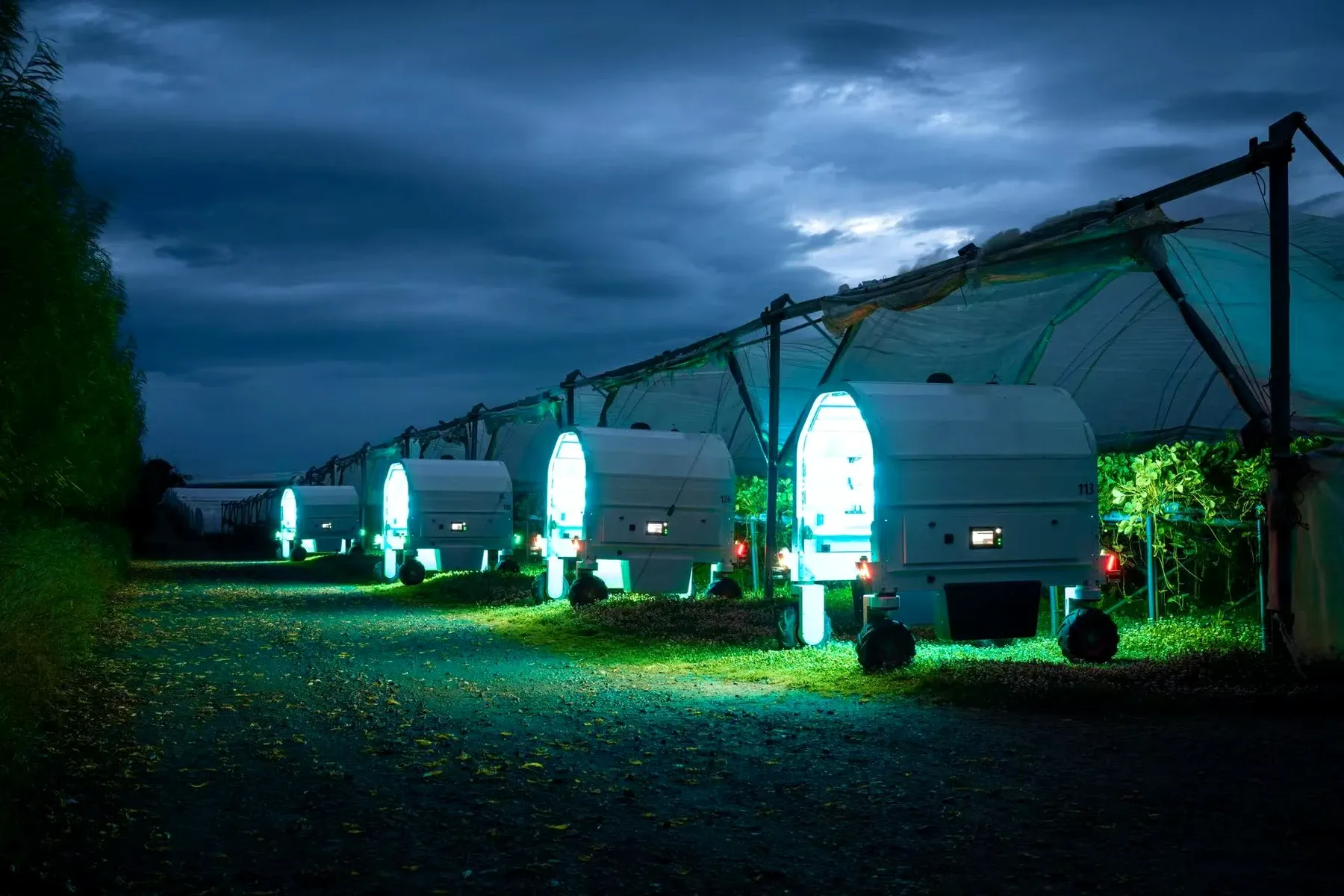
Saga Robotics builds Thorvald, an autonomous field robot that uses UVC light to suppress crop disease instead of chemical fungicide. With engineering teams split across Oslo, the UK, and California, the company has spent five years commercially deploying Thorvald on UK strawberry farms and, more recently, on wine-grape vineyards in California.
RobotToday spoke with Damian Flynn, Saga Robotics' Chief Product Officer, on July 30, 2026 — a conversation connected by PTC/Onshape in the weeks after Automate 2026.
Industry Context: Two Problems Agriculture Can't Chemical Its Way Out Of
Specialty-crop growers have leaned on the same two levers for decades: chemical inputs and manual labor. Both are getting harder to depend on. Fungicides, pesticides, and herbicides are costly, environmentally damaging, and under growing scrutiny from regulators and consumers. Farm labor — much of it seasonal and migratory — has gotten scarcer and more expensive, with no sign of reversing.
Flynn spent seven years in warehouse robotics before joining Saga. He's blunt that agriculture is the harder automation problem of the two: modern warehouses, he says, are “almost fully automated” today, but the physical environment is comparatively forgiving for a robot. Farmland, by contrast, is “the most chaotic environment” he's worked in. Saga's answer to both problems starts with a beam of UVC light.
The Interview
RobotToday: Let's start with the basics — what problem is Thorvald actually solving?
Flynn: Two structural problems, in his framing: chemical reliance and labor reliance. Fungicide and pesticide programs are expensive and environmentally costly; farm labor is seasonal, often imported, and “isn't getting any cheaper or any more available.” Thorvald was built to reduce a farm's dependence on both.
RobotToday: How does the UVC treatment actually work?
Flynn: UVC light damages the DNA of fungal spores — in particular powdery mildew, though it also has beneficial effects on botrytis, downy mildew, and sour rot. Treatment is most effective at night, because daytime blue light triggers a natural DNA-repair mechanism in the spores; suppression achieved at night lasts substantially longer. That's also what lets Thorvald run autonomously overnight, turning farm operations into a round-the-clock operation instead of a 9-to-5 one. Flynn points to peer-reviewed research out of Cornell, Washington State University, and the University of Florida as the academic basis for UVC efficacy on strawberries, cucumbers, roses, and other crops.
RobotToday: A lot of agricultural robotics activity is chasing harvesting. Why did Saga focus on disease treatment instead?
Flynn: By his estimate, roughly half of a farm's labor spend sits inside the harvest window, and the other half is spread across the rest of the growing season — spraying, scouting, and ongoing crop care. Many of the Agtech startups piled into the harvest half, competing to build picking and harvesting robots. Saga deliberately went after the other half instead, where Flynn sees less competition for a labor gap that's just as real. It's also where the night-efficiency advantage above matters most: Thorvald works overnight, when farms are hardest to staff, and — because UVC treatment is actually more effective at night than during the day — the robot isn't just filling an off-hours gap, it's doing better work in it than a daytime treatment could.
RobotToday: Thorvald started as a disease-treatment robot. What's been added since?
Flynn: A data layer, launched last year: onboard cameras and trained machine-learning models now handle crop counting, ripeness assessment, and yield forecasting; disease detection is coming soon. That data is aggregated and pushed straight to an online portal for analysis. Flynn's pitch for why this matters — growers have historically hand-sampled only 1–5% of a crop and extrapolated to the whole field, which he calls “a terrible way of guessing.” Next up the roadmap: a mite-dispenser product for biological pest control, targeted for trials next season, with a longer-term goal of a closed loop where Thorvald detects a problem like a leafhopper infestation on one pass and autonomously deploys the fix — releasing beneficial mites — on a later one.
RobotToday: How do you sell a grower who's never used a robot before?
Flynn: Saga sells access, not just hardware. New customers trial the robot on a small slice of acreage and pay by treated area. Saga supplies the robot, staff training, and an app that tells operators which zones need treatment and the status of the robot assigned to treat it. Flynn cites zero customer churn across five years of commercial operation, and says growers typically expand acreage once they can directly compare a season on Thorvald against their prior chemical program. Some growers now run Thorvald across their entire farm and have cut spray use by 100%; others layer UVC on top of conventional spraying in their highest-pressure zones rather than replacing it outright.
RobotToday Editorial Note — Adoption Economics Flynn's zero-churn and full-spray-reduction claims were not accompanied by named customers or independently verifiable figures on this call. Saga agreed to follow up with yield-improvement percentages and disease-treatment efficacy data for this piece. |
RobotToday: You've expanded from UK strawberries into California wine grapes. What's different about that market?
Flynn: The two markets are at very different stages. In the UK, Saga now treats roughly 30% of the country's strawberry harvest and works with over 10 of its largest growers, with market share growing by roughly 10 percentage points a year. In California, Saga has been active for about four years, with a roughly 10-person local team; this year the company treated around 3,000 acres of wine grape, against a statewide total of roughly 250,000 acres. Environment is a bigger factor in the US: Flynn described dealing with boulders, gopher holes, rattlesnakes, and — in one case — a mountain lion encountering a robot, versus wind, rain, and mud as the main obstacles in the UK. Flynn frames the four-year US push as a deliberate bet rather than an experiment: one of Saga's co-founders relocated to the US four years ago specifically to build out the California business. Beyond wine grapes, he said Saga is now evaluating various berry crops for the California market specifically, and points to the state's broader openness to adopting new agricultural technology as part of why the company is confident expanding there.
RobotToday: Same robot, two very different crops — how much of the platform actually changes?
Flynn: Less than you'd expect. The original arch-and-reflective-surface design, built to minimize shadowing so UVC light penetrates the canopy, translates well from tabletop strawberries to trellised wine grapes, since vines are trained on a similar vertical structure. The California variant carries a bigger battery (for longer nights), larger wheels (to clear challenging terrain), and stronger motors (for slopes) — but runs the same software stack. “We've tried to keep it a standard platform and only change the parts you need to change to make the variant,” Flynn said. He sees the same architecture working on raspberries, potted blueberries, roses, and cannabis, but says Saga is deliberately staying focused on just these two crops for now rather than expanding coverage.
RobotToday: What does it actually take for a farm to get up and running with Thorvald?
Flynn: GPS positioning and internet connectivity are required — Saga can help set up alternatives like Starlink for farms in remote locations. Onboarding includes a formal training program (an online theory test and safety training) followed by ongoing in-person and remote support after handover. The biggest structural challenge, in Flynn's telling, is that agriculture has “no standardization” — every farm differs in size, layout, and process, so each deployment needs some custom integration. One staff member can oversee around ten robots.
RobotToday: How are farm workers reacting to robots showing up in the field?
Flynn: There's a clear before-and-after. Growers — and especially workers — who haven't yet worked alongside Thorvald tend to start out somewhat guarded, worried, reasonably enough, that a robot showing up means fewer jobs. That changes once a crew actually starts operating one: on farms that have adopted Thorvald, Flynn says the reaction is consistently more excited than the pre-adoption skepticism would suggest — acceptance runs higher than most people expect, largely because the job shifts rather than disappears. Workers move from repetitive manual spraying into a “robot operator/maintainer” role, which Flynn says they tend to prefer to the labor it replaces. For the US deployment specifically, he flagged Spanish-language support as a deliberate design choice given the makeup of the agricultural workforce there.
RobotToday: Zoom out — where do you think agricultural robotics is headed?
Flynn: Bullish, unambiguously. He frames food security as the second most urgent global issue after climate change, and farming as “one of the toughest but most important jobs in the world.” Closing message to growers: keep pushing for help adopting modern tools and processes to improve food production.
RobotToday Analysis
The Warehouse-to-Farm Comparison
Flynn's seven years in warehouse robotics is doing real work in this story — it's the contrast he reaches for to explain why agriculture is hard. Warehouses are largely solved, automation-wise; farms are not, because no two farms look alike and the physical environment is unpredictable by design. That framing is a reasonable way to explain why a UVC robot needed five years just to prove itself on one crop in one country before expanding.
Technical Significance
The core idea — that UVC light can suppress fungal disease without chemical input, and that timing (night-only treatment) is what makes it work — is grounded in published academic research rather than a Saga-only claim, which gives it more credibility than a typical vendor pitch. The more interesting engineering story is the platform reuse: rather than building a new robot per crop, Saga appears to have kept a common arch/software architecture and swapped only battery, wheel, and motor specs for the California variant. If that holds up, it's a meaningfully cheaper way to scale into new crops than a ground-up redesign each time. Flynn cites that using the native cloud CAD and PDM platform, Onshape, has brought them a 30-40% reduction in design cycles and supports the agile way Saga operates across multiple time zones. Onshape's collaboration features allow design reviews on any device where there is an internet connection, which he says is very useful for designs that are constantly changing and improving.
RobotToday Editorial Note — Onshape Design-Cycle Claim The “30–40% reduction in design cycles” figure is PTC/Onshape-sourced and was added during PTC's review pass on this draft, not independently verified by RobotToday. It's included here because Saga's engineering team credits it directly, but it should be read as a vendor-attributed number, not a benchmarked result. |
Commercial Significance
The trial-then-scale sales model (start on a small slice of acreage, expand once the grower can compare seasons directly) is a sensible way to de-risk a first-time robotics purchase for a conservative buyer like a farm operator. The “zero churn in five years” figure is notable if true, but it's a company-reported number with no named customers behind it in this interview — worth treating as a claim to verify rather than a fact to publish outright. Strategically, Saga's choice to target the non-harvest half of a farm's labor spend — rather than compete in the increasingly crowded harvesting-robot segment — is a distinct positioning bet: it aims Thorvald at a labor gap (night-shift, off-season crop care) that's arguably harder for a human crew to fill in the first place, which makes the robot look more like a labor substitute than a labor supplement.
Industry Outlook
Saga's UK numbers (30% of the strawberry harvest, 10 of the largest growers) suggest real market penetration in a market it has worked for years; the California business is earlier-stage by comparison, though a co-founder relocating there four years ago and an active pipeline of berry crops under evaluation both read as tangible signals of long-term commitment rather than a toe-in-the-water expansion. The company's own roadmap — moving from disease treatment, to data/ML, to biological pest control — reads as a company trying to turn one robot into a recurring, ever-more-necessary piece of farm infrastructure rather than a single-purpose tool. The worker-adoption pattern Flynn describes — skepticism before hands-on use, enthusiasm after — is also worth watching as Saga scales into new farms and new regions: it suggests the labor argument gets easier to make with each successive deployment, but only after workers actually get hands-on time with the robot.
What RobotToday Is Still Following Up On
|

Leave a comment