

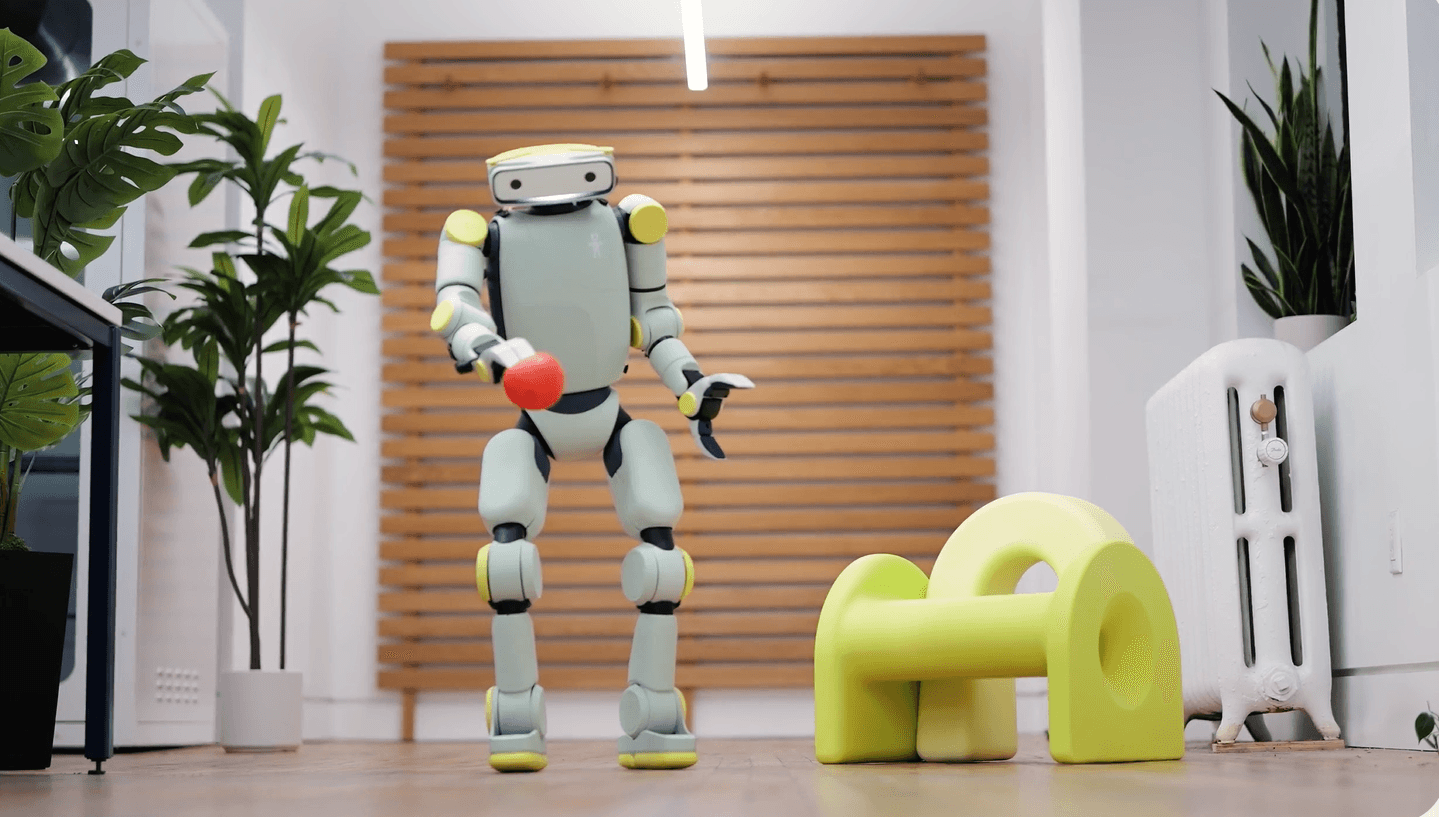
Amazon has acquired Fauna Robotics, the New York–based developer of the Sprout humanoid robot, marking a clear strategic shift from industrial automation toward consumer-facing robotics. Financial terms were not disclosed. The ~50-person team will join Amazon’s New York operations.
Strategic Signal: From Efficiency to Affinity
The move extends Amazon’s robotics trajectory beyond its 2012 acquisition of Kiva Systems and warehouse optimization, into the far less defined—but potentially larger—home robotics market. While devices like Amazon Astro explored early consumer use cases, Fauna introduces a fundamentally different thesis: success in the home depends less on raw capability and more on emotional accessibility and human-centered design.
Sprout, Fauna’s first humanoid platform, reflects this philosophy. At 107 cm tall and ~22.7 kg, it is intentionally scaled for eye-level interaction with adults and children. Its soft exterior, padded structure, and compliant actuation prioritize safety, while expressive features—such as articulated eyebrows and a 360° LED face—enable non-verbal communication. Rather than positioning itself as a “do-everything” machine, Sprout deliberately constrains expectations, emphasizing predictable interaction over performance maximalism.
Product Positioning: A Developer Platform with Emotional Intelligence
Currently offered as a $50,000 Creator Edition, Sprout targets developers, research institutions, and early enterprise adopters. It integrates locomotion, perception, navigation, and interaction capabilities out of the box, supported by SDKs and APIs for custom AI model integration.
The hardware stack includes an NVIDIA Jetson AGX Orin, stereo vision, TOF sensors, and multimodal interaction systems. While its manipulation and task execution capabilities remain limited compared to full-scale humanoids, Sprout can perform light interaction tasks (e.g., object handling) and is optimized for human-facing scenarios where emotional engagement is central.
Early customers reportedly include entertainment and robotics organizations, suggesting dual-use potential across research and experiential environments.
Market Context: A Bifurcating Humanoid Landscape
The acquisition underscores an emerging divide in humanoid robotics:
Capability-maximalist systems, such as Tesla Optimus, Figure 03, and Atlas, emphasize strength, autonomy, and long-horizon task execution—but risk creating a gap between appearance and real-world capability.
Relationship-first systems, represented by Sprout and NEO, prioritize safety, predictability, and emotional resonance, potentially better aligned with domestic environments but constrained in functional utility.
Amazon’s acquisition indicates a clear preference for the latter approach—at least in the near term—where trust, safety, and user acceptance are critical barriers to adoption.
Leadership and Technical Depth
Fauna is led by CEO Rob Cochran (ex-Meta, AWS) and co-founder Josh Merel, formerly of DeepMind. The team combines reinforcement learning expertise, embodied AI development, and robotics engineering, positioning it well for iterative platform scaling under Amazon’s infrastructure.
What to Watch
Key questions remain for EU and North American markets:
Product roadmap: Will Sprout evolve from a developer platform into a mass-market consumer device, and on what timeline?
Ecosystem integration: How tightly will humanoids integrate with Amazon’s Alexa, smart home, and logistics stack?
Regulatory and safety frameworks: Especially in the EU, where human-robot interaction in private spaces may face stricter scrutiny.
Price compression: At $50,000, Sprout is far from consumer-ready; scaling will require significant cost-down across hardware and manufacturing.
Amazon’s acquisition of Fauna Robotics is not a bet on humanoid capability leadership—but on redefining how robots are perceived and accepted in human environments. In a sector often driven by technical spectacle, this signals a pivot toward design, psychology, and trust as primary competitive variables.









Leave a comment