

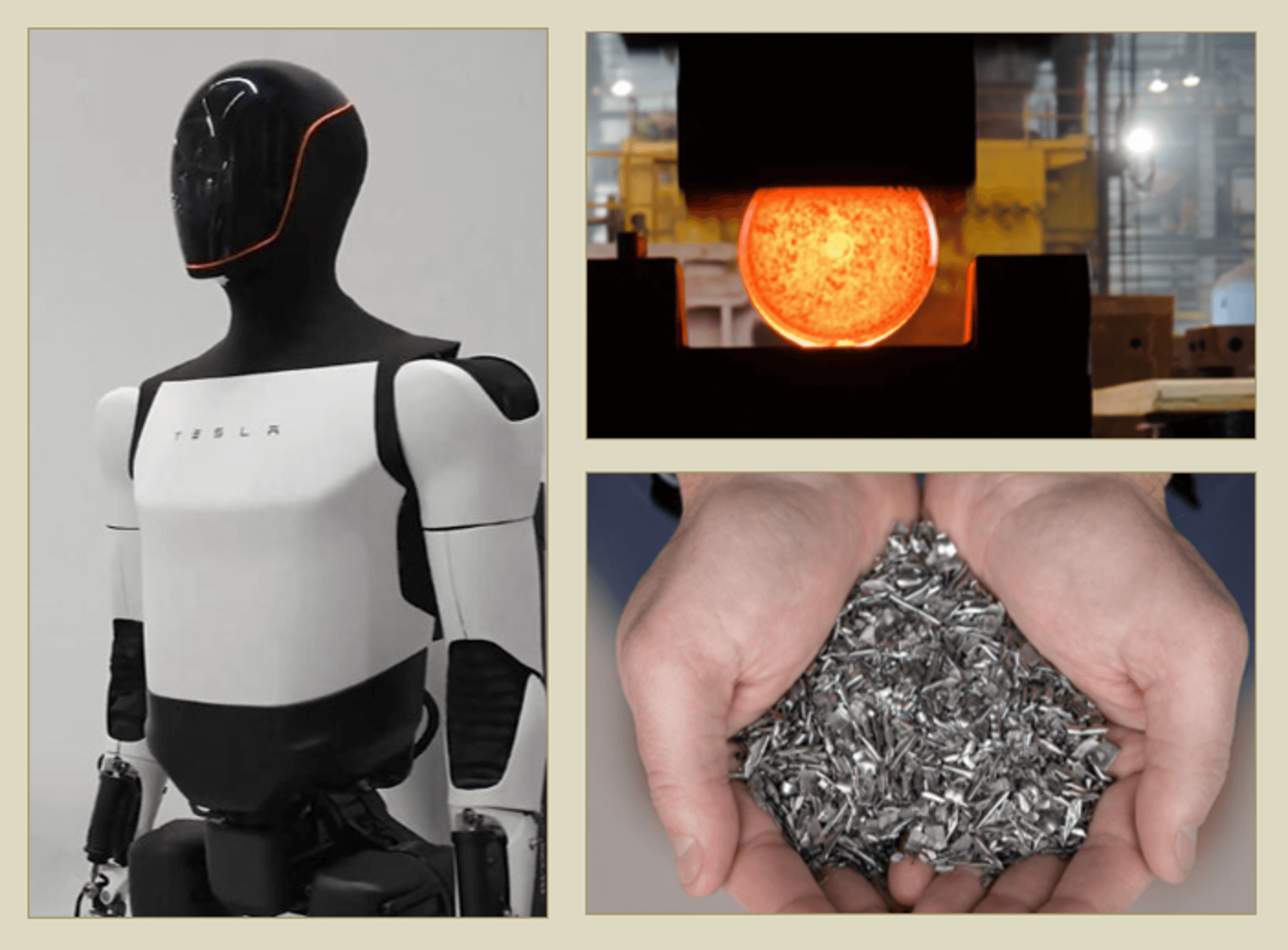
When you imagine the next generation of robots—humanoids striding across factory floors, surgical arms threading needles with sub-millimeter accuracy, or deep-sea drones navigating lightless trenches—you might picture algorithms, sensors, and chips. But ask the engineers building them, and they’ll tell you: none of that works without the right bones. Those bones are increasingly made of titanium.
1. The Core Role of Titanium in Robotics
Titanium (Ti) is emerging as one of the core structural materials for advanced robotics—the very “bones and joints” of intelligent machines.
The three defining trends of robotics—lightweighting, strength optimization, and extreme environment adaptation—align perfectly with titanium’s three key advantages:
- Light: Only ~60% as dense as steel but equally strong.
- Strong: Over twice the strength of aluminum with superior fatigue resistance.
- Corrosion-resistant: Remains stable in seawater, chemicals, and even within the human body.
As such, titanium is rapidly shifting from an optional material to a strategic backbone in humanoid, medical, underwater, exoskeleton, aerospace, and nuclear robotics.
“Titanium has shifted from being a specialty metal to a structural standard for robotic frames,” says Dr. Hiroshi Tanaka, materials scientist at Osaka Institute of Technology.
2. Titanium’s Expanding Influence Across Robotic Sectors
Humanoid Robots
Titanium alloys are ideal for skeletal and joint structures—lightweight yet capable of withstanding shock and load. For humanoids that walk, jump, and lift (e.g., Tesla Optimus, Agility Digit, UBTech Walker S, Unitree H1), weight reduction directly enhances endurance and gait stability.
Trend Forecast: By 2030, titanium could account for 30–40% of key humanoid structures (joint shells, frame supports), replacing parts previously made from aluminum or carbon composites.
Medical and Surgical Robots
Titanium’s biocompatibility and anti-corrosive properties make it a natural fit for surgical tools, implants, and micro-robotic arms. Surface treatments like plasma spraying, nano-texturing, and PVD coatings enable antimicrobial and bioactive functionalities.
Trend Forecast: The medical robotics sector is one of the fastest-growing segments for titanium use (CAGR ≈15%), especially in joint implants and minimally invasive device components.
Underwater and Deep-Sea Robots
Titanium’s density and compressive strength make it the go-to metal for pressure vessels, propeller housings, and underwater connectors. At depths beyond 1,000 m, it’s virtually the only metal that resists both corrosion and fatigue.
Example: China’s Jiaolong deep-sea submersible and Kongsberg/SAAB Seaeye ROVs all deploy titanium pressure housings.
Exoskeletons and Wearable Robots
In exoskeletons, titanium drastically reduces load and enhances durability. When combined with carbon fiber in hybrid structures, it achieves optimal stiffness-to-weight ratios for ergonomic mobility.
Trend Forecast: Titanium will replace select steel parts in exoskeleton frameworks and joints, improving endurance and operational life by 20–30%.
Aerospace, Nuclear, and Extreme-Environment Robots
Titanium’s high-temperature stability and radiation tolerance make it indispensable in space and nuclear robotics. Even at 400°C, titanium maintains strength and resists creep, enabling its use in space probes (NASA Perseverance, lunar rovers) and reactor-maintenance bots.
3. Technology Trends & Breakthroughs in Titanium Engineering
| Technology | Description | Impact on Robotics |
|---|---|---|
| Additive Manufacturing (3D Printing) | Powder-bed fusion or electron-beam melting to produce complex Ti structures | Reduces cost, enables complex joint or lightweight frame geometries |
| Low-Cost Extraction (e.g., FFC Cambridge, Kroll alternatives) | Cuts titanium sponge production cost by 30–50% | Turns Ti from a “luxury metal” into a structural standard |
| Titanium Composites | Reinforced with carbon fiber or ceramics | Balances lightness, strength, and thermal resistance |
| Surface Functionalization | Nano anti-corrosion coatings, low-friction and self-healing layers | Extends robot lifetime in moisture, seawater, or biological environments |
“By combining topology optimization with electron-beam melting, we’ve increased printing efficiency four-fold and cut energy use by 65%,” says Liang Wei, head of metal AM research at Baoti Group.
Japan’s Toray achieved a 20% weight reduction with Ti–Al laminates, while QuesTek Innovations used machine learning to create vanadium-free titanium, eliminating toxicity for surgical robots.
4. Economic & Supply Chain Impacts
- Cost Challenge: Titanium remains 5× more expensive than aluminum and 20× more than steel. Yet with additive manufacturing and new extraction methods, costs may halve in 5–10 years.
- Localization Advantage: China’s full titanium value chain—from ore to alloy powder—positions it as a key supplier for the robotics materials ecosystem.
- Strategic Significance: Titanium’s light strength profile underpins the next generation of long-endurance, high-mobility robots—vital for energy efficiency and autonomy.
“By 2026, titanium recycling in robotics will reach 30%, driven by standardized recovery systems,” notes Chen Xiaofeng, supply-chain analyst at China Mining University.
5. Timeline: The Titanium–Robotics Relationship (2025–2035)
| Period | Core Trend | Titanium Influence |
| 2025–2027 | Titanium alloys dominate medical and underwater robots | ★★★★☆ |
| 2027–2030 | 3D-printed titanium enters humanoid robot production | ★★★★★ |
| 2030+ | Ti–composite hybrids become standard in aerospace and defense robots | ★★★★★ |
“The question is no longer whether titanium can be affordable,” says Prof. Elena Kovacs, robotics materials researcher at TU Wien. “It’s how quickly we can integrate it into mass-produced robots.”
6. Market Outlook: High Value, Low Volume
The titanium alloy market for humanoid robots is projected to grow from ¥1.28B (2024) to ¥18.7B (2030)—CAGR ≈49%. The overall titanium market is expanding from USD 28.6B (2024) to USD 53.6B (2034). Robotics will be among the most dynamic sub-sectors due to lightness, endurance, and component miniaturization demands.
7. Toward a Titanium-Powered Future
Titanium will become the skeletal metal of the intelligent era—not a substitute like carbon fiber, but a bridge between intelligence and physical embodiment. As rare earths define the motor, titanium will define the body.
From the air to the ocean floor, the next revolution in robotics won’t just be coded in algorithms. It will be forged in metal.










Leave a comment