


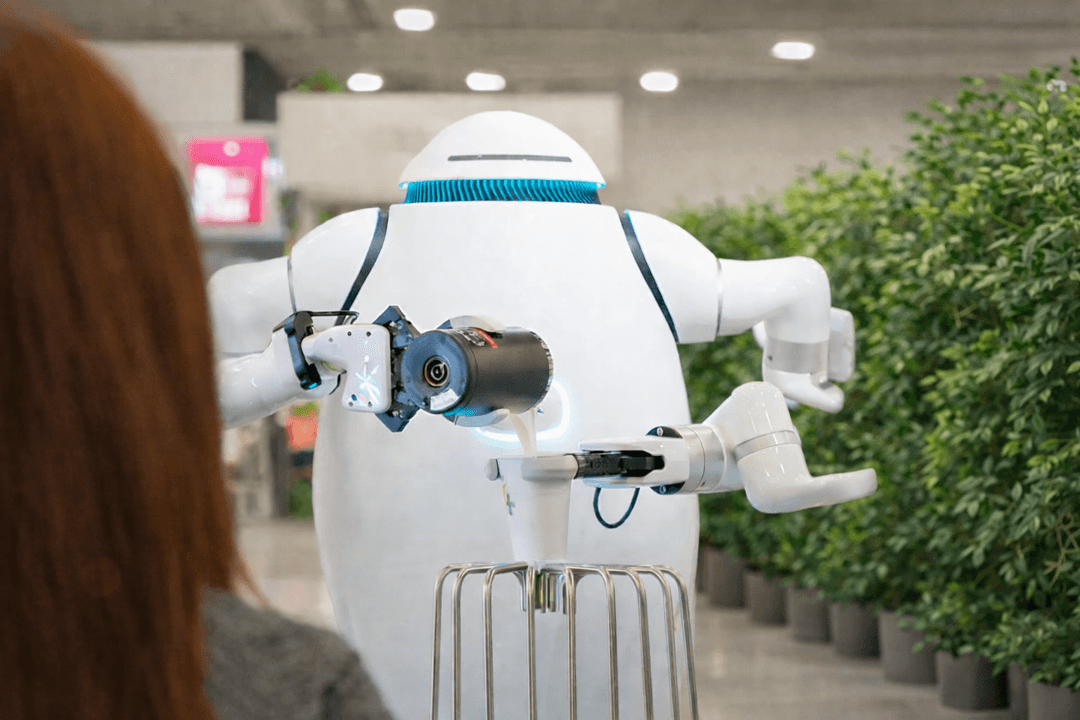
Recent disclosures indicate that RichTech Robotics’ latest revenue figures reflect incremental market traction rather than a clean financial inflection. Reported growth suggests expanding deployments across U.S. commercial service environments, but operational indicators— including cost structure, deployment efficiency, and margin stability—continue to point to the execution challenges typical of hardware-centric robotics companies operating at scale.
The more meaningful signal, however, lies beyond short-term financial performance: RichTech’s ability to sustain U.S. customer engagement while maintaining a China-anchored manufacturing base suggests that its hybrid operating model is beginning to function as intended, translating supply-chain efficiency into real market presence, albeit with uneven near-term results.
A different starting point: an American market problem, not a Chinese export story
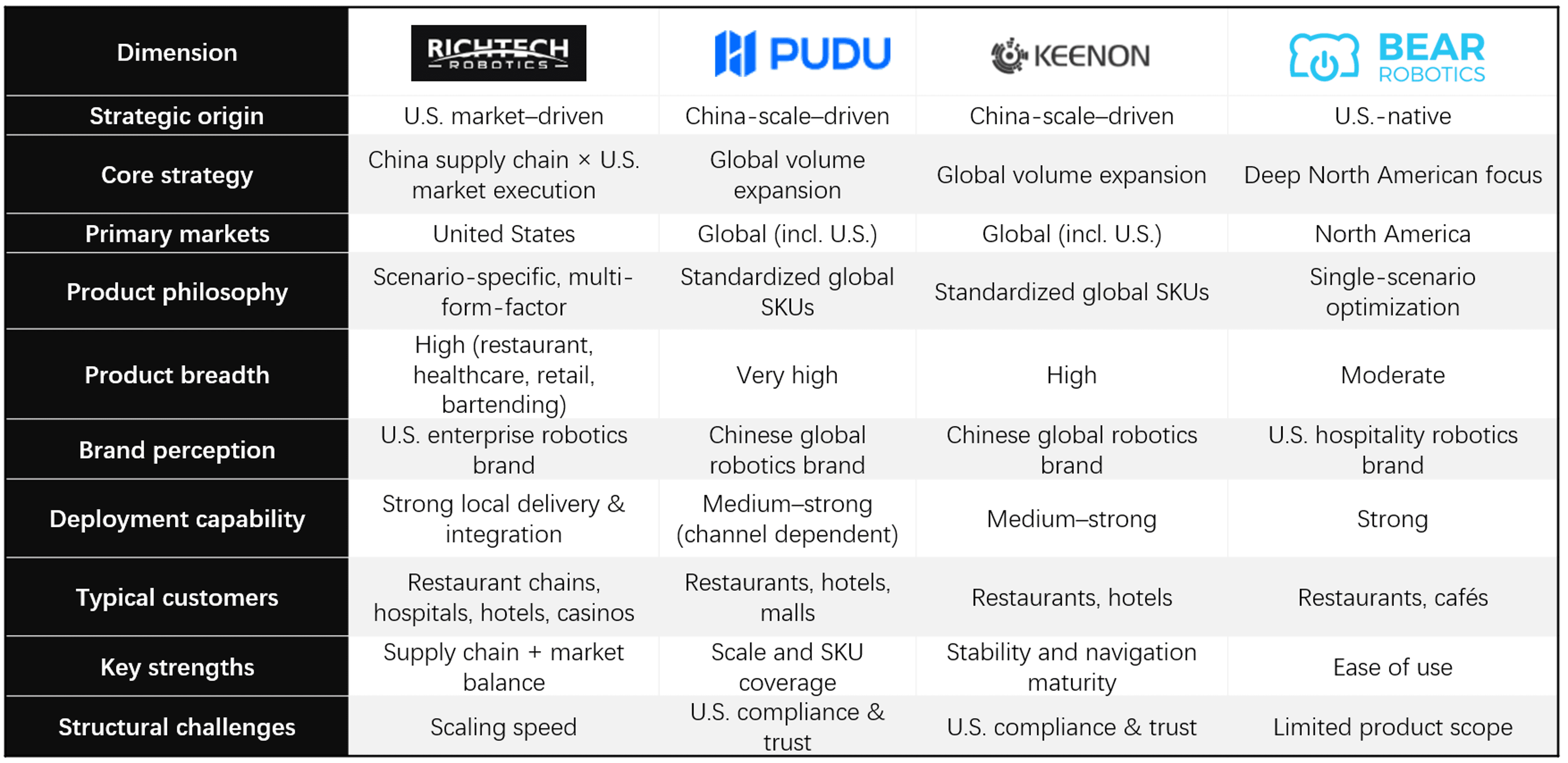
Unlike Pudu Robotics or Keenon Robotics—both of which scaled rapidly in China before expanding globally—RichTech was designed from the beginning around U.S. commercial environments. Restaurants, hospitals, hotels, casinos, and retail venues in the United States face high labor costs, strict compliance requirements, and fragmented operational workflows. RichTech treated these constraints not as obstacles, but as the core design input.
As a result, RichTech evolved less like a traditional “robot manufacturer” and more like a scenario-driven automation company. Its product roadmap followed U.S. customer pain points rather than global SKU standardization. Early deployments focused on narrow but commercially viable workloads—food delivery, bussing, internal hospital logistics, and front-of-house engagement—where robots could reduce labor pressure without disrupting existing operations.
Product evolution through modularization, not reinvention
As deployments increased, RichTech avoided frequent platform resets. Instead, it built a modular AMR technology stack that could be reshaped into multiple form factors. Restaurant service robots (Matradee series), hospital logistics robots (Medbot), heavy-payload indoor transport (Titan), and high-visibility robotic bartenders (Adam, Scorpion) all share common navigation, mobility, and control foundations.
This approach allowed RichTech to expand horizontally across use cases while maintaining engineering continuity. More importantly, it supported faster iteration cycles—an advantage that is difficult to achieve without access to a mature hardware supply base.
Leveraging China’s supply chain without inheriting its branding constraints
RichTech’s relationship with China is primarily industrial, not narrative. Motors, drivetrains, sheet metal, structural components, sensors, and electronics are sourced from China’s deeply optimized robotics and automation supply chain. Cost control, yield stability, and delivery speed are treated as baseline expectations rather than differentiators.
Crucially, these components are not part of RichTech’s brand story. From the customer’s perspective, what matters is not where a wheel motor is manufactured, but whether the robot can be deployed across dozens or hundreds of sites, maintained reliably, and integrated into real operations. China functions as the hardware capability pool; the U.S. remains the center of product definition, system integration, and commercial accountability.
Why the hardest problems are intentionally kept in the U.S.
The real barriers in the American market are not mechanical—they are operational and institutional. RichTech has invested heavily in areas that many hardware-first companies underestimate: regulatory alignment, on-site deployment, staff training, after-sales service, and long-term support contracts.
In healthcare environments, this includes navigation safety, privacy sensitivity, and workflow compatibility. In hospitality and food service, it means working within ADA constraints, fire regulations, narrow floorplans, and high customer traffic variability. RichTech’s value proposition increasingly resembles that of a robotics system integrator with a proprietary platform, rather than a device vendor.
This positioning places RichTech much closer to Bear Robotics in market logic, even though their product portfolios differ significantly.
Building a U.S. brand without “de-Chinaizing” the supply chain
SEC filings show Richtech’s key suppliers are primarily in the U.S. and China, and that it outsources manufacturing of Matradee/MedBot/DUST-E to contract factories, while ADAM body components are manufactured in China and shipped to the U.S. for assembly.
RichTech does not market itself as “non-Chinese,” nor does it emphasize manufacturing geography. Instead, it has largely removed supply chain nationality from the customer conversation altogether. The brand focuses on reliability, scalability, and service continuity—attributes that matter most to enterprise buyers.
In practice, this changes the nature of customer dialogue. While many Chinese-origin brands are frequently asked where they come from, RichTech is more often asked whether it can support a 100-store rollout, meet SLA commitments, or integrate with existing operational systems. That distinction is subtle, but commercially decisive.
Competitive positioning: RichTech vs. Pudu vs. Keenon vs. Bear Robotics
RobotToday perspective: why RichTech matters beyond its own growth
RichTech’s trajectory illustrates a model that is likely to become increasingly important across service robotics and AMR categories. It demonstrates that sustainable growth does not require abandoning China’s manufacturing ecosystem, nor does it require fully reshoring hardware production. Instead, it requires decoupling hardware origin from market trust, and investing where trust is actually created: deployment, service, and accountability.
This “China-origin supply, U.S.-market execution” model is slower than pure export, but far more resilient. As regulatory scrutiny, enterprise procurement standards, and operational complexity increase, companies that master this balance will be better positioned than those relying solely on volume or novelty.
For RobotToday readers, RichTech is less a single-company success story than a reference architecture for how robotics businesses can globalize without losing market credibility.




Leave a comment