


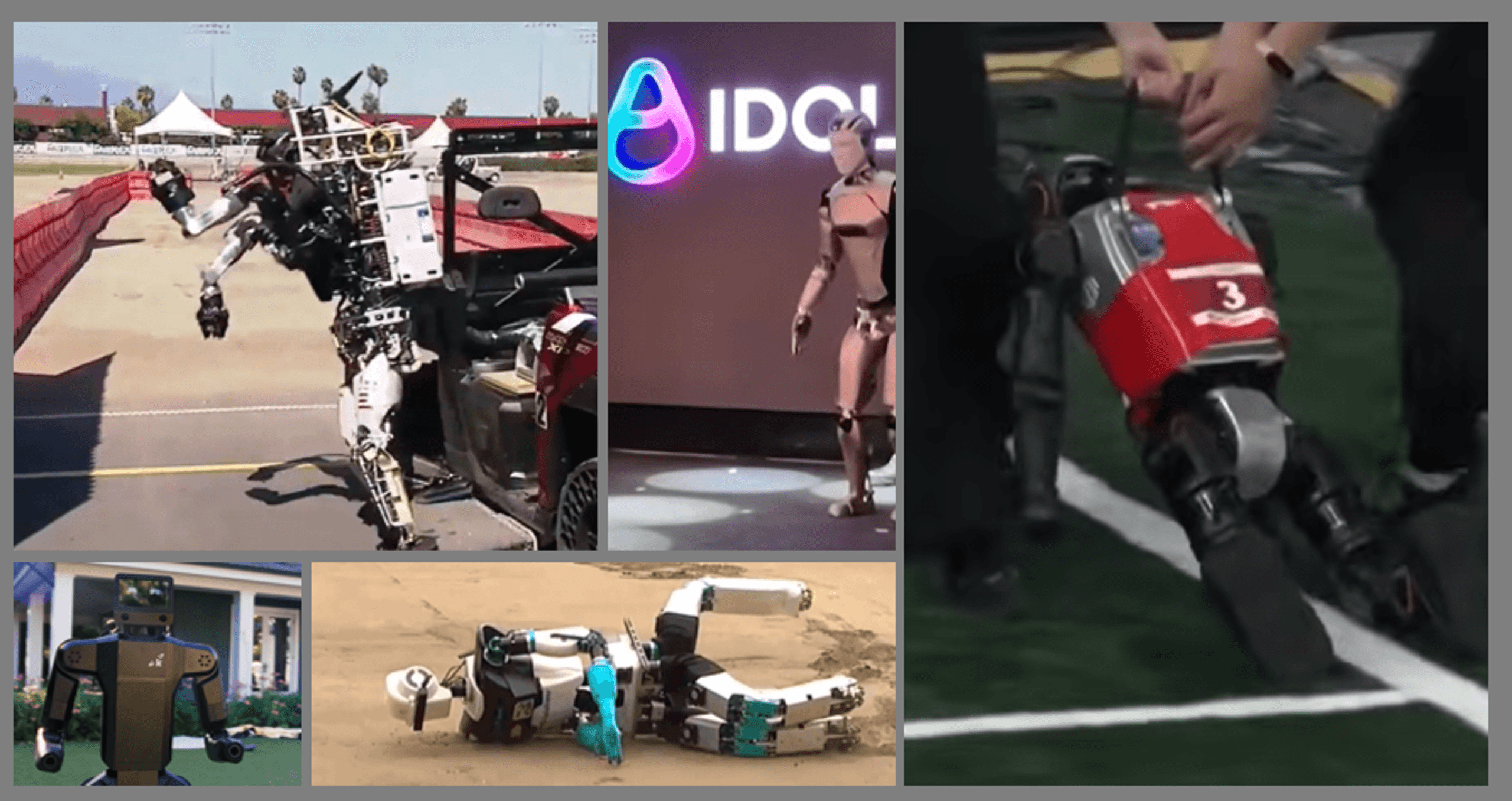
When K-Scale’s CEO admitted they once relied on Amazon-grade LX16 actuators to bring up their early humanoid prototypes—only to discover the MTBF was a few hundred hours and a 30-actuator robot would fail every two weeks—the global robotics community nodded in painful recognition. Because this is not a China-only issue. It is the universal barrier every humanoid team across the U.S., Europe, Japan, Korea, and China is trying to cross.
From Tesla Optimus in California, Agility’s Digit in Oregon, Apptronik Apollo in Texas, Sanctuary Phoenix in Vancouver, Figure 01 in Sunnyvale, Fourier GR-1 in Shanghai, to UBTECH Walker S in Shenzhen—the story is the same: walking, balancing, and manipulation are secondary milestones.
The real bottleneck is reliability.
Tesla’s engineering VP once summarized it bluntly:
“A humanoid that fails every week is not a product—it’s a prototype.”
Reliability is not a later-stage optimization. It is the first gate separating a “cool demo” from an industrial machine someone can trust.
1. The Global Consensus: MTBF, Not Walking Speed, Defines Commercial Readiness
Across all major robotics markets, reliability has become the decisive KPI. Industrial robots from ABB, FANUC, KUKA, and Yaskawa routinely operate with MTBF levels above 50,000 hours. By contrast, most early humanoids struggle to achieve a few hundred hours per joint. McKinsey’s 2024–2025 humanoid robotics report explicitly identifies “sustained uptime” as one of the four bridges required to move humanoids from pilot demonstrations to true scaled deployment.
In the U.S., Agility Robotics has publicly reported 98.5–99% uptime for Digit across multiple customer sites—showing that “industrial-grade humanoid reliability” is achievable, but only with massive engineering investment, real-world testing at scale, and a no-compromise approach to component quality.
The market has shifted as well. Buyers do not ask, “How fast does the robot walk?” They ask, “How many hours can it work per day without breaking?”
Reliability has become the ROI driver, not dexterity or speed.
2. The Real Failure Sources: Global Data Shows Reliability Breaks at the Same Points Everywhere
Decades of field data from U.S. warehouse robots, EU mobile platforms, Japanese industrial arms, and Chinese humanoid pilots reveal a surprisingly consistent pattern. The top reliability killers are the same worldwide: control system errors rank first, mechanical wear in actuators and reducers follows closely, and power or thermal failures complete the list.
AI rarely causes catastrophic failures. Instead, nearly all real-world breakdowns come from mechanical fatigue, loose tolerances, thermal runaway, BMS power cutoffs, sensor drift, or communication faults. This is why Tesla openly states that off-the-shelf actuators are insufficient and why nearly every top-tier humanoid program—from Figure to Fourier—is investing heavily in custom, car-grade electromechanical design.
No matter where the robot is made, the failure patterns converge. And so do the solutions.
3. The Actuator: The Global “Bottleneck of Bottlenecks”
Every global expert agrees: actuators determine whether humanoids can escape prototype purgatory.
A humanoid robot contains 30–40 precision mechanisms, each effectively a micro-scale industrial robot. Japan still dominates precision reducers—Nabtesco’s RV units and Harmonic Drive Systems’ strain-wave reducers lead the world in accuracy, backlash control, and multi-year lifespan. This is why Japanese industrial robots rarely experience critical failures.
Across the Pacific, the same realization has driven U.S. companies toward vertical integration. Tesla’s Optimus team now designs custom motors, reducers, and encoders with automotive-level tolerances. Figure, Sanctuary, and Apptronik are making similar decisions, focusing on torque density, thermal stability, and multi-thousand-hour durability.
China provides the fastest iteration cycles—pushing rapid improvements in motors, harmonic reducers, servo drivers, and integrated joint modules—but reaching industrial reliability requires automotive-grade metallurgy, tolerances, sealing, lubrication, and HALT testing, rather than purely rapid manufacturing.
As one European robotics research director told RobotToday:
“The actuator is where physics sends the bill. Software can’t paper over bad mechanics.”
Across continents, teams are converging on the same truth:
The road to reliable humanoids begins—and often ends—with car-grade actuators.
4. Subsystem Reliability: From “One Failure = Fall Down” to “Graceful Degradation”
The most successful humanoid architectures—across the U.S., Japan, and China—now incorporate a clear principle: a single joint failure must not collapse the entire robot.
This is the dividing line between demo robots and deployable robots. Critical joints such as hips and ankles are redesigned with N+1 redundancy, enabling the robot to continue walking—even if imperfectly—when one actuator or sensor fails. Supercapacitors are increasingly used to bridge BMS cutoffs so that the robot can complete its gait cycle before transitioning into a safe state.
This shift reflects a mindset borrowed from aviation and automotive functional safety:
failure is assumed, so the system must remain controllable when it happens.
Humanoids are evolving into distributed, fault-tolerant cyber-physical systems rather than delicate mechanical showcases.
5. System-Level Reliability: Detect Faults Before They Become Failures
The global reliability trend is shifting toward proactive health monitoring. Leading companies embed vibration sensors, current sensors, IMUs, temperature probes, and multi-channel encoders in each joint. Real-time FFT analysis exposes bearing wear long before a catastrophic failure occurs; torque ripple abnormalities flag gearbox degradation; thermal spikes reveal friction growth or lubrication degradation.
At the network level, EtherCAT and CAN-FD implement heartbeat and CRC validation at high frequency, isolating misbehaving nodes instantly. This transforms humanoids into machines that detect failures early, degrade gracefully, and self-protect rather than collapse.
Predictive maintenance—long a staple of industrial automation—is finally becoming standard in humanoid robotics.
6. Operational Reliability: The Rise of Full-Scale “Robot Destruction Factories”
Every major humanoid robotics leader is now building large-scale testing environments designed to break robots systematically. Agility Robotics invested ten years turning Cassie into Digit through relentless warehouse abuse testing. Scythe Robotics formalized reliability iteration through a scalable testing framework, accelerating hardware generations.
Japanese robotics emphasizes ALT/HALT and HASS testing—temperature shocks, humidity cycling, vibration exposure, and endurance loops. Chinese humanoid teams now operate 24/7 gait farms simulating real warehouse terrain and multi-thousand-hour joint cycles.
Without destructive testing at scale, no company—no matter how well-funded—can produce reliable humanoids.
Testing factories are becoming the ultimate competitive moat.
7. The Global Roadmap: The Five Steps Every Humanoid Company Must Take
Across continents, a consistent “Reliability Stack” has emerged.
First, every component must rise from hobby-grade to automotive-grade. This alone moves joint life from hundreds to thousands of hours. Second, subsystem redundancy ensures catastrophic failures become controllable events. Third, online diagnostics allow robots to predict their own failures. Fourth, power and thermal architecture must prevent sudden shutdowns from turning into physical accidents. And finally, operational efficiency demands ultra-fast field-swappable joints, hands, and batteries, reducing MTTR from hours to minutes.
Together, these steps form the global blueprint for escaping the “two-week failure loop.”
8. RobotToday Final Take: The Reliability War Will Decide the Winners
The humanoid race is no longer about impressive demo videos or rapid gait speeds. It is about which teams can deliver 8–10 hours of stable, repeatable daily operation and bring robots back online within minutes when faults occur.
A humanoid robot is not a clever mechanical toy—it is a fault-tolerant industrial machine whose success depends on disciplines drawn from automotive safety, aerospace redundancy, industrial uptime engineering, and cloud-level diagnostics.
The winners will be the companies that combine automotive-grade actuators, industrial-grade functional safety, predictive diagnostics, fast-swap serviceability, and massive destructive testing infrastructure. These teams will not ship dozens of robots—they will ship tens of thousands.
RobotToday will continue tracking the global Reliability Race—factory by factory, actuator by actuator.









Leave a comment