


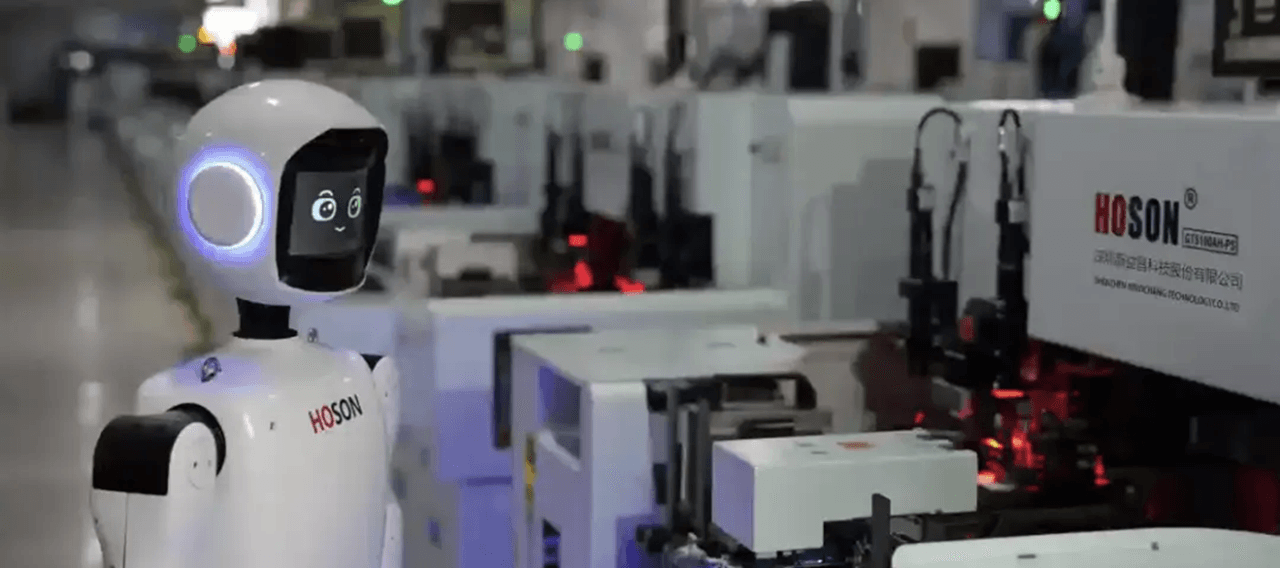
Shenzhen Xinyichang Technology Co., Ltd. officially unveiled its embodied intelligence robot, HOSON-Robot.
From the demonstration video, the robot adopts a wheeled humanoid form factor. It integrates Xinyichang’s fully self-developed “cerebellum” motion controller, dexterous hands, and joint modules, enabling intelligent operations such as material picking, extraction, placement, and fixation.
This launch represents more than the debut of a single product. It is a strategic declaration by a company that has spent years deeply rooted in high-precision semiconductor equipment manufacturing and is now making a decisive move into the humanoid robotics arena.
Xinyichang has stated that humanoid robotics has been elevated to a core strategic growth direction. Following the release of the first-generation HOSON-Robot and upcoming small-batch production, the company plans continuous iterative upgrades of the platform.
Technical Foundations and Equipment Legacy
Xinyichang’s move into humanoid robotics is not a spur-of-the-moment, trend-driven experiment. Rather, it is a natural extension of more than a decade of accumulated expertise in semiconductor manufacturing equipment.
As a leading domestic provider of intelligent manufacturing equipment for semiconductor and new-display packaging as well as capacitor aging test systems, Xinyichang has built strong capabilities in product quality, technological innovation, and high-efficiency service delivery. Over the years, it has established a robust cooperative ecosystem with leading customers across industries, including Huawei, JCET, CSOT, BOE, Huatian Technology, AiHua Group, and Jianghai Capacitor.
Both in terms of technical depth and ecosystem resources, Xinyichang’s long development trajectory has already laid the groundwork for entering the humanoid robotics field, forming a distinctive competitive barrier.
In semiconductor equipment, Xinyichang’s capabilities have been thoroughly validated by the market. Its products demand extreme precision, real-time motion control, and long-term stability—requirements that closely overlap with the core technical needs of humanoid robots and can be directly translated into “hard-core” robotic capabilities.
Lithium battery equipment, a rapidly growing business for Xinyichang in recent years, is also central to humanoid robots as a power source. In this area, the company has closely followed market trends and continues to deepen its strategy in solid-state battery key equipment, particularly in sheet fabrication and winding processes. With their high energy density, compact size, and superior safety, solid-state batteries may become a next-generation energy solution for humanoid robots.
In addition, Xinyichang has already achieved in-house development and manufacturing of core components for some of its intelligent manufacturing equipment, including drives, high-precision read heads, linear motors, and voice-coil motors. It is among the few domestic equipment manufacturers with end-to-end capabilities in independent R&D and production of critical components.
These accumulated capabilities provide a solid foundation for technology transfer and adaptation into robotics.
Strategic Positioning and Product Architecture
Xinyichang’s formal pivot toward robotics can be traced back to the establishment of its robotics subsidiary.
On May 23, 2025, the company founded Xinyichang Robotics, focusing on AI R&D as well as the manufacturing and sales of various robots. Leveraging its existing manufacturing capacity and motion-control expertise, the subsidiary is dedicated to developing and optimizing the robot “cerebellum” responsible for trajectory planning and motion control, along with other key robotic components.
This business layout clearly indicates that Xinyichang had already prepared for entry into the humanoid robot space at that time. Following the subsidiary’s establishment, the company officially added the “robotics concept” to its corporate profile.
With this shift, investor perception of the company has also evolved, laying a solid foundation for deeper and longer-term investment in robotics.
Thanks to its prior technical accumulation, Xinyichang’s embodied intelligence robot has already reached leading-edge performance in multiple dimensions.
At the core of HOSON-Robot is Xinyichang’s self-developed embodied intelligence “cerebellum” controller, RMC100. Based on a multi-core heterogeneous architecture, it integrates four key capabilities—motion control, multi-protocol communication, obstacle-avoidance perception, and remote maintenance—breaking through full-stack control bottlenecks in complex environments.
RMC100 supports synchronous control of up to 64 joint motors, achieving control frequencies of up to 4 kHz while maintaining synchronization errors below 100 ns. This enables rapid motion response and provides stable support for high-intensity, high-precision operations.
The dexterous hand, built upon Xinyichang’s self-developed high-precision DDR motors, motion-control cards, and integrated controllers, serves as the key enabler of fine manipulation. Based on a screw-theory kinematic model, it achieves millisecond-level real-time computation and fuses tactile, torque, and positional data to deliver high-precision grasping control.
The dexterous hand has already completed preliminary adaptation for industrial scenarios. With its scenario-adaptive control strategies, it is expected to expand into a broader range of applications.
Lightweight joint module design underpins the robot’s mobility. Xinyichang’s self-developed joint modules feature compact size, low weight, and high power density. They integrate high-value shock-resistant gear reducers, high-precision encoders, frameless motors, and integrated drives. This coordinated design allows HOSON-Robot to maintain precise positioning while delivering high overload output.
Notably, the joint drive adopts vector control and end-effector vibration suppression technologies, ensuring both speed and precision in robotic motion.
By innovating synergistically on top of its existing technology base, Xinyichang has rapidly achieved breakthroughs while controlling costs and ensuring strong alignment between product capabilities and real-world scenarios—forming a technological moat that is difficult to replicate. Looking ahead, the company plans to establish a normalized R&D iteration mechanism, continuously advancing its robot “cerebellum” controllers, hybrid intelligence architectures, and critical components.
Conclusion and Outlook
According to previously disclosed plans, Xinyichang has a clear roadmap for its robotics strategy. The company is expected to release a bipedal humanoid robot after New Year’s Day 2026, targeting both industrial assembly and daily-life service scenarios.
Xinyichang’s actions offer a practical blueprint for entering the humanoid robotics field: build on core strengths, focus on concrete application scenarios, define a clear roadmap, and address industry pain points through independent control of core technologies.
In a broader sense, Xinyichang’s humanoid robot initiative reflects China’s manufacturing transformation and upgrade. When enterprises move beyond a single track and pursue cross-domain breakthroughs, they may chart new paths for extending core capabilities into future industries.




Leave a comment