


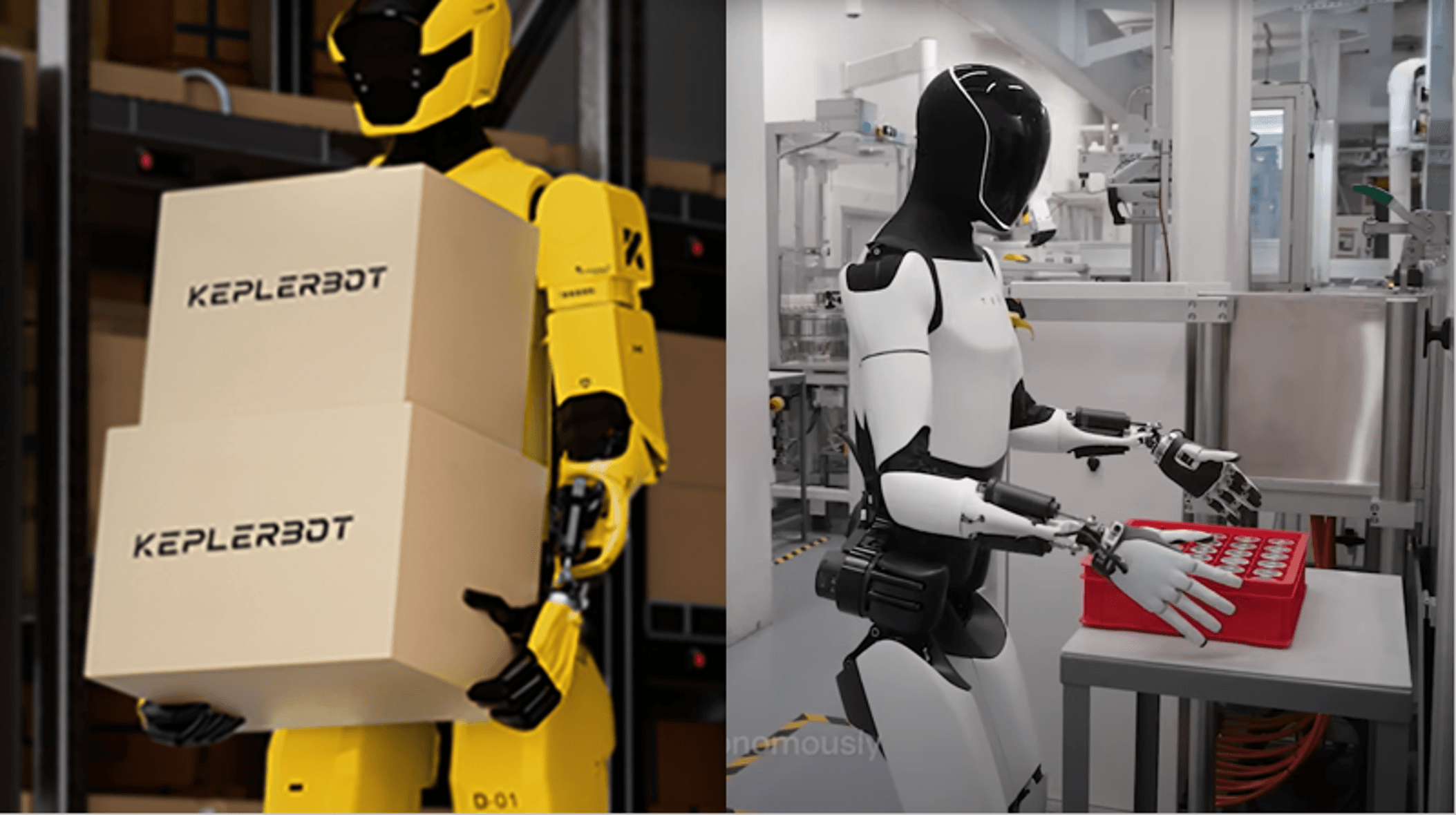
Tesla’s latest shareholder meeting reignited debate over the industrial future of humanoid robots.
CEO Elon Musk announced plans to rapidly expand production capacity — starting with a one-million-unit line in Fremont and scaling to ten million in Texas — and confirmed that Optimus Gen3 is expected to reach production readiness in 2026.
Although Musk avoided giving a firm mass-production date, the statement underscored a growing race among developers of hybrid-architecture humanoids — a configuration combining linear actuators with rotary joints to achieve human-like motion.
Hybrid Architecture Becomes the Core Contest
Tesla’s Optimus, XPeng’s IRON, and Kepler Robotics’ K2 Bumblebee all employ a mixed linear-rotary actuation system.
This design enables smoother gait control and fine manipulation, allowing robots to perform both industrial handling and precise assembly tasks.
Tesla has demonstrated early factory deployments in parts sorting and vehicle body assembly, validating the industrial promise of this approach.
Yet only a handful of companies have reached meaningful commercialization milestones. XPeng plans to begin scaled production by late 2026, while Tesla has started pilot runs in Fremont.
Kepler Robotics, a lesser-known but technically ambitious entrant, became one of the first to bring a hybrid-architecture humanoid to market with its K2 Bumblebee, priced from RMB 248,000 (~USD 34,000).
Engineering Approach and Actuator Design
To address the mechanical challenges of hybrid actuation, Kepler’s engineers developed an in-house planetary roller-screw actuator, improving load-bearing capacity and efficiency over conventional ball-screw systems.
The K2 can perform stable, straight-knee walking — a benchmark for dynamic balance in humanoids — and maintain high precision under complex multi-joint loads.
The system integrates torque-controlled linear motors and reinforcement-learning algorithms for adaptive gait transitions in uneven environments.
Its forearm and hand system, the Nimble Master, provides 11 degrees of freedom and 25 tactile sensors per finger, supported by a six-axis force-sensing wrist.
The result is fine-grained manipulation suitable for button pressing, tool handling, or inspection tasks, approaching early industrial-grade dexterity.
Efficiency and Industrial Readiness
The roller-screw transmission achieves 81.3% mechanical efficiency, enabling one-hour charging for up to eight hours of operation.
Dual-arm payload capacity reaches 30 kg, while low-noise operation and reduced wear extend lifespan several times beyond standard ball-screw systems — traits that position the K2 for factory deployment rather than laboratory demonstration.
AI Stack and Developer Ecosystem
While hardware determines motion capability, software defines intelligence.
Kepler has built a proprietary software stack integrating a hierarchical VLA+ language–action model, allowing the K2 to interpret natural-language commands and execute multi-step tasks.
Training combines simulation and physical-robot data to improve motion planning and task generalization.
The company also unveiled Kepler Studio, a one-stop developer platform presented at the 2025 IEEE/RSJ IROS Conference.
The platform offers APIs for motion control, vision, navigation, and speech, as well as digital-twin simulation and block-based task programming tools.
Developers can design industrial scenarios via drag-and-drop or code-level access, reducing programming barriers for automation use cases.
A tiered toolchain supports both non-technical users and experienced programmers, while built-in multi-layer safety modules ensure safe testing and deployment.
Kepler has also launched a “Lighthouse Initiative” to foster collaboration with global developers and component suppliers, linking technical R&D with commercial implementation.
Ecosystem and Commercial Deployment
Kepler has established partnerships with Chinese component suppliers and automotive companies — including Inovance, Hanwei Technology, Keli Sensing, and Zhaofeng Components — to secure upstream support for its hybrid-actuator supply chain.
On the application side, the K2 has already been tested in real-world factory environments such as SAIC-GM, and joint deployments are being explored with Furen De Manufacturing and TaoTao Vehicles for overseas markets.
The company reportedly completed three funding rounds in the past six months, backed by seven publicly listed firms from the automotive and robotics industries.
Conclusion
As Musk projected, scaling production to the million-unit level could bring per-robot costs down to around USD 20,000 — transforming humanoids from prototypes to mass-market industrial tools.
While Tesla’s large-scale rollout remains a year away, Kepler’s early production start signals that hybrid-architecture humanoids are moving from laboratory development toward practical deployment.
About Kepler Robotics
Kepler Robotics, headquartered in Shenzhen, China, specializes in hybrid-actuation humanoid systems and high-precision mechatronic components such as roller-screw actuators and dexterous robotic hands.
The company integrates AI control, motion planning, and developer-platform tools to accelerate industrial adoption of humanoid robots worldwide.
www.gotokepler.com





Leave a comment