

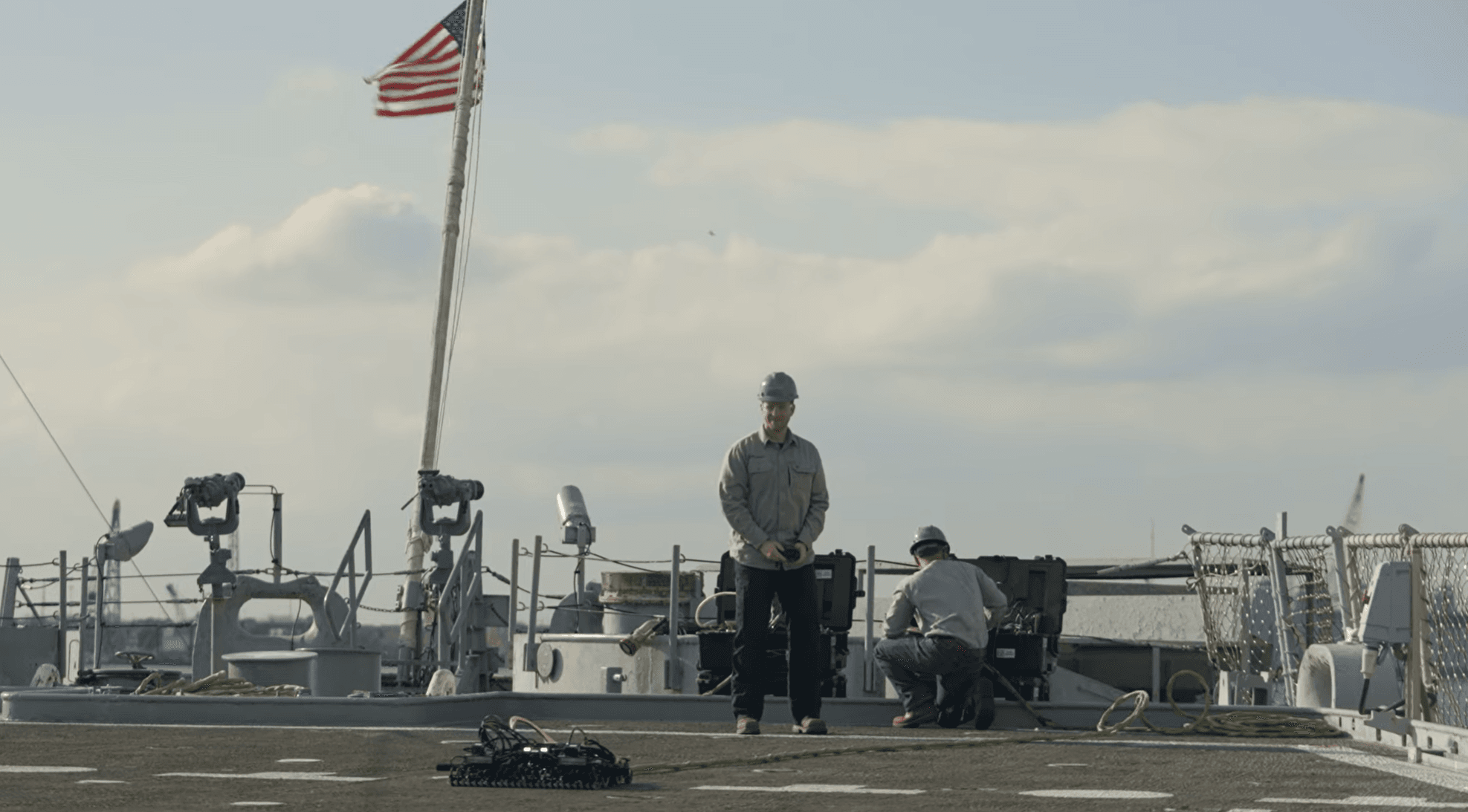
The U.S. Navy and GSA awarded Gecko Robotics a five-year, $71 million IDIQ contract on 17 March 2026 to deploy AI and robotics across the Pacific Fleet, beginning with 18 ships under an initial award of up to $54 million. The vehicle is government-wide — every branch of the U.S. military can access it without a separate procurement cycle. On paper it is a robotics deal. In practice it is a bet that naval readiness can be software-defined.
The Chief of Naval Operations has set a public target of 80% fleet readiness by 2027. Reaching that benchmark through conventional means — periodic manual inspections, reactive repair cycles, siloed maintenance records — is not credible. Gecko's pitch is a structural replacement for that model, not an upgrade.
What Gecko's System Actually Does
Gecko operates in three integrated layers. Wall-climbing robots, drones, and fixed sensors gather high-resolution data from hulls, flight decks, ballast tanks, and welds — environments where human access is constrained, slow, or hazardous. That data feeds AI models trained on large-scale infrastructure datasets, capable of detecting micro-defects invisible to the naked eye. The output lands in Cantilever, Gecko's operating platform, which converts inspection data into continuously updated digital twins of physical assets.
The company says its technology identifies repairs up to 50 times faster and more accurately than manual methods. U.S. Navy data cited by Gecko shows that a single robotic evaluation of a flight deck eliminated more than three months of potential maintenance delay for a single vessel. At fleet scale those gains compound quickly.
Cantilever is not a data warehouse. It integrates inspection, maintenance, and logistics information into a unified planning layer, allowing the Navy to anticipate failures, scope repair work before ships enter drydock, and pre-position the parts and labour required. The system shifts operations from reactive maintenance to predictive readiness management.
"Readiness isn't just a metric, it's all that matters."
— Jake Loosararian, Co-founder & CEO, Gecko Robotics
The Readiness Gap Is a Strategic Constraint
The Navy's maintenance backlog is not an administrative inconvenience. Vessels unavailable for deployment reduce strategic flexibility, inflate lifecycle costs, and create pressure on shipyards operating near capacity. Every month a destroyer waits for repairs is a month it is not deployable.
Traditional inspection methods compound the problem. Issues surface too late. Repair scope is underestimated before docking. Data sits in separate systems across programmes. Gecko reports a 90% reduction in inspection span and a 40% increase in throughput at partner facilities in the Defence Industrial Base. Those figures would represent a material shift in how maintenance cycles consume time and budget.
Gecko has worked across the Navy's surface fleet since at least 2023, covering destroyers, amphibious ships, aircraft carriers, and Virginia- and Columbia-class nuclear submarine programmes. The IDIQ structure allows expansion to Air Force, Army, and other customers without re-running procurement.
Key Performance Figures (Gecko Robotics / U.S. Navy data)
50× faster defect identification vs. manual inspection
90% reduction in inspection span
40% throughput increase at DIB partner facilities
3+ months maintenance delay eliminated per vessel (flight deck case)
2 weeks reduction in maintenance backlog per ship
Sources: Gecko Robotics press release, geckorobotics.com/defense
Why Commercial-First Matters
Gecko did not develop its AI models inside a defence laboratory. Before the Navy relationship, the company deployed inspection technology across power generation, oil and gas, steel, and heavy manufacturing. That commercial track record provides two things a pure defence vendor cannot easily replicate: large, diverse training datasets across varied materials and degradation patterns, and a proven ROI case in high-stakes, non-military environments.
Iterating in commercial markets also shortens development cycles. Quarterly pressure to deliver measurable results forces technical refinement that classified programme structures tend to slow. The defence application inherits those improvements.
"We're now seeing solutions that move the needle on outcome metrics not by percentage points but by orders of magnitude."
— Justin Fanelli, CTO, Department of the Navy
Platform Architecture, Not Robotics Products
The Gecko stack separates into three functions: data acquisition (robots, drones, fixed sensors), interpretation (AI models detecting and prioritising defects), and decision support (Cantilever, turning outputs into maintenance and logistics planning). Each layer has value independently. Combined, they create a dependency that deepens over time as the platform accumulates fleet-specific data and the AI models grow more accurate.
Standalone inspection robots are a commodity. What commands a premium — and generates operational lock-in — is the intelligence layer. Cantilever is the accumulation of inspection history, defect patterns, and predictive models across every vessel it has assessed. The longer it runs, the harder it is for a competitor to offer an equivalent.
Aviation maintenance, energy grid monitoring, and data centre operations have all followed this trajectory: from periodic human checks to continuous, AI-mediated condition awareness. Defence infrastructure is a later adopter, partly for institutional reasons and partly because the stakes make experimentation expensive. The IDIQ structure manages that risk by allowing the Navy to expand scope incrementally as the value case strengthens.
Market Implications
The Gecko contract has several read-across implications for the defence robotics market:
Digital twins move from pilot to infrastructure. The technology is no longer being evaluated — it is being embedded in operational planning for the most complex assets the U.S. military maintains.
Platform lock-in is a real competitive moat. As Cantilever accumulates fleet-specific data, switching costs for the Navy rise. This dynamic will influence how other defence buyers structure future technology agreements.
Dual-use is now the preferred entry point. Defence buyers are increasingly receptive to companies that demonstrate the technology at commercial scale before seeking military contracts. A pure prime-contractor positioning becomes harder to defend.
The IDIQ vehicle enables lateral expansion. Air Force airframes, Army ground vehicles, missile silo monitoring, and POL storage are listed active application areas on Gecko's defence platform. The contract architecture removes the procurement barrier to each.








Leave a comment