


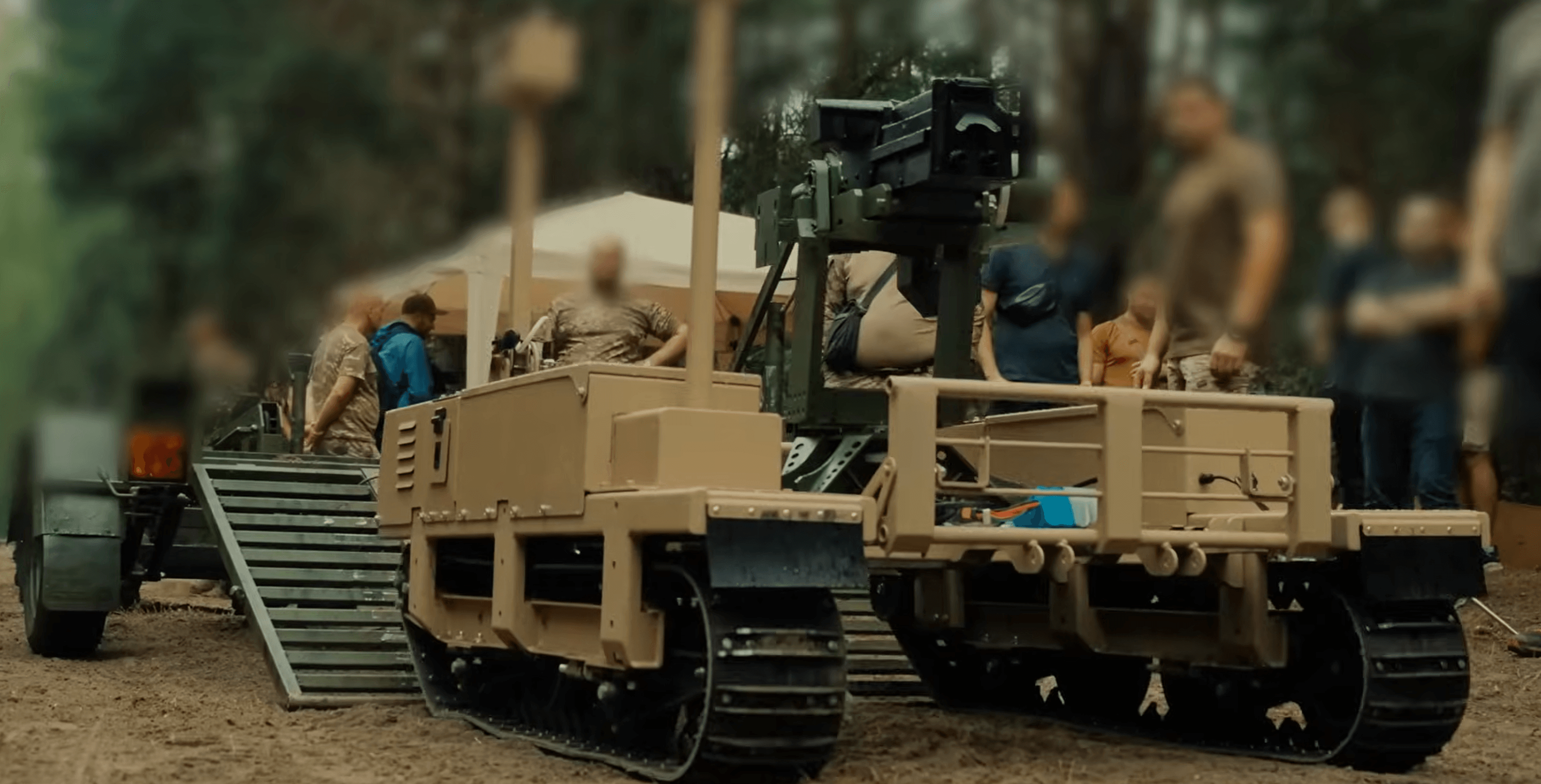
The ground domain is the last frontier of autonomous systems — harder to navigate than air, harder to jam-proof than sea, and harder to automate than either. Yet the war in Ukraine has produced the world’s largest real-world UGV deployment in history, compressing what would have been a decade of peacetime procurement and testing into two years of combat iteration.
The lesson emerging from that experience is not that ground robots will replace infantry — they will not, not this decade — but that they are already reshaping the economics of attrition on the ground: extending the kill zone, removing humans from the most lethal supply runs, and holding positions that no soldier should have to hold.
Introduction: The Robot at the Zero Line
In the forest belts near Pokrovsk, in eastern Ukraine, a small tracked vehicle called the TerMIT crawls along cratered roads in the dark. It carries 150 to 200 kilograms of ammunition, food, and water to positions where any other form of delivery — pickup truck, armoured vehicle, human runner — would result in near-certain casualties. Russian fibre-optic drones, which cannot be jammed because they transmit down a physical cable rather than via radio, have extended the kill zone deep into the Ukrainian rear. In sectors like Pokrovsk, Avdiivka, and Kupiansk, carriers of supplies face a 70 to 90 percent probability of death or wounding. The TerMIT does not bleed.
This is not a future scenario. It is current operational reality. By November 2025, the BBC reported that up to 90 percent of all supplies to Ukrainian front-line positions around Pokrovsk were being delivered by unmanned ground vehicles. Ukraine’s Ministry of Defence announced it had surpassed all UGV procurement targets in 2025, delivering over 15,000 units to the front — a figure that exceeds the total UGV inventory of every other military on earth. Plans for 2026 target 20,000 units or more.
The ground robotics story of 2025–2026 is simultaneously one of extraordinary battlefield innovation in Ukraine and of frustrating institutional inertia in the United States — a contrast that defines the current state of the global UGV competition.
Sources: Atlantic Council, January 2026; Jamestown Foundation, January 2026; New Voice of Ukraine, January 2026
15,000+ UGVs deployed by Ukraine (2025) | 20,000+ Ukraine target 2026 | 90% Pokrovsk supplies by UGV (Nov 2025) | 270+ Ukrainian UGV companies | 200 UGV models in production |
I. Ukraine’s UGV Revolution: 15,000 Robots and Counting
The numbers are almost impossible to contextualise against the baseline of conventional military procurement. In 2024, Ukraine produced approximately 2,000 UGVs. By end-2025, the Ministry of Defence had delivered 15,000 to frontline units — a 650 percent increase in a single year. More than 270 Ukrainian companies are now developing UGVs, producing over 200 distinct models. Ninety-nine percent of platforms are manufactured domestically. The Brave1 defence-innovation marketplace — Ukraine’s government-backed procurement accelerator — lists over 60 UGV models and variants across logistics, mine-clearance, minelaying, combat, and evacuation roles.
The Logistics Imperative
The primary driver of Ukraine’s UGV surge is not combat but supply. As Samuel Bendett of CNAS has noted, full autonomy for ground combat remains distant — but logistics UGVs require only reliable navigation on fixed routes and enough electronic warfare resilience to complete a delivery run. Ukraine’s operators discovered that a small vehicle crawling along cratered roads is a far less visible target to thermal optics than a truck. Once Starlink Mini terminals became available in early 2025, communications range stopped being a constraint. Operators can now control UGVs remotely from 10 kilometres away using first-person video.
The economics are stark. A typical logistics UGV costs between $15,800 and $18,400 and survives approximately seven to eight trips before being hit or breaking down. Each mission costs roughly $2,000 to $2,300 — approximately the price of a single quadcopter drone. For that, 150 to 200 kilograms of cargo reaches a position where sending a human would be suicidal. The decision mathematics, at the front-line level, are not complicated.
Combat Roles: Emerging but Not Yet Decisive
Ukraine has pushed UGVs into combat roles with increasing ambition, though with more mixed results than in logistics. In late 2025, the Ukrainian military made what its officials described as history: a single land drone armed with a mounted machine gun held a front-line position for 45 days, undergoing maintenance and reloading every 48 hours. ‘Only the UGV system was present at the position,’ said Mykola Zinkevych of Ukraine’s Third Army Corps. ‘This was the core concept. Robots do not bleed.’
In January 2026, a DevDroid Droid TW-7.62 — a reconnaissance and strike UGV built on the NUMO platform — was used to capture three Russian soldiers in eastern Ukraine, the first documented case of a UGV effecting a prisoner capture in combat. Armed UGVs have also demonstrated anti-armour capability: a large-calibre machine gun-equipped UGV of Ukraine’s 5th Separate Assault Brigade disabled an MT-LB armoured personnel carrier in a night operation in November 2025.
The Economist noted in June 2025 that over 200 UGV models were in Ukrainian production, with 40 new variants appearing that year alone. Each iteration incorporates front-line feedback in a cycle measured in weeks, not the years that characterise Western procurement programmes. The Brave1 marketplace has tested over 70 ground robotic vehicles from 50 manufacturers under combat-like conditions; most exceeded benchmarks.
“This is no longer science fiction. It’s a tool of war.”
— ‘Oleksandr,’ UGV commander, Antares Battalion, Rubizh Brigade, August 2025
The Kill Zone Is Expanding
Vadym Poritskyi, a leading Ukrainian UGV developer, predicts that by late 2026 the ‘kill zone’ — where any movement is under effective fire — will expand from its current 20 kilometres to 50 kilometres. If that trajectory holds, the entire concept of forward logistics using human-driven vehicles collapses. The front line becomes a domain accessible only to unmanned systems. His vision of the battlefront in two to three years is unambiguous: ‘The first line will be robots only. Humans will stay back — maintaining, repairing, replacing.’
Western Companies in Ukraine
German company ARX Robotics has secured a contract to deliver its GEREON UGVs to Ukraine — a deal described by analysts as paving the way for the world’s largest networked military ground robot fleet. ARX Robotics has also partnered with Helsing, Europe’s leading AI defence startup, to develop integrated AI-based reconnaissance and strike networks combining drones and UGVs. French company Alta Ares is building turbojet interceptor drones with Ukrainian company Tenebris. As of April 2025, 55 Ukrainian UGVs had been codified to NATO standards through the Brave1 programme.
The strategic implication is significant: Ukraine is not merely a consumer of Western defence technology. It is generating the most valuable real-world UGV development dataset on earth, and Western companies that establish joint manufacturing and procurement relationships with Ukrainian operators gain access to combat-validated performance data that no test range can replicate.
Sources: Jamestown Foundation, January 2026; New Voice of Ukraine, January 2026; Atlantic Council, January
II. The U.S. Programme Landscape: Mules, Cancelled Tanks, and a Fresh Start
The United States Army’s approach to unmanned ground vehicles in 2025–2026 is a study in contrasts: genuine progress on logistics platforms, significant investment in autonomy software, and a high-profile cancellation of its flagship combat vehicle programme at a cost of years of development and hundreds of millions of dollars.
S-MET: The Mule That Works
The Small Multipurpose Equipment Transport (S-MET) is the Army’s principal in-service UGV — a radio-controlled, eight-wheeled platform designed to carry equipment, generate power, and operate without constraints across rough terrain. The first increment, delivered by General Dynamics Land Systems under a $249 million contract, entered service in 2022 and fields 624 units. It can carry up to 450 kilograms and operate as a controllerless follower, by remote control, or semi-autonomously.
Increment II is now in competitive prototype evaluation. In September 2024, the Army awarded $22 million in contracts to two teams — American Rheinmetall Vehicles (in partnership with Textron Systems) and HDT Expeditionary Systems — for eight prototypes each. Key upgrades include doubling payload capacity to 900 kilograms, improved electronic warfare resilience, a dismounted wireless mesh communications network, and a modular open architecture for mission payload integration. If prototype testing proceeds on schedule, a production contract is targeted for late FY2027, with an Army acquisition objective of up to 2,195 units.
In parallel, Textron Systems has joined AM General and Carnegie Robotics in developing the Medium Modular Equipment Transport (M-MET) — a next-generation autonomous logistics platform designed to close supply gaps between Brigade Support Areas and dispersed forward units. The M-MET request for proposal is expected in 2026.
The RCV Cancellation: A Cautionary Tale
The Army’s Robotic Combat Vehicle programme — designed to field an unmanned armed ground platform capable of operating alongside manned units in direct combat — was cancelled in May 2025 as part of an 8 percent budget reduction exercise. The cancellation came despite a competition winner having already been identified: Textron Systems’ Ripsaw 3. Programme Executive Officer Major General Glenn Dean stated the reason plainly: ‘We don’t want to downselect just to one vendor and pay almost $3 million per copy.’
The RCV’s failure illuminates a structural problem that extends beyond any single programme. The hardware — the tracked chassis, the weapons mount, the sensor suite — was engineered to a high standard. What generated the cost and complexity that killed it was software: autonomous navigation in off-road environments, electronic warfare resilience, and interoperability with Army command networks. The Senate Armed Services Committee had already noted that ‘multiple commercial products’ offering ‘advanced ground autonomy’ existed and urged the Army to ‘reexamine its funding decisions.’ The Army’s own Robotic Technology Kernel autonomy package was slower, more expensive, and less capable than what was available off-the-shelf.
“We need robotic combat vehicles, but we want a consortium of vendors to bring their robotics and the best software folk. We don’t want to downselect just to one vendor and pay almost $3 million per copy.”
— Maj. Gen. Glenn Dean, Program Executive Officer, Ground Combat Systems, May 2025
In August 2025, the Army announced a new competition under a new name, targeting a price cap of $650,000 per unit — less than a quarter of the RCV’s projected cost. The new programme explicitly invites a consortium approach and prioritises off-the-shelf autonomy software over custom Army-developed solutions. It is, in essence, an admission that the previous decade of RCV development got the cost equation wrong, and that Ukraine’s $5,000–$50,000 combat UGVs — built in garages, iterated in weeks, and tolerated as attritable — have reframed what ‘acceptable’ looks like.
Overland AI and the Autonomy Software Gap
The RCV’s implosion has created a clear market signal: the bottleneck in ground autonomy is not hardware, it is software. Overland AI, a San Francisco-based startup founded by veterans of Waymo and Zoox, has positioned itself to fill that gap with its OverDrive autonomy stack — designed for off-road, GPS-contested, electronically degraded environments. Overland AI’s approach treats the autonomy layer as a separable software product that can run on multiple vehicle platforms, avoiding the single-vendor lock-in that undermined the RCV.
Sources: Breaking Defense, May and August 2025; Defense Update, October 2024; Army Recognition; Unmanned Systems Technology, October 2025; CRS RCV Programme Report IF11876, 2025
III. Quadrupeds: The $3,000 Problem
If the logistics UGV is the most operationally validated ground robot of 2025–2026, the quadruped — the four-legged ‘robot dog’ — is the most geopolitically significant. The reason is a price gap that no Western programme has yet resolved: Unitree’s GO2 Pro quadruped, manufactured in Hangzhou, China, retails for approximately $3,000. Boston Dynamics’ Spot costs $75,000. Ghost Robotics’ Vision 60, purpose-built for military applications, costs significantly more. The cost differential is not merely a procurement nuance — it is a proliferation risk.
Ghost Robotics Vision 60: The Western Military Standard
Ghost Robotics’ Vision 60 has established itself as the primary quadruped platform for U.S. military applications. It is deployed by the U.S. Air Force for airbase perimeter security and by the Marine Corps for reconnaissance. The Vision 60 operates in GPS-denied environments using SLAM-based navigation, endures rain, snow, and extreme temperatures (−40°C to +55°C), and offers three hours of continuous walking or 21 hours of standby. In December 2025, Ghost Robotics unveiled a Manipulator Arm for the Vision 60 — six degrees of freedom, force-sensitive, modular — expanding the platform from sensor-and-observe to interact-and-manipulate.
The Vision 60 has also been demonstrated in an armed configuration with an AR-15-type rifle mounted on a front turret and an electro-optical targeting system. Ghost Robotics is explicit that both the weapon and the vehicle require manual operation — the limited autonomy present is confined to obstacle avoidance and waypoint navigation, not targeting decisions. South Korea’s LIG Nex1 has developed quadruped platforms in partnership with Ghost Robotics’ broader technology ecosystem, with significant R&D investment in counter-UAS and perimeter defence applications.
Unitree and the PLA: The Proliferation Problem
Unitree has signed pledges not to weaponise its robots. It has also, apparently, watched the PLA do exactly that with its hardware. State-owned CCTV footage from May 2024 showed Unitree B1 quadrupeds in joint exercises between China and Cambodia, working alongside armed quadcopters in urban assault simulations. ‘It can serve as a new member in our urban combat operations, replacing humans in reconnaissance and target strikes,’ a Chinese soldier told CCTV.
By 2025, Unitree’s CEO Wang Xingxing had shaken hands with Xi Jinping at a February state meeting — photographed alongside Huawei’s CEO. Procurement records analysed by Kharon show Unitree products sold to nearly 30 Chinese universities with long-running ties to the PLA and military-AI research. Under Beijing’s March 2025 rules restricting publication about the military, Unitree is legally prohibited from disclosing details of PLA use of its systems even if it wished to.
The strategic implications are stark. Unitree may control approximately 70 percent of the global quadruped market. A Unitree GO2 Pro costs $3,000; an assault rifle costs under $500. China has demonstrated drone-deployed robot dogs — quadrupeds dropped from heavy-lift drones that activate upon landing and begin patrolling or engaging. There is no Western equivalent of this concept at scale. IEEE Spectrum noted in January 2026 that Ghost Robotics, which manufactures domestically, will require sustained U.S. government support to compete with Chinese-subsidised production.
Sources: Kharon, October 2025; IEEE Spectrum, December 2025 and January 2026; 24/7 Wall St., October 2025; Ghost Robotics product data; Defense Post, August 2024
Quadruped Comparison: Key Parameters (2025–2026)
| Platform | Origin | Unit Cost | Battery Life | Primary Role | Military Status |
| Ghost Robotics Vision 60 | USA | ~$150K+ | 3h walk / 21h standby | Perimeter, ISR, lethality | In service: USAF, USMC |
| Boston Dynamics Spot | USA | ~$75,000 | ~90 min active | ISR, inspection, EOD | Limited DoD use |
| Unitree GO2 Pro | China | ~$3,000 | ~2–5 hours | Commercial / PLA exercises | PLA (MCF pathway) |
| LIG Nex1 (Ghost-derived) | South Korea | Undisclosed | Comparable to V60 | Perimeter, counter-UAS | ROKA development |
IV. Humanoids: The Long Game
The humanoid robot — two legs, two arms, designed for the environments humans built for themselves — remains the most technically ambitious category in ground robotics, and the one furthest from operational reality. Yet it is advancing faster than most defence analysts anticipated, and its military rationale is specifically grounded in the environments where wheeled and tracked UGVs fail: stairwells, rubble, narrow corridors, and CBRN (chemical, biological, radiological, nuclear) contamination zones.
Foundation Phantom MK1
Foundation FFI’s Phantom MK1 is the most advanced humanoid platform with confirmed DoD contracts. At approximately $150,000 per unit — roughly the price of a Ghost Robotics Vision 60 — it is designed explicitly for military and first-responder environments. The Phantom MK1 is CBRN-capable, can climb stairs and navigate rubble, and is engineered to operate as a ground swarm node: a platform that can reach locations inaccessible to aerial drones or wheeled UGVs. Foundation has secured $10 million in initial DoD contracts and is targeting a production run of 50,000 units.
The Army is testing humanoid-UGV-UAV combined formations through Project Convergence, integrating Phantom MK1-type platforms into the JADC2 sensor-sharing network alongside wheeled logistics UGVs and aerial ISR drones. The vision is not a bipedal soldier replacement but a ground swarm node: a platform that holds a stairwell, clears a room, or operates in a contaminated environment while a human operator supervises from a kilometre away.
China’s Humanoid Push
China’s PLA has explicitly requested humanoid robots in procurement documents. A Georgetown CSET analysis of 2,857 PLA AI contract awards (2023–2024) found requirements for ‘humanoid robots’ alongside robot dogs and drone swarms. Unitree’s humanoid H1 — retailing at roughly $16,000, a fraction of Western equivalents — has been demonstrated in industrial logistics environments and is being studied for dual-use military applications under Beijing’s civil-military fusion framework. The H2 humanoid’s sparring video, circulated widely in 2025, demonstrated full-body coordination advances that compressed the expected timeline for physically capable humanoids by several years.
As with quadrupeds, the cost differential is the strategic variable. A $150,000 Western military humanoid versus a $16,000 Chinese commercial one represents the same proliferation dynamic that has already played out with FPV drones and robot dogs.
Sources: Robozaps.com 2026; Georgetown CSET, September 2025; Army Project Convergence reporting; Foundation FFI product data
V. Russia’s UGV Programme: Following the Same Trajectory, One Step Behind
Russia’s ground robotics programme has followed a broadly parallel path to Ukraine’s, but with different constraints. Russian Defence Minister Andrey Belousov stated in early 2026 that in 2025, ‘all-terrain vehicles, as well as aerial and ground robotic systems, began to be used extensively and delivered over 12,000 tonnes of various cargo,’ compared to ‘sporadic’ use the year before. This figure is, by Russia’s own account, approximately 0.2 percent of the total cargo volume moved by Russian logistics in the conflict zone — a reminder that even 12,000 tonnes represents a marginal contribution to overall supply, and that the revolution in ground robotics, while real, is still early.
Russia’s Uran-9 armed UGV — a 12-tonne platform with a 30mm autocannon, Ataka anti-tank missiles, and Shmel thermobaric rockets — saw its first combat deployment in Syria in 2018 and experienced significant communications and fire-control failures. That programme has since been refined, but the underlying challenge of maintaining reliable data links for a remotely operated combat vehicle in an electronically contested environment remains. Russia’s response has been the same as Ukraine’s: fibre-optic tethered control, which defeats jamming at the cost of range and mobility.
Light UGVs equipped with electronic warfare systems providing protection for Russian self-propelled howitzers were documented in August 2025. Engineering UGVs for mine-laying, obstacle breaching, and gap-crossing have emerged as an expanding sub-class on both sides of the conflict, with Russian and Ukrainian versions now appearing in combat operations. In 2026, Russia expects to double its robotic cargo delivery volume, suggesting the trajectory mirrors Ukraine’s — approximately one to two years behind.
Sources: European Security & Defence, March 2026; Robozaps.com, 2026
VI. What Ground Robots Cannot Do: The Limits That Matter
The most intellectually honest contribution that can be made to the current UGV discourse is to clearly state what these systems cannot do — because the limitations are as strategically significant as the capabilities.
Former Ukrainian Commander in Chief Valerii Zaluzhnyi has been explicit: robotic systems are already making it possible to remove personnel from the front lines and reduce casualties, but the current technology is insufficient to replace humans at scale. When small groups of Russian troops infiltrate Ukrainian positions and push into urban areas, soldiers are needed to clear and hold terrain. A tracked UGV cannot conduct a room clearance. A robot dog cannot interview a prisoner. A logistics mule cannot make the split-second decisions required in close-quarters combat when the mission has deviated from its pre-planned route.
The Atlantic Council’s January 2026 analysis was direct: ‘UGVs will likely prove vital for Ukraine in 2026, but they are not wonder weapons and cannot serve as a miracle cure for Kyiv’s manpower challenges.’ The European Security & Defence March 2026 assessment noted that despite the apparent increase in deployed logistics UGVs, their contribution to the entirety of logistic operations ‘remains marginal’ — with payload capacity, platform size, and mobility in high-intensity environments the persistent constraints on light platforms.
The meaningful near-term claim for UGVs is specific: they reduce casualties on the most dangerous resupply runs, they extend the range at which positions can be held without human presence, and they provide combat capability in environments — contamination zones, mined approaches, positions under constant FPV surveillance — where the alternative is unacceptable human risk. That is a substantial operational contribution. It is not a replacement for an army.
Source: Atlantic Council, January 2026; European Security & Defence, March 2026; Jamestown Foundation, January 2026
Key UGV Platforms: 2025–2026 Landscape
| Platform | Country | Category | Unit Cost | Key Capability | Status |
| TerMIT | Ukraine | Logistics | $15K–$18K | 150–200kg cargo, fibre-optic control | 15,000+ deployed 2025 |
| RATEL H | Ukraine | Logistics / CASEVAC | $15K–$30K | Casualty evacuation, 50–70% casualty reduction | Active front-line 2025 |
| DevDroid TW-7.62 | Ukraine | Strike / Recce | $20K–$50K | Machine gun, prisoner capture | Active combat 2026 |
| ARX Gereon | Germany | Networked ISR | Undisclosed | AI-enabled, Helsing integration | Ukraine contract 2025 |
| S-MET Increment I | USA | Logistics | ~$400K (sys) | 450kg, power gen, semi-autonomous | 624 units in service |
| S-MET Increment II | USA | Logistics+ | ~TBD | 900kg, EW-hardened, mesh comms | Prototypes 2025, prod. 2027 |
| M-MET | USA | Autonomous Supply | TBD | BSA-to-forward autonomous logistics | RFP 2026 |
| Ghost Robotics V60 | USA | ISR / Perimeter | ~$150K+ | All-terrain, armed-capable, GPS-denied | USAF, USMC in service |
| Rheinmetall Mission Master | Germany | Multi-mission | Undisclosed | Modular payloads, NATO interop | In USMC trials 2025 |
| Foundation Phantom MK1 | USA | Humanoid | ~$150K | CBRN, stairclimbing, swarm node | $10M DoD contracts |
| Unitree GO2 Pro | China | Commercial/PLA | $3,000 | Armed, drone-deployable, urban recce | PLA exercises 2024–2025 |
| Uran-9 | Russia | Armed UGV | ~$1M+ | 30mm autocannon, ATGM, thermobaric | Syria combat 2018; Ukraine |
| The Pokrovsk supply run. Ask the Ukrainian operator — likely in their mid-twenties, controlling a TerMIT from a position 10 kilometres behind the front — to walk through a single night mission: the route decision, the fibre-optic drone threat overhead, the moment the vehicle takes a hit and they decide whether to extract it or abandon it. Then ask the Army S-MET programme manager at Picatinny Arsenal to walk through the procurement timeline for delivering the next 2,195 units to U.S. forces. The gap between those two conversations — in pace, in iterative tolerance, in what ‘acceptable loss’ means to each of them — is the most honest summary of the current state of ground robotics competition. |
Key Sources & Expert References
Atlantic Council: ‘Ukraine’s Robot Army Will Be Crucial in 2026 but Drones Can’t Replace Infantry,’ January 2026 — atlanticcouncil.org
Jamestown Foundation: ‘Ukraine Becomes World Leader in Unmanned Ground Vehicles,’ January 2026 — jamestown.org
New Voice of Ukraine: ‘Ukraine’s Unmanned Ground Vehicles Are Reshaping the War,’ January 2026 — english.nv.ua
423grifony.com: ‘Ground Drones in the War: A Revolution on the Front Line,’ January 2026
European Security & Defence: ‘The Emerging Role of UGVs,’ March 2026 — euro-sd.com
Militarnyi.com: ‘UGV Eliminates Russian Infantry During Ambush Near Pokrovsk,’ February 2026
Breaking Defense: ‘Army to Cancel Robotic Combat Vehicle Award,’ May 2025; ‘Army August Competition,’ August 2025 — breakingdefense.com
Defense Update: U.S. Army S-MET Increment II Contract Awards, October 2024 — defense-update.com
Unmanned Systems Technology: Textron / AM General M-MET Collaboration, October 2025 — unmannedsystemstechnology.com
Kharon: ‘At Unitree Robotics, a Star Chinese Firm, the Military Connections Keep Mounting,’ October 2025 — kharon.com
IEEE Spectrum: ‘Ghost Robotics Adds Arm to Vision 60 Quadruped,’ December 2025 / January 2026 — spectrum.ieee.org
Georgetown CSET: ‘Pulling Back the Curtain on China’s Military-Civil Fusion,’ September 2025 — cset.georgetown.edu
The Economist: Ukraine UGV production coverage, June 2025
Dignitas Ukraine: ‘Building Ukraine’s UGV Ecosystem,’ October 2025 — dignitas.fund
Second Line of Defense: ‘Ukraine’s Robot Army,’ October 2025 — sldinfo.com









Leave a comment