


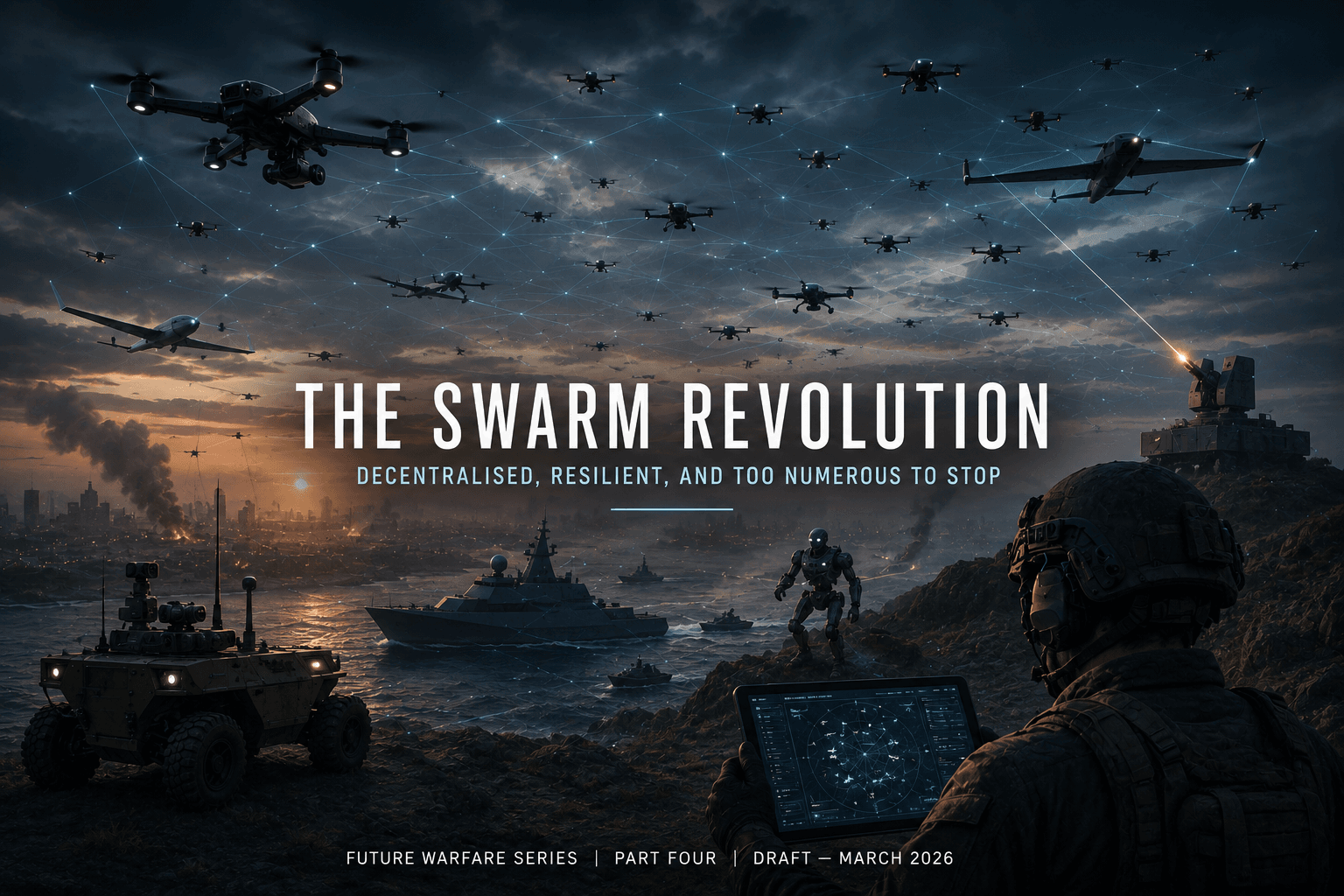
Drone swarms do not merely scale battlefield capability — they dissolve the conventional economics of attrition, deterrence, and proportionality. Part Four maps the swarm revolution: from Ukraine’s combat-proven Swarmer software and Auterion’s Nemyx strike engine to China’s DeepSeek-powered PLA formations and the Pentagon’s $100 million Orchestrator Prize Challenge. It examines the counter-UAS race — high-energy lasers, jamming shields, kinetic interceptors — and confronts the grey zone of humanoid robots as swarm nodes, where the line between human-on-the-loop and no loop at all is already dissolving.
CORE THESIS — The Dissolution of Conventional Attrition Swarms do not just scale capability — they change the nature of warfare. A swarm cannot be decisively defeated by destroying its leader: it redistributes mission logic across every surviving node. A swarm cannot be deterred by threatening mass casualties: its units have no casualties to threaten. A swarm cannot be countered proportionately: a $100,000 interceptor is still losing the economic war against a $500 drone. This is not a tactical problem. It is a civilisational one. |
Introduction
One Operator, Three Targets, Simultaneous
In January 2026, a single operator struck three separate targets simultaneously using three small attack drones — each navigating autonomously to its target with live Kraken Kinetic warheads. Conducted by Auterion using its Nemyx swarm strike engine, it was the first one-to-many lethal drone strike by a single human controller in history. The Department of War posted the footage with an unambiguous declaration: “The future of warfare is now… The @DeptofWar will be AI-FIRST.” Swarm warfare is no longer a research programme. It is policy — and the gap between what Western forces can currently field and what China is demonstrating is, on present trajectories, widening.
I. Swarm Intelligence Architecture
A drone swarm is not a fleet flying in formation — it is a distributed intelligence spread across hundreds of nodes, each capable of independent action, each able to absorb the mission of any destroyed unit. Three principles define the architecture: redundancy (no node is essential); mesh communication (each drone connects to neighbours, not a central controller, resisting jamming); and emergent decision-making (collective behaviour arises from local rules, inherently defeating decapitation strategies).
The Kargu-2: First Combat-Proven Autonomous Swarm Weapon
Turkey’s STM Kargu-2 — 6.8 kg, ~30-minute endurance, onboard computer vision for autonomous target detection and strike — was cited by a UN Panel of Experts (2021) for autonomous lethal engagement in Libya without data connectivity: the first documented case in combat history. Up to 20 units operate in coordinated formation. The Kargu-2 makes LAWS governance retroactive rather than precautionary. The definitional dispute over ‘meaningful human control’ has run in Geneva ever since — without resolution.
Ukraine Swarmer & Auterion Nemyx
Swarmer’s software enables 3–25 drones as a single tactical unit; by end-2025 it had logged 100+ combat deployments, replacing a 9-person team with three — a 67% reduction in human workload. Auterion has shipped 33,000+ Skynode AI strike kits to Ukraine, lifting FPV success rates from ~20% to ~80%. Its Nemyx system — the first to coordinate drones from multiple manufacturers into a single AI-guided strike force — includes an instant swarm-wide arm/disarm layer. Critics note that a single operator overseeing dozens of simultaneous engagements may make meaningful oversight theoretical at higher swarm scales.
Sources: Auterion, January 2026; Defense One, January 2026; Interesting Engineering, January 2026
“What this shows is that the customer trusts the system enough to put live warheads on swarming drones not directly controlled by the operator.”
— Lorenz Meier, CEO Auterion, January 2026
II. China’s Scale Advantage
If the West is debating how to build swarms, China is building them. The PLA’s programme has three defining features: scale ambition in the hundreds of units; systematic integration of DeepSeek and other commercial AI into military platforms at speed; and algorithmic sovereignty — reducing dependence on Western chips before any conflict makes that dependence catastrophic. In January 2026, NUDT researchers broadcast on CCTV a 200-drone swarm with an explicit anti-jamming claim: each drone could autonomously replan its path when communications were disrupted, monitored by a single operator on a single screen. Whether this reflects genuine operational capability or aspirational theatre is contested — but the threshold for strategic deterrence is perception as much as reality. DeepSeek’s significance goes beyond performance: designed for near-peer AI capability at dramatically lower compute, it maps precisely onto the edge-compute constraints of drone hardware. U.S. chip export controls intended to cap China’s AI progress instead accelerated development of military AI that does not need the restricted chips.
| China’s Swarm AI: Key Milestones (2024–2026) |
| Beihang Univ. (Apr 2024): Hawk/dove swarm AI — 5-on-5 test, all opponents destroyed in 5.3 sec; patent filed. |
| Beihang Univ. (2025): DeepSeek integrated into swarm decision-making vs. ‘low, slow, small’ targets; patent filed. |
| PLA procurement (2025): DeepSeek appears in 12+ PLA tenders; Huawei Ascend chip substitution accelerating. |
| PLA Aug 2025: Drone swarms and ‘robot wolves’ in human-machine collaborative urban warfare exercises (CNA). |
| NUDT (Jan 23, 2026): 200-drone anti-jamming swarm on CCTV; single operator; GPS-denied autonomous replanning claimed. |
| Swarm-I: Single operator coordinating 200+ fixed-wing drones from a mobile launch platform; state media demonstration. |
“China prioritises smart, small drones due to its 80 percent global production dominance. The supply chain advantage is not just economic — it is a strategic lever.”
— Stacie Pettyjohn, Center for a New American Security
III. The U.S. Response: ACT, ORIENT, and the Orchestrator Problem
The Pentagon’s swarm strategy has shifted from mass procurement (Replicator, 2023) to command capacity. The limiting factor is not platform count but the ability to direct heterogeneous swarms — drones from different manufacturers, across different domains — as a unified force. The $100 million Orchestrator Prize Challenge (DIU/DAWG/Navy, January 2026) seeks exactly this: a commander expresses intent in plain language; the orchestrator translates it into coordinated autonomous action across hundreds of platforms. Underlying frameworks include ACT (Autonomous Collaborative Teaming) for multi-domain coordination and ORIENT (mesh networking for EW resilience), while CENTCOM’s LUCAS Task Force Scorpion Strike — the first dedicated kamikaze drone squadron, activated December 2025 — embeds mesh-network swarming from the outset.
Anduril’s Lattice OS provides a proprietary parallel: absorbing multi-source sensor data and distributing mission tasking across swarm assets, demonstrated in CENTCOM’s Desert Guardian 1.0 exercise targeting SAM sites. If Lattice becomes the de facto swarm OS for U.S. forces, it would represent proprietary lock-in at the core of American military autonomy with no procurement precedent — which is precisely what the Orchestrator challenge is designed to insure against.
Sources: Defense One, January 15, 2026; GovConWire, December 2025; DefenseScoop, 2025
“We want orchestrator technologies that allow humans to work the way they already command — through plain language that expresses desired effects, not by clicking through menus.”
— Gen. Frank Donovan, Defence Autonomous Warfare Group (DAWG), January 2026
IV. Counter-UAS: The Race the Defence Has Not Yet Won
The C-UAS sector in 2026 is defined by a fundamental asymmetry: offensive swarm technology is cheaper, faster-iterating, and more globally distributed than the defences meant to defeat it. More than 60 vendors supply the drone swarm sector (GlobalData); credible C-UAS vendors capable of countering a 50+ platform coordinated swarm can be counted on one hand.
Jamming and spoofing remain the primary near-term counter — but swarm architectures are engineered to defeat this. Autonomous GPS-denied flight (Shield AI Hivemind, Sparc AI Overwatch) and Russia’s shift to unjammable fibre-optic drones both illustrate how rapidly offensive systems neutralise the defender’s primary tool. High-energy lasers are the most structurally promising answer: AeroVironment’s JLTV-mounted LOCUST 20 kW system, delivered to the Army in December 2025, engages Group 1–2 UAS threats at near energy cost — directly addressing C-UAS economics. The Army’s E-HEL programme (competition Q2 FY2026) marks the transition from prototype to doctrine. The layered architecture — EW outer shield, directed energy mid-tier, kinetics last resort — is sound in concept; its components sit at very different points on the deployment curve.
Sources: Army Recognition, December 2025; DefenseScoop, November 2025 & March 2026
C-UAS Layer Comparison
| C-UAS Layer | Cost/Engagement | Vs. Swarms | Key Limitation |
| EW (jamming/spoofing) | ~$1–$50 | High vs. GPS-dependent; declining vs. AI-nav | NUDT-class anti-jamming; fibre-optic drones |
| Directed Energy: LOCUST 20 kW (fielded) | ~$1–$10/shot | Effective vs. Group 1–2 UAS | Atmospheric degradation; limited vs. larger threats |
| Directed Energy: 500 kW (2025–30 roadmap) | TBD (energy cost) | Projected vs. cruise missiles | Not yet at operational scale |
| Kinetic: Coyote Block 2/3 | $100K–$200K/round | Effective; limited magazine | Asymmetric cost vs. $500–$5,000 swarm drones |
| Kinetic: Roadrunner (reusable) | ~$500K/unit | Effective; reuse unproven | Operational reuse rate unverified |
| Kinetic: Patriot PAC-3 | $3M+/missile | Effective; unsustainable vs. mass | Exchange rate adversaries can sustain indefinitely |
V. Humanoid Robots in the Swarm
The most unsettling swarm development is not aerial drone proliferation — it is the gradual integration of bipedal, stair-climbing, CBRN-capable humanoid robots into swarm formations. Foundation FFI’s Phantom MK1 (~$150,000/unit), designed for multi-floor buildings and rubble fields inaccessible to wheeled systems, has secured ~$10 million in initial DoD contracts, with Army experiments testing humanoid-UGV-UAV combined formations via Project Convergence JADC2. Unitree’s armed robot dogs appeared in PLA exercises in March 2025; France’s Pendragon programme targets demonstration in 2026 and deployment in 2027. The psychological impact on soldiers who face these systems — and whether autonomous warfare erodes the moral restraints on human escalation — has received almost no systematic study. The FY2026 NDAA’s Section 737 psychological effects mandate is a first acknowledgment that human factors engineering has not kept pace with the hardware.
Sources: Defense News, December 3, 2025; Reuters, October 2025
VI. The Proliferation Asymmetry
More than 60 active vendors now supply the global drone swarm sector — roughly doubled since 2022. The Kargu-2 has been deployed in at least four theatres; Iran’s Shahed has been reverse-engineered by Russia at scale. The technology is not contained; it is ubiquitous. The UN General Assembly’s December 2024 resolution (166–3, Russia/North Korea/Belarus dissenting) established a two-tier LAWS framework — enhanced monitoring for some systems, potential prohibition for others — but remains non-binding, its definitions unresolved, its three principal dissenters the three states most actively deploying autonomous weapons in live conflicts.
Proliferation operates at sub-state level too. Non-state actors across Yemen, Lebanon, and the Sahel have acquired and in some cases manufactured swarming systems from consumer electronics for a few thousand dollars. Governance frameworks designed for state-to-state transfers are structurally inapplicable. As of March 2026, no autonomous weapons treaty is under negotiation — while the technology it would govern is being shipped from a factory in Lausanne to Ukrainian front lines under a Pentagon contract.
Sources: UN GA Resolution A/RES/79/67, December 2024; GlobalData, 2025–2026; DroneXL, December 2025
VII. The Cautionary Arithmetic
What is genuinely proven: swarm software operational in Ukraine; China integrating AI into autonomous weapons at systemic scale; directed energy C-UAS crossing into early operational deployment; the Orchestrator challenge correctly diagnosing command capacity as the primary constraint. What warrants scrutiny: Ukraine’s Swarmer deployments involve 3–25 drones — orders of magnitude below China’s 200-unit demonstrations. The engineering gap between a 25-drone tactical formation and a 200-drone autonomous battle group is qualitative, not quantitative. China’s NUDT anti-jamming demonstration was a CCTV broadcast, not a peer-reviewed field test. The gap between demonstration and operational capability is, as the RCV programme showed, often wider than advertised.
| Swarm Capability Reality Check: March 2026 |
| PROVEN IN COMBAT: 3–25 drone coordinated formations (Swarmer, Ukraine 2025); Kargu-2 autonomous engagement (Libya 2019–20) |
| OPERATIONALLY DEPLOYED: Auterion Nemyx one-to-many lethal strike (Jan 2026); 33,000+ Skynode kits shipped to Ukraine; LOCUST JLTV laser delivered to Army (Dec 2025) |
| ⚠ DEMONSTRATED, NOT COMBAT-TESTED: China Swarm-I (200+ drones); NUDT anti-jamming swarm (CCTV broadcast, Jan 2026) |
| ⏳ IN DEVELOPMENT: Orchestrator Prize Challenge ($100M, Jan 2026); Anduril Lattice as swarm OS; France Pendragon (demo 2026) |
| 💭 ASPIRATIONAL: Humanoid robots as swarm nodes at scale; cross-domain UGV-UAV-USV heterogeneous swarms |
| ✖ GOVERNANCE: Zero binding international agreements. UN resolution non-binding. Three principal deployers voted against. |
The question the Auterion Swarm Forge demonstration left unanswered is the one that matters most: at the moment the operator approved the simultaneous strike of three drones on three targets, were they exercising meaningful human control, or endorsing a decision the algorithm had already effectively made? The speed of swarm warfare may make that question unanswerable in real time. And if it is unanswerable in real time, every legal and ethical framework built on the premise of meaningful human control is, in practice, already obsolete.
Sources: Auterion, January 2026; CNAS, Stacie Pettyjohn; Defense News, December 2025
Key Sources & Expert References
Auterion: Nemyx Swarm Strike Engine (September 2025); Swarm Forge demonstration (January 2026) — auterion.com
Defense One: ‘The Pentagon Leans Into Drone Swarms with a $100M Challenge’ — Patrick Tucker, January 15, 2026
Reuters / multiple outlets: ‘Robot Dogs and AI Drone Swarms: How China Could Use DeepSeek for an Era of War’ — October 27, 2025
Jamestown Foundation: PLA Procurement Network Analysis, Sunny Cheung (2025) — jamestown.org
DroneXL: ‘China’s PLA Demos 200-Drone Swarm Controlled by Single Soldier’ — January 23, 2026 — dronexl.co
CNA: PLA urban warfare swarm exercises, ‘robot wolves’ (August 2025) — cna.org
DefenseScoop: Army E-HEL RFI (November 2025); White Sands laser test (March 2026) — defensescoop.com
Army Recognition: JLTV-mounted LOCUST delivery (December 2025) — armyrecognition.com
Defense News: ‘France Is Two Years from Fielding Drone Swarms’ — December 3, 2025 — defensenews.com
UN General Assembly Resolution A/RES/79/67 on Lethal Autonomous Weapons Systems — December 2024 — un.org
GlobalData: 60+ global vendors in drone swarm sector (2025–2026 survey)
CNAS: Stacie Pettyjohn on China’s swarm strategy and 80% global production dominance









Leave a comment