

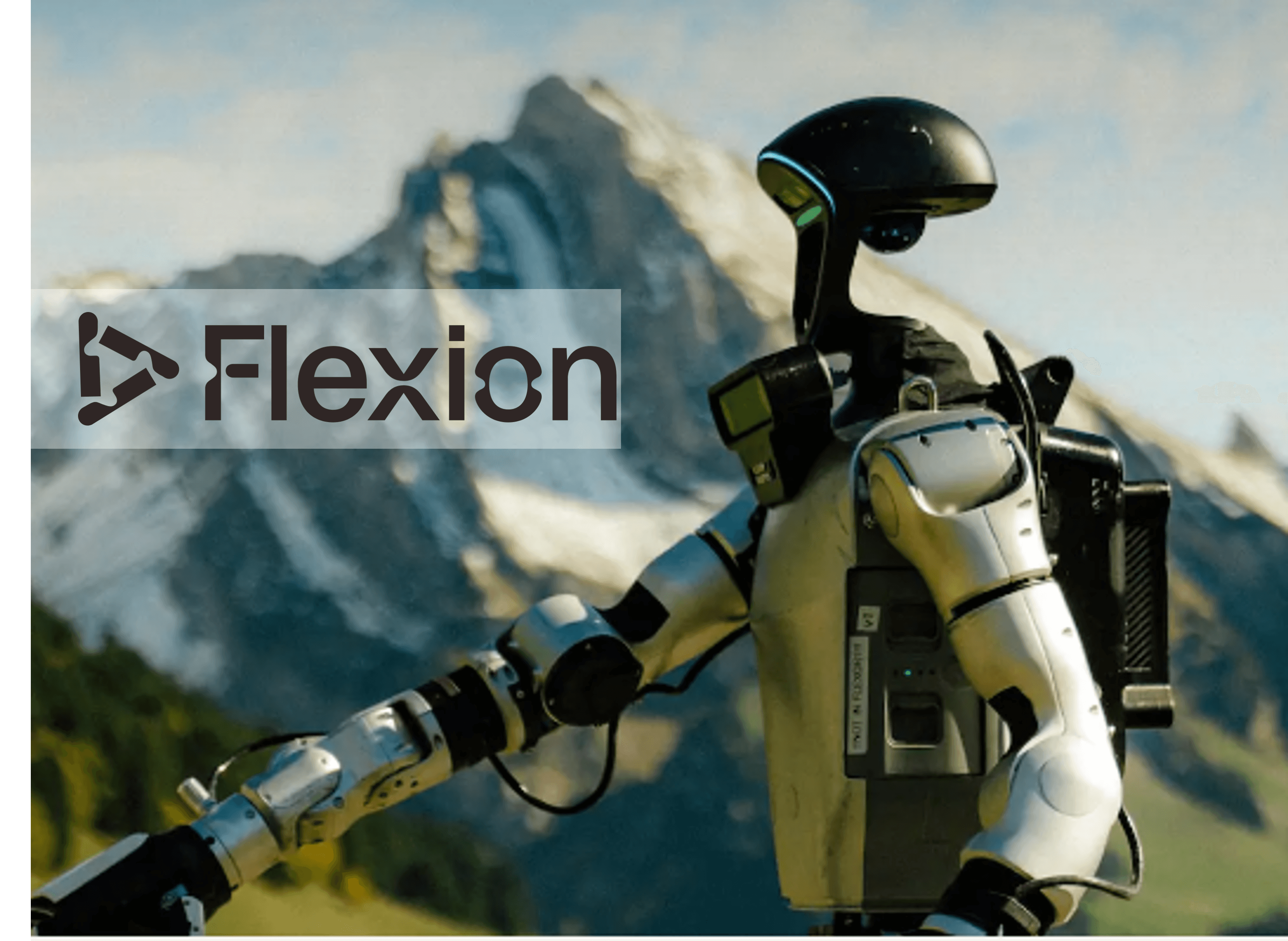
As robotics shifts from rigid automation toward adaptive, learning-driven autonomy, a new category is emerging: companies building the “brain” layer for physical AI systems. Among the most promising of these is Flexion, an ETH Zurich–born startup developing a unified embodied intelligence stack designed to power humanoids, quadrupeds, and mobile manipulators.
Flexion’s ambition is clear: to become a foundational infrastructure provider for next-generation robots by merging perception, reasoning, and control into a single AI-native architecture.
Latest Fundraising and Strategic Backing
Flexion recently completed a 2024–2025 seed extension round, raising approximately USD 5–8 million according to industry disclosures. The round attracted prominent European deep-tech investors including Lakestar, Verve Ventures, Acequia Capital, and Zeiss Ventures, alongside strategic angel investors.
Investors were drawn by a rare combination: frontier-level foundational robotics AI emerging directly from the ETH Zurich ecosystem, early technical validation from robotics OEMs in Europe and the United States, and strong positioning in one of robotics’ fastest-growing segments — AI-native control stacks for embodied systems.
With this latest raise, Flexion’s total funding is estimated at roughly $10–12 million, placing it among Europe’s better-capitalized early-stage robotics intelligence startups.
Core Team: ETH Robotics Lineage Meets Product Engineering
Flexion is led by co-founder and CEO Niklas Steenfatt, whose background in ETH’s robotics ecosystem includes high-fidelity simulation, robot learning, humanoid control, and locomotion optimization. His experience spans both theoretical control systems and real-world deployment, shaping the company’s emphasis on robust embodied intelligence.
Flexion also benefits from the broader ETH robotics lineage associated with Marco Hutter, one of the most influential figures in modern legged robotics. Hutter is widely known for leading the development of ANYmal and pioneering optimization-based and learning-augmented control systems. His lab has produced multiple successful robotics ventures, including ANYbotics, Sevensense Robotics, and Verity. Flexion emerges from this same high-performance research culture.
Beyond academic depth, the engineering team includes talent from ETH’s Robotic Systems Lab, former researchers from Google DeepMind, and control engineers with experience linked to Boston Dynamics. The result is a hybrid capability: research-grade robotics science integrated with product-grade engineering execution.
Technical Advantage: Building a Unified Embodied Intelligence Stack
Flexion is developing what it describes as an AI-native “Brain OS” — a unified architecture that eliminates the fragmentation traditionally found in robotics software stacks. Instead of isolating perception, planning, and control into separate subsystems, Flexion integrates high-dimensional motion planning, foundation-model reasoning, vision-language-action capabilities, and low-latency whole-body control into a continuous loop.
This architecture enables robots to perceive, reason, and act as a coherent system rather than a stitched-together pipeline. The goal is not incremental improvement, but a shift toward generalizable embodied intelligence.
A key differentiator is large-scale simulation training. Leveraging GPU-accelerated environments inspired by platforms such as NVIDIA Isaac, combined with ETH-developed extensions, Flexion trains robotic policies across millions of trajectories and domain-randomized environments. By blending reinforcement learning and imitation learning, the company targets robust skill generalization rather than brittle task scripts.
Importantly, Flexion’s stack is hardware-agnostic. It is designed to operate across humanoids, quadrupeds, industrial arms, and mobile manipulators. For OEMs, this provides plug-in intelligence without the need to build an in-house AI stack from scratch — accelerating commercialization timelines significantly.
Long-Term Vision: Toward General-Purpose Robotics Intelligence
Flexion’s roadmap extends beyond static task execution. The company is building toward continual learning in the field, adaptive skill acquisition, and increasingly human-like spatial reasoning. Its vision aligns with the broader transition from narrow robotics automation to general-purpose embodied AI systems.
If successful, this approach could underpin the next wave of household humanoids, factory-grade mobile manipulators, and autonomous service robots operating in dynamic, unstructured environments.
Why Zurich — and ETH — Matter
The emergence of Flexion is not accidental. ETH Zurich is widely regarded as one of the top global robotics institutions, frequently mentioned alongside MIT and Stanford. Its contributions to locomotion, SLAM, dexterous manipulation, and control theory have shaped modern robotics research.
ETH’s legacy includes platforms such as ANYmal and advanced whole-body control frameworks that set performance standards across the industry. The university has also cultivated one of Europe’s strongest robotics startup pipelines, producing companies like ANYbotics, Sevensense Robotics, Verity, and others.
Zurich itself offers a supportive commercialization ecosystem, with proximity to industrial leaders such as ABB Robotics, Hilti, Carl Zeiss AG, and Swisslog. Strong national R&D programs and EU collaboration frameworks further reinforce the region’s deep-tech strength.
Equally critical is talent density. ETH consistently attracts specialists in motion control, machine learning, mechatronics, embedded AI, and systems engineering — precisely the disciplines required to build the next generation of intelligent machines.
Conclusion
Flexion represents a new category of robotics company: not a hardware manufacturer, but a builder of intelligence infrastructure. By combining ETH’s robotics lineage, large-scale simulation training, and a unified embodied AI stack, the startup is positioning itself at the center of the physical AI transition.
As humanoids and autonomous robots move closer to mainstream deployment, the race to define the “robot brain” layer is accelerating. Flexion intends to be one of the companies that defines it.









Leave a comment