

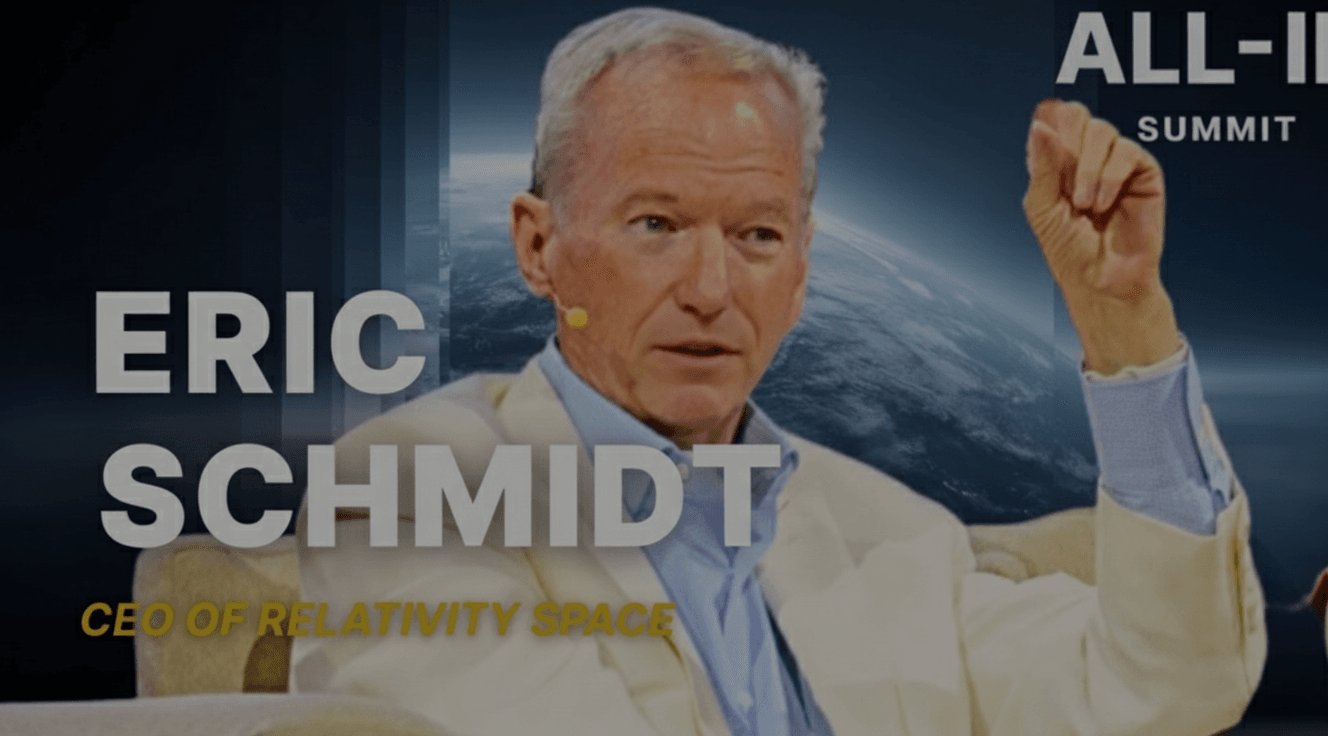
Former Google CEO and Executive Chairman Eric Schmidt recently delivered a stark assessment of the global tech landscape, warning that the AI revolution is "underhyped" and that the United States is facing a critical strategic disadvantage against China in the battle for AI dominance.
In a wide-ranging interview, Schmidt covered everything from the AGI timeline to the future of warfare, offering several key takeaways for the tech industry:
1. The AGI Reality: 6 Years Away, Not 3
Schmidt challenged the prevailing narrative of immediate Artificial General Intelligence (AGI), which has dominated Silicon Valley discourse.
- The New Timeline: While acknowledging that "savant-level" super-intelligence (AI specialized in areas like physics or math) is coming, Schmidt believes it is likely six or seven years away, pushing back against the three-year timeline often cited by others.
- The Missing Link: The current technical roadblock for true AGI is the inability of large language models (LLMs) to "set their own objective function." Until AI can set its own goals, it remains a powerful, but incomplete, system.
- Human-AI Synergy: Schmidt predicts that for the next few years, AI will primarily function as an assistant. He described AI as "middle to middle" versus humans being "end to end," meaning AI will be highly synergistic with people who define the prompts and objectives.
2. The Open-Source Battleground is a "Major Geopolitical Issue"
The competition with China is not about AGI, but about application and distribution. Schmidt noted that due to US chip restrictions and capital limitations, China is focusing its efforts on applying AI across everything, from consumer apps to robotics.
The most critical issue, according to Schmidt, is the open-source divide:
- China’s Advantage: Beijing is actively promoting models with "open weights" and open training data.
- US Risk: As the US largely focuses on closed models, Schmidt warns that the majority of the world, particularly emerging nations, will adopt Chinese models, risking the proliferation of AI that is not grounded in "Western values."
3. The End of the Tank: Warfare Transformed by $5k Drones
Schmidt provided an update on modern conflict, informed by his advisory work, stating that the Ukraine war demonstrates the complete transformation of military structure.
- The Kill Ratio: He declared traditional military assets like tanks obsolete. A high-tech American tank costing $30 million can be destroyed by a well-armed, off-the-shelf drone with a small payload costing as little as $5,000.
- AI Deterrence: The ultimate form of warfare will involve fully autonomous, AI-driven drone battles. Paradoxically, Schmidt suggests that the unpredictability of these AI-generated battle plans—where neither side can accurately calculate the other's strategy—will create a state of mutually assured destruction (MAD) deterrence for the future.
4. A Call for Commitment and Capital
Finally, Schmidt touched on internal American issues, urging tech leaders to commit to their work ethic ("996 is who you're competing against") and leverage the country's strengths: its deep financial markets, chaotic creativity, and entrepreneurial base. He also called out declining birth rates as a global concern that will inevitably lead to declining revenues and innovation across economies.







Leave a comment