

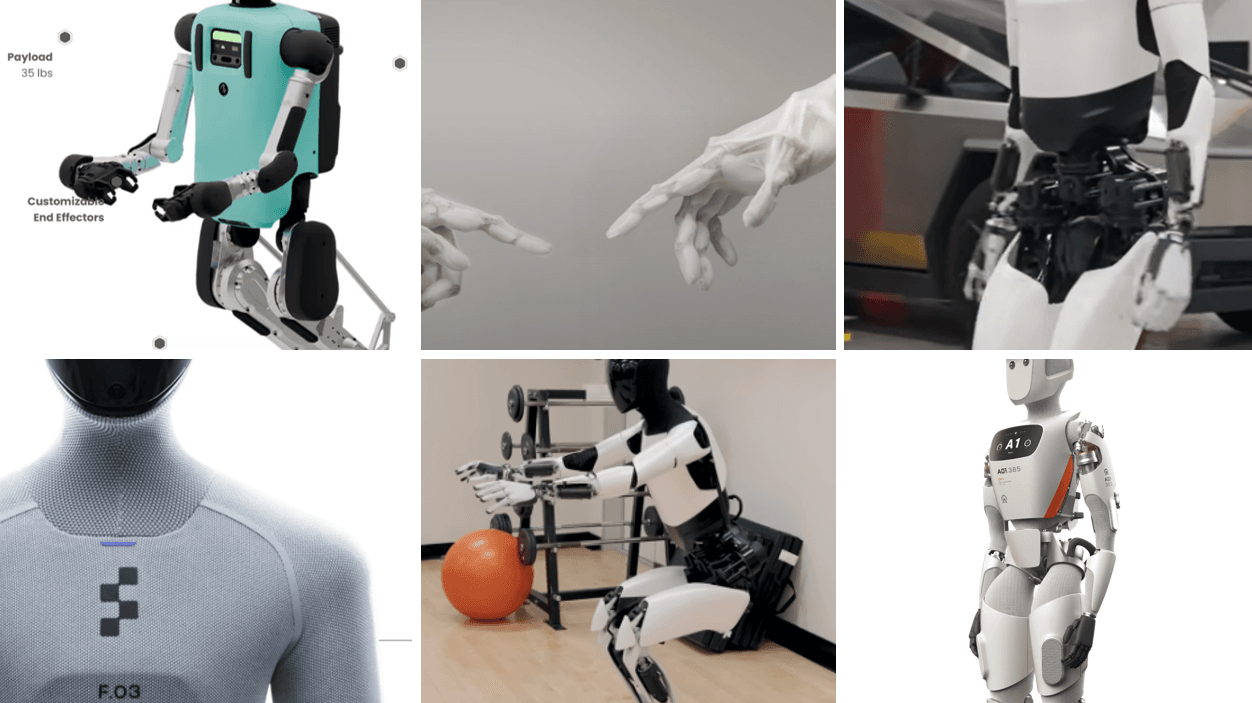
Humanoid robots are rapidly transitioning from science fiction concepts to reality. From Elon Musk’s "Optimus" to China’s Unitree Robotics' low-cost strategy, leading global robotics companies are engaged in fierce competition in this transformative sector.
However, on the eve of market explosion, a distinct strategic divergence has emerged among these giants regarding their technological focus and target application scenarios, forming a core controversy in the current industry landscape. This article will compare the development paths of companies like Tesla, Figure AI, Unitree Robotics, and 1X NEO, discussing whether humanoids will "enter the factory first" or "enter the home first," and if the focus remains on "showmanship" or shifts to "practical application."
I. Contrasting the Development Directions of Top Global Humanoid Robot Companies
Humanoid robot companies generally choose different "carriers" (robot form) and "tracks" (application scenarios) based on their core technological strengths and commercial goals. The main strategic points of divergence are summarized below:
Company /Product | Country /Region | Key Features/Technical Approach | Primary Positioning/Target Application Scenarios | Expected First Entry Scene |
|---|---|---|---|---|
| Tesla / Optimus | USA | Strong in AI and mass manufacturing; aiming for general-purpose utility. | General-Purpose Service: Industrial production, logistics, home applications. | Application Scene (Industry/Manufacturing) |
| Figure AI / Figure 01/02 | USA | Strong AI integration; high-profile funding; real-world testing (e.g., BMW factory). | Labor-Intensive Tasks: Warehousing, logistics, manufacturing. | Application Scene (Industry/Logistics) |
| Apptronik / Apollo | USA | General-purpose design, emphasizing human-like size and payload capacity (55 lbs). | 3PL, Retail, Manufacturing: Handling, palletizing, machine tending, trailer unloading. | Application Scene (Logistics/Warehousing) |
| Agility Robotics / Digit | USA | Strong bipedal locomotion, focused on logistics and material handling; dual-arm design. | Logistics and Warehousing: Moving objects and boxes in human-designed environments. | Application Scene (Logistics/Warehousing) |
| Boston Dynamics / Atlas | USA | Extreme dynamic balance and motion capabilities. | R&D/Demonstration; Future industrial applications (new electric version). | Application Scene (R&D/Testing) |
| Unitree Robotics / G1/H1/H2 | China | High cost-performance, rapid iteration, deep experience in motion control. | Education, R&D, Exhibition, Light Industry; goal is high-value accessibility. | Application Scene (R&D/Education/Light Industry) |
| 1X Technologies / NEO | USA /Norway | Soft design, tendon-driven; focus on home safety. | Household Services: Home assistant, daily chores. | Home Scene (Early stages require human teleoperation assistance) |
| Clone Robotics / Clone Alpha | USA | Musculoskeletal bionic structure, using artificial muscle (Myofiber). | High-Fidelity Bionic Companion for high-end home services. | Home Scene (Advanced bionic R&D) |
II. Deep Analysis of Core Strategic Controversies
The current strategic disagreements mainly fall into two key areas: technical focus and deployment path.
Controversy 1: Mobility Demonstration (Showmanship) vs. Task Execution (Embodied AI)
In the past, humanoid robots were often associated with "showmanship," such as Boston Dynamics' Atlas performing astonishing parkour and backflips. However, industry consensus is shifting.
1. The Value and Limitations of Mobility Showmanship
Value (Validating Foundation): Extreme mobility is a crucial test of a robot's underlying hardware, control algorithms, and dynamic balancing capabilities. This robustness is essential for navigating unexpected disruptions in the real world (e.g., uneven floors, sudden bumps).
Limitation: Commercial applications do not require backflips; they demand stable, reliable, and high-precision daily operational capacity. Over-indexing on extreme motion is often seen as a misallocation of resources.
2. The Shift to Embodied AI (Focus on the Brain)
The current R&D focus has decisively shifted toward "Embodied AI," which means giving the robot an intelligent brain capable of perception, reasoning, decision-making, and action.
Technical Core: AI Large Models (VLM/VLA). These allow robots to understand complex natural language instructions and autonomously plan and execute tasks by integrating visual information.
Executive Consensus: Companies like Tesla and Figure AI emphasize that the robot's value lies in general-purpose utility and solving real-world problems. Executives widely agree that resources should be spent on:
Dexterous Manipulation: The biggest bottleneck for executing complex tasks (e.g., screwing, picking up irregular objects).
Cost Reduction: The total robot cost must be brought down to consumer-acceptable levels (Tesla aims for below $20,000) for mass adoption.
Controversy 2: Contained Industry (B2B) vs. Complex Home (C2B)
Regarding whether humanoids will "enter the factory first" or "enter the home first," the industry strongly favors application scenarios (B2B) leading the way.
| Deployment Scenario | Core Characteristics | Robot Challenge | Current Status & Representative |
|---|---|---|---|
B2B (Factory /Logistics) | Relatively contained environments, standardized tasks, clear ROI. | Focus on high reliability, high efficiency, and safety (with or without human interaction). | Frontrunner (e.g., Figure AI, Hexagon AEON, Unitree): Clear ROI, manageable risk. |
| C2B (Home Services) | Highly unstructured environments, high task variability, extreme safety demands. | Must possess superior general cognitive ability and safe, soft interaction with humans. | Lagging (e.g., 1X NEO): Aggressive deployment, but requires human remote assistance to cope with complexity. |
Final Conclusion: Industry Leads, Home Follows
The industrial and commercial sectors offer a perfect testbed for humanoids:
- Validate Technology: Quickly test and iterate the robot's hardware and software reliability in structured settings.
- Quantify Return: Generate rapid commercial returns by addressing labor shortages, thereby funding further R&D.
- Gather Data: Collect vast amounts of task data in real-world scenarios to train the Embodied AI large models.
Therefore, the humanoid robot's development will follow a clear path: starting with "practical work" in factories and warehouses to accumulate embodied intelligence, eventually achieving mass market adoption in the home with lower costs and greater versatility.





Leave a comment