


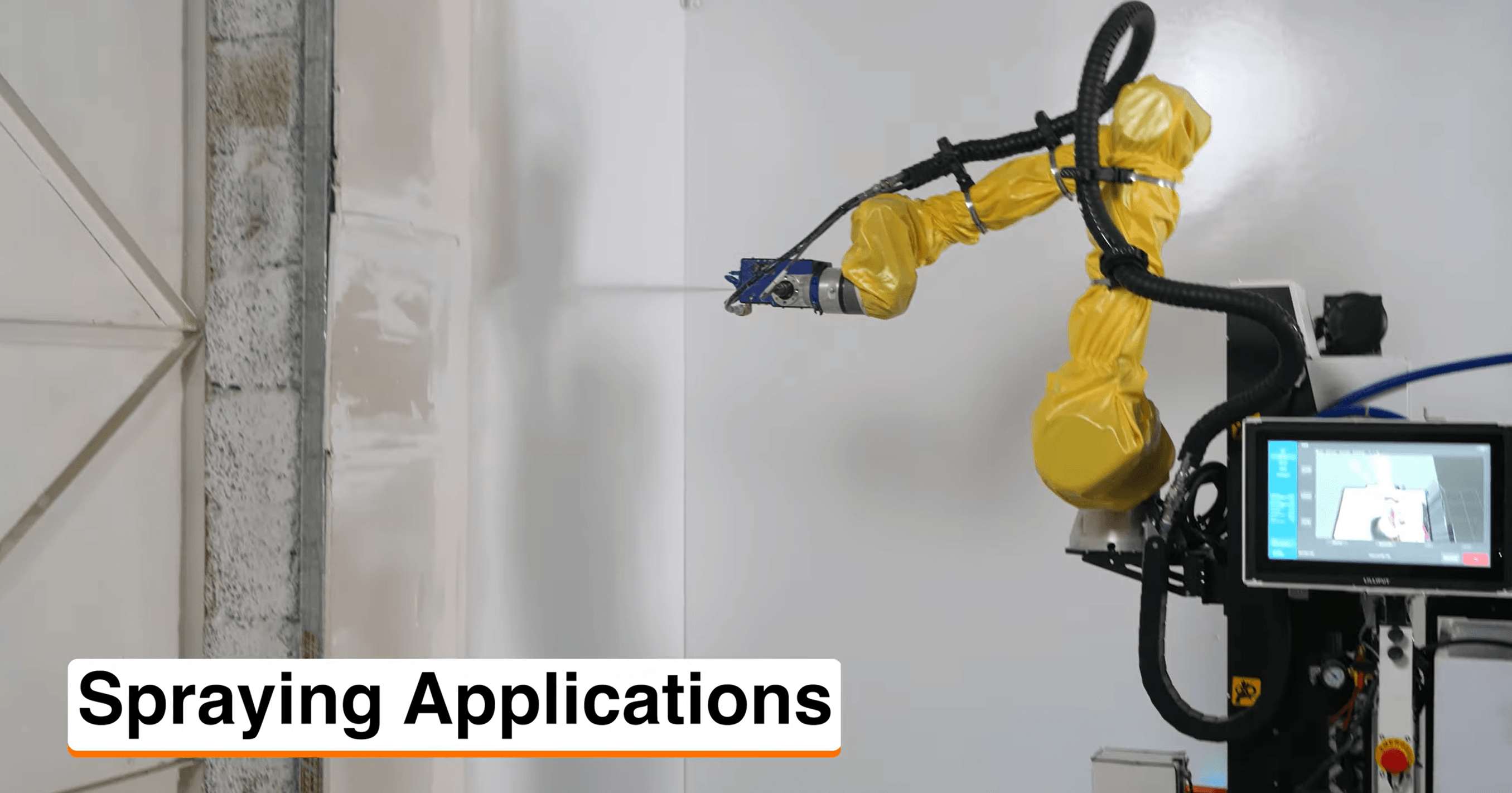
Surface Finishing & Painting: The Market Leader That Nobody Saw Coming
Okibo's EG7+ robot finishes 1,000 sq ft per hour. One robot costs 50% less than a human crew and runs 10x faster. Interior finishing is now construction's fastest-moving automation segment.
THE SEGMENT NO ONE EXPECTED TO LEAD
Surface finishing has long been considered too delicate for robots. Painting, plastering, drywall taping, and tile-setting demand tactile sensitivity and spatial judgment.
That assumption is now obsolete. A cohort of companies from Israel to Singapore have cracked the finishing problem. The market leader by revenue is not a rebar robot or a demolition machine.
It is a painting robot. And the innovation is happening faster than most analysts predicted.
The finishing segment accounts for 20% of total construction robot market share in 2025, per FactMR. That share is rising. The overall construction robot market is valued at $4.2 billion in 2025 and is projected to reach $12.3 billion by 2035.
Source: FactMR Construction Robot Market Report, 2025. Market sizing figures across reports vary significantly; these are illustrative estimates and have not been independently verified by a governmental body.
| Metric | Value | Year | Source / Note |
| Construction robot market size | $4.2 billion | 2025 | FactMR estimate |
| Projected market (2035) | $12.3 billion | 2035 | FactMR projection |
| Finishing segment share | ~20% | 2025 | FactMR; unverified |
| Finishing segment CAGR | ~14–17% | 2025–2033 | Multiple market reports |
| Okibo cost vs. human labor | 50% reduction | 2024–2025 | Company data; unverified |
| Okibo speed vs. human | Up to 10x faster | 2024–2025 | Company data; unverified |
| Canvas schedule reduction | Up to 60% | 2024 | Company data; unverified |
| Dusty Robotics layout speed | 10x faster than manual | 2024 | Company data; unverified |
Note: All company-reported performance figures are based on company disclosure or investor materials. They have not been independently verified by third parties.
THE PROBLEM THE SECTOR WAS WAITING TO SOLVE
Interior finishing work is the last major bottleneck on most commercial construction projects. Framing finishes. Mechanical and electrical finishes. Then painting and drywall crews arrive and compress every schedule.
One in four construction workers ends their career with a musculoskeletal injury. Drywall finishing and overhead painting are primary causes. Rotator cuff damage from sustained arm elevation is endemic.
Finishing trades are also among the hardest to staff. Skilled Level 4 and Level 5 drywall finishers take four years to develop consistent quality through muscle memory. That pipeline cannot be rebuilt quickly.
Wage costs in specialty trades are rising 5 to 7 percent annually across most developed markets. On a fixed-price contract, that trajectory destroys margins directly.
A skilled drywall finisher takes four years to train. A Canvas-trained operator reaches production quality in four months. The economics of finishing have permanently shifted.
THE KEY PLAYERS: DEEP PROFILES
1. Okibo (Israel / USA) — The Revenue Leader
Founded: 2018 | HQ: Englewood, NJ (US) and Tel Aviv, Israel | Products: EG7, EG7+ | Status: Commercially deployed in Europe and USA
Okibo is the global leader in construction painting and drywall finishing robotics by deployed revenue. Its AI-guided robots have covered more than one million square feet across Europe.
The EG7+ launched nationally in the US in late 2025. It debuted at Hensel Phelps' Federal and AEC Innovation Day in Phoenix, Arizona. The robot performs sanding, painting, and Level 4 drywall finishing.
The EG7+ reaches 24 feet for high-wall applications. It weighs 800 pounds and is 27 inches wide. It fits through standard doorways and needs zero site preparation, external references, or WiFi.
Its navigation is built on a patented AI-driven 3D scanning and real-time modeling algorithm. No BIM tools, no markings, no total station required. One operator guides it to the room and monitors output.
In July 2025, Performance Contracting Inc. deployed Okibo robots on a large project in King of Prussia, PA. PCI reported up to a 5x productivity increase for Level 4 and 5 sanding. PCI and Okibo plan to extend their partnership for a Washington DC data center project.
In August 2025, Okibo's platform was used on the Netflix House project, also operated by PCI. These are commercial deployments, not pilots.
Source: Okibo company announcements, July–December 2025. Performance data originates from Okibo and PCI. It has not been independently verified by a third party.
| Metric | EG7+ Performance | Source / Note |
| Finishing speed | 1,000 sq ft per hour | Okibo company data |
| Cost vs. human labor | ~50% reduction | Shadow Ventures investor note |
| Speed vs. human painter | Up to 10x | Shadow Ventures investor note |
| Reach height | 24 feet (EG7+) | Okibo announcement, Dec 2025 |
| Unit weight | 800 lb | Okibo spec sheet |
| Width | 27 inches | Okibo spec sheet |
| Site preparation required | Zero | Okibo company data |
| External connectivity needed | None (no WiFi/5G) | Okibo company data |
| Sanding productivity (Level 4/5) | Up to 5x vs. manual | PCI/Okibo joint report, 2025 |
Note: The 50% cost reduction and 10x speed figures originate from Shadow Ventures' investment note on Okibo. They are not independently audited. The 5x sanding productivity figure comes from Performance Contracting, Inc. based on one project. Results will vary by project type and conditions.
2. Canvas (USA) — The Drywall Pioneer
Founded: 2017 | HQ: San Francisco, CA | Products: 1550 model, 1200CX | Status: Commercially deployed across major US contractors
Canvas built the world's first robotic drywall finishing system. Its machines combine a Universal Robots UR10e cobot arm with onboard AI and vision for wall mapping and compound application.
The system requires no plans, no pre-mapping, and no site scanning. A worker rolls it to the wall. The robot detects the surface, applies compound in a single engineered pass on day one, then sands on day two.
Canvas reduces finishing schedules by up to 60 percent and labor requirements by approximately 40 percent. A five-to-seven-day manual process becomes two days. That schedule compression compounds across every project.
In July 2024, Canvas launched the 1200CX. It measures 30 by 34.5 inches and weighs 1,200 pounds. It reaches 12 feet. It complements the existing 1550 model which reaches 15.5 feet for taller spaces.
The 1200CX was designed specifically for multifamily, tower, and hospitality projects where the larger model cannot maneuver. Canvas pushed an over-the-air update enabling Level 4 finishing — previously the system only did Level 5.
This OTA capability matters. Canvas CTO Maria Telleria described it as the first time in construction history that tools improve after purchase. That is a software-company logic applied to hardware. It changes the capex calculus.
Training time is another structural advantage. A traditional drywall apprentice takes four years to develop consistent quality. A Canvas-trained crew member reaches production quality in four months.
Source: Canvas company announcements, Universal Robots case study (2025). Performance claims originate from Canvas and have not been independently audited.
| Feature | 1200CX | 1550 Model |
| Dimensions | 30" × 34.5" | Wider footprint |
| Weight | 1,200 lb | Heavier |
| Finishing height | 12 feet | 15.5 feet |
| Best application | Multifamily, tower, hospitality | Open commercial, data center |
| Finishing levels | L4 and L5 (via OTA) | L4 and L5 |
| Dust capture | 99.9% (vacuum system) | 99.9% (vacuum system) |
| Schedule reduction | Up to 60% vs. manual | Up to 60% vs. manual |
Source: Canvas company data and The Robot Report (July 2024). Performance figures originate from Canvas and are not independently verified.
3. Dusty Robotics (USA) — The Layout Enabler
Founded: 2018 | HQ: Mountain View, CA | Product: FieldPrinter 2 | Status: Deployed at scale across North America
Dusty Robotics is a precision layout automation company. Its FieldPrinter 2 takes BIM data and prints full-scale floor plans directly onto job site floors. It eliminates manual chalk-line layout entirely.
The robot prints 10,000 to 15,000 square feet per day with one operator. It achieves accuracy within 1/16 of an inch. That precision matters most in finishing trades, where tile-setting and partition placement depend on exact reference lines.
In January 2024, Dusty launched the FieldPrinter 2. The new model is more compact, prints closer to edges, shadow-prints behind columns, and features a wider print head. The 23-pound robot improved navigation via onboard sensors.
In July 2025, Dusty announced a partnership with Hexagon's Leica Absolute Tracker AT500. This collaboration improves setup speed and maintains industrial-grade accuracy. The target applications include data centers and healthcare facilities.
Dusty's FieldPrint Platform integrates a Revit plug-in, a cloud portal for multi-trade coordination, and OTA update capabilities. By Q1 2022, contractors had used FieldPrinter to print layouts on 25 million square feet.
Dusty does not directly finish surfaces. But layout precision is the upstream prerequisite for finishing quality. Tiles misaligned at layout become waste at finishing. Dusty's contribution to finishing economics is real.
Source: Dusty Robotics company announcements and TechCrunch (January 2024). The 25 million sq ft figure is from Q1 2022 and predates current deployment scale.
4. Pictobot / Transforma Robotics (Singapore) — The Asian Industrial Specialist
Origin: Nanyang Technological University (NTU), Singapore | Developer: Transforma Robotics | Partner: Aitech Robotics | Status: Trials and commercial deployment in Singapore
Pictobot was developed by NTU Singapore in cooperation with JTC Corporation and Aitech Robotics. It is designed for spray-painting the interiors of industrial buildings with high ceilings.
The robot uses an optical camera and laser scanner to autonomously navigate and paint walls up to 10 meters high. It requires only one human supervisor for paint refills. It can operate in darkness and run continuously.
Pictobot paints 25 percent faster than a crew of two painters. It eliminates the need for scissor lifts. Safety risk at heights is removed from the equation. One operator can manage multiple units simultaneously.
Transforma Robotics has developed Pictobot into a commercially available product for paint contractors, developers, and property owners. The Red Dot Award-winning redesign focused on ergonomics and manufacturing readiness.
Singapore's construction sector faces severe labor constraints. The government actively funds construction robotics through the National Research Foundation. Pictobot is a direct policy-driven technology deployment.
The Singapore-Israel innovation corridor for finishing robots is notable. Both markets have acute labor shortages, technology-friendly governments, and high construction density. They are proving grounds for the world.
Source: NTU Singapore press releases and EurekAlert (2016–2022). Red Dot Award entry (2023). Transforma Robotics product listings. Performance claims originate from NTU research team and have not been independently verified.
5. Brightrobot (China) — The Volume Player
HQ: China | Segment: Interior wall plastering and painting automation | Status: Operating in domestic Chinese construction market
Brightrobot operates in China's vast interior finishing market. It focuses on automated wall plastering and painting for residential and commercial construction projects.
China's construction sector faces a significant demographic problem. Young workers increasingly avoid physically demanding trades. Coastal cities face acute skilled-labor shortages in finishing trades.
Brightrobot's deployment scale in China's domestic market is not fully disclosed publicly. Chinese construction automation companies often operate without Western-market visibility. Their commercial traction is real but harder to verify.
The Chinese market context matters. China builds more floor area annually than any other country. Even modest penetration of the finishing automation market in China represents enormous volume.
Note: Brightrobot's specific performance data and financial metrics are not publicly disclosed in Western sources. The above is based on available market information and should be treated with appropriate caution.
THE ISRAEL-SINGAPORE INNOVATION CORRIDOR
The geographic concentration of finishing robot innovation is not random. Israel and Singapore share structural characteristics that drive robotics urgency.
Both markets have small domestic labor pools. Both face high construction demand relative to workforce size. Both have strong government support for technology adoption. Both have invested in deep computer vision and AI engineering talent.
Israel produced Okibo's founding team from prior robotics company experience. NTU Singapore produced Pictobot from academic robotics infrastructure. In both cases, extreme labor scarcity accelerated commercial deployment timelines.
The US adopted Israeli-origin technology through Okibo's US expansion and investor entry. Singapore's approach remains more domestically focused but serves as a model for other land-constrained Asian markets.
Israel and Singapore share the same structural urgency: small labor pools, high construction demand, and strong government support for automation. They are proving the finishing robot market for the world.
NEW TECHNOLOGIES DRIVING THE SECTOR
AI-Guided 3D Scanning and Real-Time Mapping
The single most important enabling technology is real-time 3D environmental scanning. Finishing robots cannot work from static maps. Construction sites change daily.
Okibo's EG7+ uses a patented AI-driven 3D scanning algorithm that creates a live model of the room as the robot moves. This replaces the need for BIM tools, total stations, or pre-set markers.
Canvas uses onboard AI vision to detect wall surfaces and seam locations without plans or pre-mapping. The robot arrives at a wall and figures out what needs to be done in real time.
This shift from pre-programmed to adaptive behavior is the core technology unlock. It is what separates commercially viable finishing robots from laboratory demonstrations.
Computer Vision and Force Control
Drywall finishing requires extreme sensitivity. Joint compound can be scratched with a fingernail. Uneven pressure creates visible imperfections in the final surface.
Canvas selected Universal Robots' UR10e cobot specifically for its built-in force control. The robot applies compound with consistent, controlled pressure. No external force sensor is needed.
Okibo's EG7+ uses computer vision to detect surface variations and adjust application in real time. The robot adapts to wall irregularities that would require human judgment to handle.
Over-the-Air Software Updates
Canvas introduced OTA updates to its drywall finishing robots. This enabled Level 4 finishing capability to be deployed to existing units in the field without hardware changes.
This is software-company behavior applied to construction equipment. The installed base improves continuously. It changes the total-cost-of-ownership model fundamentally.
Dusty Robotics applies the same logic. Its FieldPrint Platform receives updates that expand capabilities. The robot that exists on a job site today is not the same product it was 12 months ago.
Foundation Model AI and Embodied Intelligence
McKinsey estimated the general-purpose robotics market could reach $370 billion by 2040. The report, published June 2025, specifically identified embodied AI as a transformative force for construction.
Finishing robots are direct beneficiaries. Generalist AI models trained on diverse visual and physical tasks can adapt to new surface types, materials, and building configurations faster than task-specific systems.
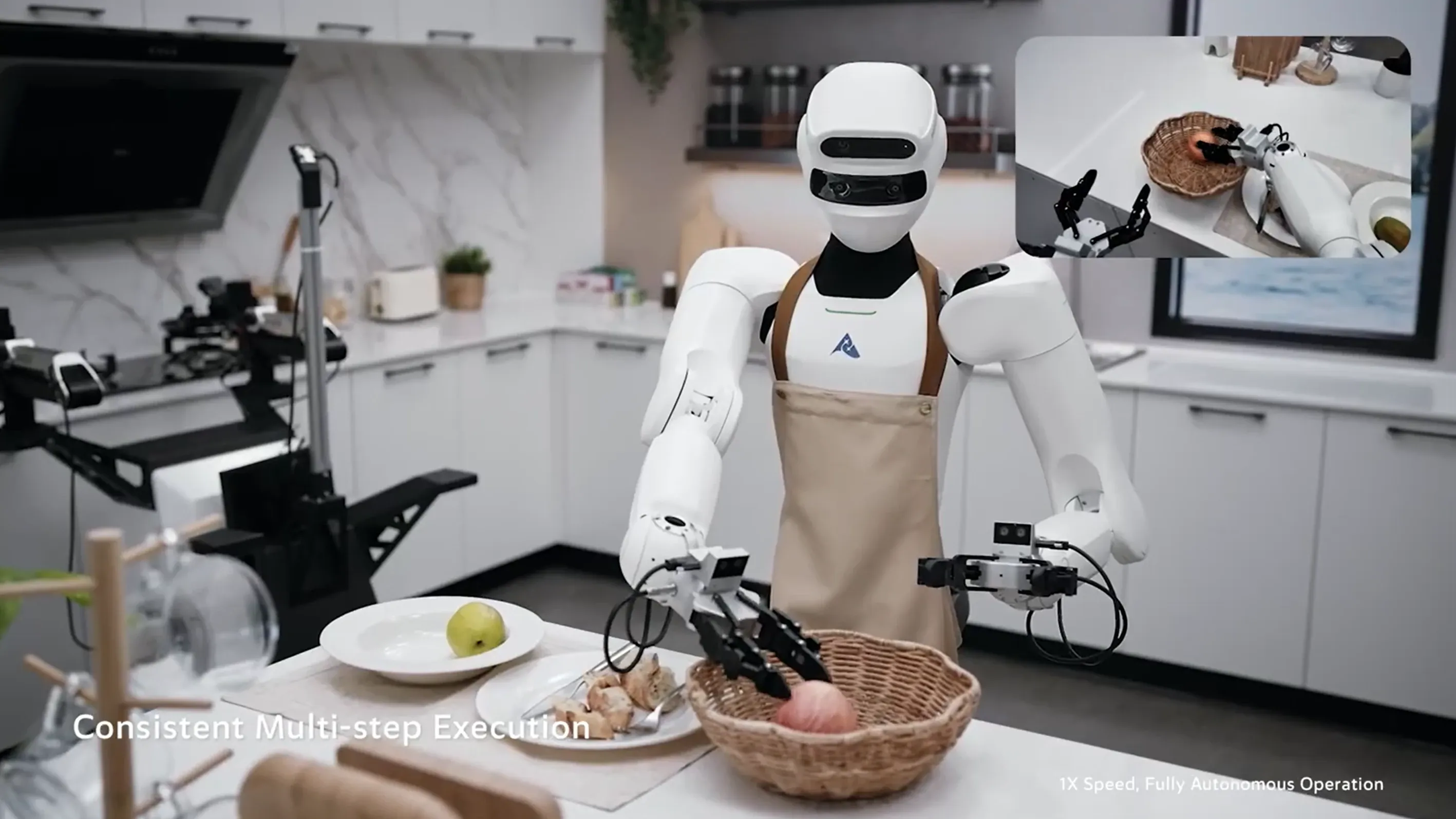
Humanoid robot developers including Figure AI and Boston Dynamics are targeting construction as a key application. Surface finishing — with its combination of mobility, dexterity, and visual judgment — is a natural fit.
This is not yet commercial reality. But the technology trajectory points toward finishing robots becoming dramatically more capable within three to five years as foundation model AI matures.
| Technology Force | Current Application | Future Impact |
| Real-time 3D scanning | Okibo EG7+, Pictobot navigation | Eliminates all site prep requirements |
| Force-controlled cobot arms | Canvas compound application | Finer surfaces, more material types |
| Over-the-air updates | Canvas L4/L5, Dusty FieldPrint | Continuous improvement without hardware swap |
| Computer vision quality inspection | Nascent in finishing robots | Inline quality assurance replaces human inspection |
| Foundation model AI | Research stage in finishing | Generalist robots adaptable to any surface |
| Humanoid robotics | Pre-commercial for finishing | Potential full-task automation by 2030 |
Note: Future impact projections are forward-looking assessments based on technology trend analysis. They are not guarantees of commercial availability or performance.
THE HARD PROBLEMS THAT REMAIN
Unstructured Environments at Scale
Construction sites are the most dynamic and unpredictable environments robots operate in. A finishing robot that works perfectly in a clear room fails when debris, scaffolding, or other trades are present.
Canvas CEO Kevin Albert described this as the core problem: construction is completely different from logistics or manufacturing. Every site is unique. Every day is different.
Finishing robots that require cleared floors and single-trade access represent a scheduling problem. Real sites do not work that way. The next product generation must tolerate more chaos.
Regulatory Fragmentation
There are no unified global safety standards for construction finishing robots. CE certification covers European requirements. US OSHA frameworks were not written with autonomous finishing equipment in mind.
Okibo achieved CE certification for the EG7+. That enables European deployment. But each new market adds compliance complexity. Union rules in specialty trades add a further layer of negotiation.
Canvas introduced its robots to labor unions and reached collaborative agreements. That required relationship investment and product design choices that positioned the robot as a co-worker, not a replacement.
Capital Costs and ROI Timeline
Finishing robots represent significant upfront capital. The payback period depends on project volume, wage rates, and utilization rates. On high-volume commercial projects, the case is strong.
On smaller residential or scattered-site work, the economics are less clear. This limits the addressable market in the short term to large contractors with steady project pipelines.
Dusty Robotics specifically cited supply chain and capital constraints as limiting growth. Hardware startup economics are punishing. Lead times that run to nine months create cash flow mismatches.
Quality Consistency in Complex Geometries
Flat wall sections are a solved problem for current finishing robots. Corners, curves, reveals, and transitions between surfaces remain challenging.
Level 5 finishes require extreme uniformity. Under raking light, any imperfection is visible. Current robots achieve consistency on standard flat walls. Complex architectural features still require human skill.
This limits robot penetration to the portion of finishing work that involves large flat surface areas. That is a substantial portion of total finishing labor. But it is not the whole job.
| Challenge | Severity | Mitigation Strategy |
| Unstructured site environments | High | Improved real-time SLAM and obstacle avoidance |
| Regulatory fragmentation | Medium | Market-by-market certification; union engagement |
| Capital cost / ROI timeline | Medium-High | Rental/as-a-service models emerging |
| Complex geometry finishing | High | Remains human domain; robots handle flat sections |
| Multi-trade coordination | Medium | BIM integration and digital twin pre-coordination |
| Training and operator adoption | Low-Medium | Short training cycles (days, not months) |
Source: Challenge assessments are based on industry analysis, company interviews, and academic literature. Severity ratings are qualitative judgments by the authors.
MARKET DYNAMICS AND COMPETITIVE STRUCTURE
The finishing robot market has a clear leader in Okibo by deployed commercial revenue. Canvas leads in drywall-specific robotics by installed base in North America. Dusty Robotics leads in layout automation.
These three US and Israeli companies have distinct positions in the finishing workflow. Dusty does layout. Canvas does drywall compound and sanding. Okibo does painting and finishing at scale.
There is no single platform that does all finishing tasks. That gap is the next competitive frontier. The company that integrates layout, drywall, and painting into a coordinated workflow will capture disproportionate value.
Chinese players including Brightrobot operate in a different competitive context. They serve the world's largest construction market with different cost structures and procurement channels. Western market entry is not the near-term priority.
The as-a-service model is becoming standard. Renting robots by the project rather than selling capital equipment lowers contractor adoption barriers dramatically. Canvas, Okibo, and Dusty all offer service-based commercial terms.
The company that integrates layout precision, drywall automation, and painting into a single coordinated workflow will capture disproportionate value in finishing automation. That race has started.
AI AND ROBOTICS: THE BROADER ACCELERATION
The finishing segment is benefiting from technology advances made for other industries. Computer vision from autonomous vehicles. Force control from surgical robotics. Foundation models from language AI.
NVIDIA's robotics platform investment is creating hardware and software infrastructure that benefits small construction robotics companies. Isaac ROS, Omniverse simulation, and Jetson edge compute are becoming standard building blocks.
Funding for humanoid and general-purpose robots grew fivefold from 2022 to 2024 and now exceeds $1 billion annually, per McKinsey. Most goes to US and Chinese companies. This capital will produce more capable manipulation platforms.
Those platforms will find finishing work a natural test case. Painting and sanding are physically demanding, repetitive, visually guided, and safety-adjacent. They match the strength profile of current humanoid development.
The timeline for humanoid robots in commercial finishing is a 2028 to 2032 horizon for the most optimistic scenarios. But the specialized robots of today — Okibo, Canvas, Dusty, Pictobot — are building the commercial infrastructure they will inherit.
KEY FINDINGS AT A GLANCE
| Finding | Implication |
| Finishing is construction robotics' highest-revenue segment | Capital should follow the established market, not emerging adjacencies |
| Okibo EG7+ reduces costs 50%, operates 10x faster (company data) | Labor-cost ROI case is proven on real projects, not simulations |
| Canvas cuts drywall schedules up to 60% | Schedule compression compounds across the project, not just one trade |
| Dusty Robotics prints layouts 10x faster at 1/16" accuracy | Precision upstream reduces waste and rework downstream in finishing |
| Singapore and Israel are the proving grounds | Government-industry partnerships accelerate commercial deployment timelines |
| Complex geometries remain human domain | Full automation of finishing is a decade away; partial automation is now |
| OTA updates change the capex model | Hardware investments improve without replacement — changes total cost of ownership |
| Foundation model AI is the next unlock | Generalist robots adaptable to any surface will arrive within 3–5 years |
THE INFLECTION POINT IS HERE
Surface finishing is no longer waiting for automation. The technology is deployed. The economics are proven. The labor shortage is deepening every quarter.
The 41 percent of the US construction workforce projected to retire by 2031 includes a disproportionate share of finishing trade journeymen. Their institutional knowledge leaves with them.
Finishing robots do not replicate a journeyman. They change the workflow so that less experience is required to produce consistent results. A Canvas-trained operator produces Level 4 quality in four months, not four years.
That is not a small improvement. It is a structural rewrite of how finishing trades function. The contractors who understand this will scale faster. The ones who wait will face both the labor cliff and the productivity gap simultaneously.
The Israel-Singapore innovation corridor has proven the concept. The US is now the growth market. The next three years will determine which companies become the dominant platforms for interior finishing automation globally.
SOURCES & METHODOLOGY NOTE
Primary sources: Okibo company announcements and press releases (2024–2025), Canvas company announcements and Universal Robots case study (2024–2025), Dusty Robotics company announcements and TechCrunch (2024), NTU Singapore / EurekAlert (2016–2022), Shadow Ventures investment note on Okibo, Performance Contracting Inc. / Okibo joint project reports (2025), FactMR Construction Robot Market Report (2025), McKinsey Global Institute General-Purpose Robotics Market Analysis (June 2025), Hensel Phelps AEC Innovation Day, Phoenix AZ (2025), The Robot Report, Engineering.com, Robotics 24/7 (2024–2025).
Where data originates from proprietary company models, investor materials, or unaudited field reports, this has been noted inline. Market sizing figures across different research providers vary substantially. Readers should treat all market projections as directional estimates rather than verified forecasts. Company performance claims have not been independently audited unless otherwise noted.


Leave a comment