


The Invisible Enabler That Outperforms the Headline Acts
Thirty percent of construction site time is spent moving materials, not installing them. Autonomous logistics robots are eliminating that waste — quietly, profitably, and faster than any bricklaying headline ever managed.
The Invisible Bottleneck Nobody Fixed
Construction sites lose enormous time to logistics. Workers wait for materials. Tools arrive at the wrong floor. Pallets block access routes. Scaffold crews hand-carry loads six stories up before any productive work begins.
The scale is measurable. Studies of construction projects show workers spend roughly 30% of their time on non-productive material movement, not skilled installation. That figure is consistent across commercial, industrial, and residential project types.
Up to 30% of all materials delivered to job sites end up as waste, per industry material management research published in January 2026. Poor logistics drives much of that waste. Materials delivered to wrong locations get damaged. Excess ordering masks the absence of real-time inventory visibility.
Bricklaying robots attract cameras. Demolition robots attract safety headlines. Logistics robots attract neither. They work quietly in the background, moving things, lifting things, tracking things. That invisibility is exactly why their ROI often exceeds the headline-grabbing applications.
~30% of construction worker time spent on non-productive material movement Industry research consensus. Not independently verified by a single governmental source.
Market Snapshot: A Segment Hiding Inside Larger Numbers
Construction logistics robots do not have a clean market category. They overlap with industrial AMR markets, scaffolding automation, earthmoving, and site analytics. Aggregate construction robotics markets are valued at USD 3–12 billion in 2025 depending on methodology — the range reflects scope disagreement, not data quality.
The autonomous mobile robot market across all industries is projected to reach USD 35 billion by 2025, per warehouse automation research. Construction captures a growing but still under-reported share of that base.
The clearest data point is activity. The 2025 BuiltWorlds Robotics Top 50 list included multiple new entrants focused specifically on material transport, not task robots. GoLe Robotics (South Korea), Optimotive, Gravis Robotics, and Baubot all made the list in 2025 with material-handling-first platforms.
This is a market in the process of being defined. The companies creating it are moving faster than the analysts tracking it.
Note: Market size figures above are commercial research estimates and have not been independently verified by governmental statistical bodies.
Key Players: Materials Logistics & Site Automation (2025–2026)
| Company | Country | Product / Platform | Key Metric | Status |
| Kewazo | Germany / USA | Liftbot — scaffold material hoist | 70% man-hour reduction; 45% efficiency gain | Commercial — EU, NA, expanding |
| Built Robotics | USA | Exosystem — autonomous earthmoving kit | $112M funded; solar pile driving pivot | Commercial — US infrastructure |
| Bedrock Robotics | USA | Autonomous excavation platform | 65,000+ cu yd moved; 20–80 ton machines | Supervised deployment, 3 US states |
| GoLe Robotics | South Korea | BIM-integrated AMR transport | 50–110 kg payload; cloud path planning | Emerging — BuiltWorlds Top 50 2025 |
| Dusty Robotics FieldPrinter 2 | USA | Autonomous layout robot | 10x faster than manual; 1/16" accuracy | Commercial — North America |
| Hilti ON!Track + Nuron Platform | Liechtenstein | Asset tracking + logistics intelligence | 40% warehouse loading time reduction | Commercial — 120 countries |
| Baubot | Austria / EU | Versatile site robot — material + inspection | Multi-task autonomous platform | Commercial — EU |
| Gravis Robotics | Switzerland | Heavy machine automation | Labor-intensive tasks; AEC focus | BuiltWorlds Top 50 2025 |
Sources: Company disclosures, BuiltWorlds 2025 Robotics Top 50, Construction Dive, Kewazo company data. Performance claims are manufacturer-stated and have not been independently verified by third parties unless noted.
Deep Profiles: The Four Systems Doing Real Work
1. Kewazo Liftbot — Scaffolding Logistics Redefined
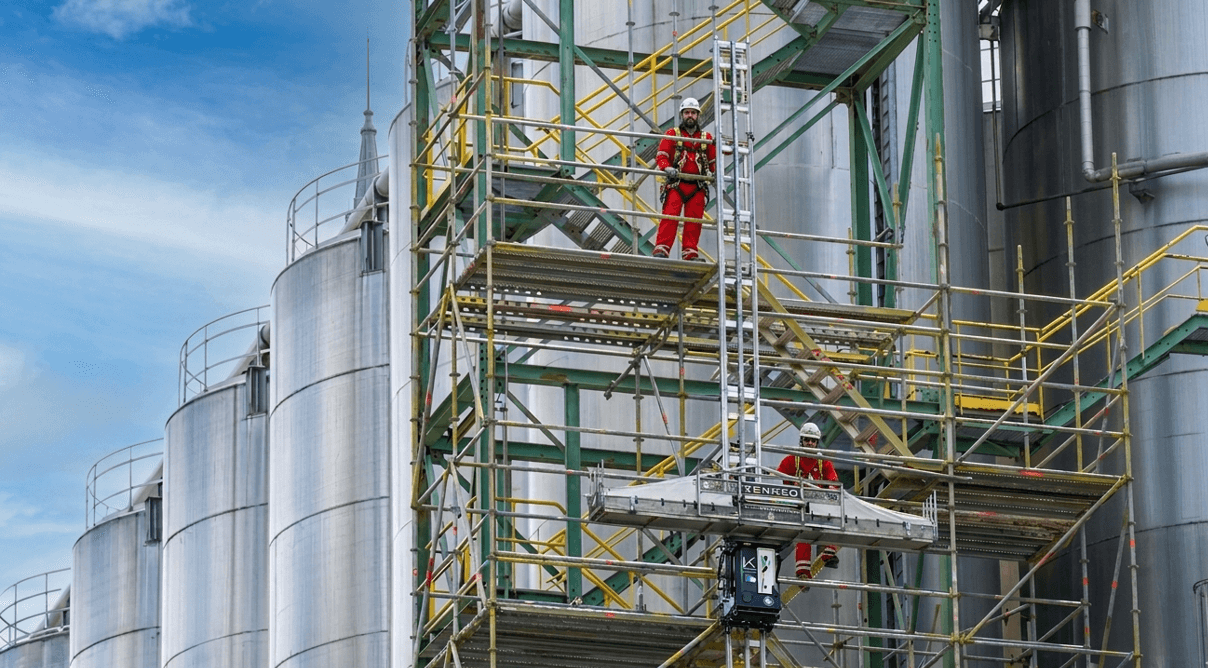
Kewazo (Munich, Germany / Houston, USA) built the most commercially proven construction logistics robot outside of earthmoving. Its Liftbot is a battery-powered, wireless vertical hoist that automates material transport on scaffolded structures.
The performance data from real deployments is documented. At Stadtwerke München, Liftbot saved 37% of man-hours in one week. A NÜSSLI Group pilot in Brandenburg delivered a 45% efficiency gain. At a Czech power plant project, two workers replaced four for a 40-meter scaffold structure. Customers include Bilfinger, BASF, ExxonMobil, Chevron, and Shell.
The headline claim — 70% man-hour reduction in scaffold assembly — is the company figure cited across its deployment data. This is Kewazo company data and has not been independently verified by a third party.
Setup takes 20 minutes. No access bay is required. No changes to scaffold design. No additional anchors. The Liftbot runs 10 hours on a single charge from a standard outlet. Certified to 50 meters. It operates at 42 metres per minute, handles up to 6,000 kg average per 8-hour shift with three workers.
Kewazo raised $10 million in a Series A led by Fifth Wall in January 2023, doubling total funding to $20 million. Its international expansion into North America is underway. The US scaffolding market is a $50 billion industry. More than 80% of it still operates completely manually, per Kewazo's market claim.
"The use of LIFTBOT resulted in a remarkable 45% increase in efficiency." — NÜSSLI Group pilot project, Brandenburg, Germany. Company-reported figure.
2. Bedrock Robotics — Autonomous Mass Excavation
Bedrock Robotics launched what it calls the construction industry's largest supervised autonomy deployment for mass excavation, partnering with Sundt Construction in November 2025.
The platform has moved more than 65,000 cubic yards of soil at a 130-acre manufacturing development site. Excavators ranging from 20-ton to 80-ton machines run the Bedrock Operator platform. The system handles repetitive truck-loading tasks autonomously, freeing skilled operators for complex decision-making.
Sundt's project manager described the problem precisely. Experienced operators are unavailable for months of repetitive earthmoving. Bedrock's technology handles the monotony. Skilled crews redirect to higher-value work.
Deployments are active across Arizona, Texas, and Arkansas. Full autonomous operation (without supervision) is targeted for 2026. Boris Sofman, Bedrock's CEO and co-founder of Anki Robotics, is building a platform designed to be non-disruptive to existing contractor workflows.
This is not a sideshow application. Mass earthmoving is the first activity on any construction site. Compressing its schedule accelerates every subsequent trade. Logistics automation at the excavation phase has multiplier effects across total project timelines.
3. Dusty Robotics FieldPrinter 2 — Logistics of Precision
Dusty Robotics does not carry materials. It eliminates the logistics of layout error. The FieldPrinter 2, launched January 2024, prints full-scale floor plans directly onto job site floors from BIM data.
Speed is 10,000 to 15,000 square feet per day with one operator. Accuracy is within 1/16 of an inch. The robot prints closer to edges, shadow-prints behind columns, and features a wider print head than its predecessor. At 23 pounds, it navigates via onboard sensors without pre-mapping.
The July 2025 partnership with Hexagon's Leica Absolute Tracker AT500 improved setup speed and industrial-grade accuracy for data centers and healthcare facilities. This is a direct response to the market's largest project types requiring the tightest tolerances.
Layout errors generate massive downstream logistics costs. Tiles placed on wrong reference lines must be torn out. Partitions built off incorrect marks require rework. Every mis-marked line creates material waste and labor hours — at a point in the project where schedule compression matters most.
Dusty's contribution to logistics is indirect but structural. Accurate layout on day one eliminates material-handling rework on day fifteen.
4. Hilti ON!Track — Asset Intelligence as Logistics Infrastructure
Hilti's approach to site logistics is not a robot. It is a data platform. ON!Track is Hilti's asset management system, now integrated with Telematics Gateways and Van Gateways as part of the Lead 2030 strategy.
The logistics case is documented. FarEye's deployment of Hilti's logistics optimization produced a 40% reduction in warehouse loading time. Tool and equipment visibility reduced project delays caused by missing assets.
In October 2025, Hilti extended its Nuron battery platform to more than 60 heavy-duty products, with initial launches in Q4 2025. The Nuron platform won a Construction Equipment 2025 Top 100 New Product Award. The platform's battery management integrates directly with ON!Track, creating unified asset and energy intelligence for tool fleets across projects.
Hilti's model is integration, not standalone hardware. Hilti reported CHF 6.4 billion in 2024 sales — a 1.5% increase in local currencies. Its construction division spans 120 countries. ON!Track's reach is structural, not startup-scale.
Source: Hilti company disclosures, FarEye case study. All performance claims originate from company or partner disclosures and have not been independently audited.
AI and Robotics: What Is Now Enabling Construction Logistics
The technology enabling logistics automation in construction is largely borrowed from adjacent industries. It is arriving faster than purpose-built construction robotics R&D alone would deliver.
SLAM and Real-Time Navigation
Autonomous mobile robots on construction sites use SLAM — Simultaneous Localisation and Mapping — to navigate without fixed infrastructure. No magnetic tape, no QR codes, no pre-mapped routes.
AMRs detect obstacles in real time, reroute around workers and equipment, and adapt to daily changes in site layout. GoLe Robotics' AMR platform uses cloud-based path planning paired with SLAM to deliver 50–110 kg payloads across dynamic construction floor layouts. This is self-driving car navigation technology applied to a 10-kilogram robot on a concrete slab.
BIM Integration as a Logistics Backbone
Building Information Modelling data is now the control layer for logistics robots. Dusty's FieldPrinter reads directly from Autodesk Revit. Buildroid AI generates robot instructions from BIM models. Hilti's ON!Track syncs with BIM to correlate tool location with project schedule.
This integration eliminates a separate logistics planning step. When the design model updates, robot instructions update automatically. The logistics workflow adapts to project changes without human re-entry of data.
Fleet Management and Multi-Robot Coordination
Single robots solve single problems. Fleets solve logistics systems. Multiple AMRs coordinated by a central platform can manage horizontal transport, vertical hoist, and tool delivery simultaneously.
The construction site as a system — where materials, tools, and equipment flow from delivery to point of use with no manual intervention — is the medium-term objective. It is not commercially standard yet. The enabling software is arriving faster than the hardware.
Shimizu's Smart Site in Japan coordinates multiple robot types via BIM-based fleet management. XCMG's X-Dragon AI platform manages autonomous equipment fleets in mining, with direct construction transfer. These are early blueprints for what site logistics automation will look like at scale.
Data Ownership and Predictive Logistics
Every connected logistics robot is also a data node. Kewazo's platform captures material flow data, labor hours, and equipment utilisation from every Liftbot deployment. Hilti's ON!Track tracks tool location, usage hours, and charge state.
This data enables predictive logistics. Patterns of material delivery timing, worker movement, and equipment idle time become visible. Project managers can adjust delivery schedules and tool positioning before shortages occur, not after.
The most underappreciated ROI in construction logistics is prevention. A prevented material shortage costs nothing. A remedied one costs labor hours, schedule delay, and management time.
Challenges: The Barriers That Still Slow Adoption
Logistics robots face different barriers from task robots. The problems are not precision or safety certification. They are connectivity, site variability, and procurement mindset.
| Challenge | Current State | Expected Resolution Pathway |
| Unstructured terrain | AMRs designed for flat warehouse floors struggle on muddy, debris-covered job sites | Ruggedised AMR designs; outdoor-rated SLAM navigation maturing |
| GPS denial and connectivity | Indoor sites and basements limit GPS; poor 5G coverage disrupts fleet management | Mesh radio, private 5G networks, tethered operations |
| Multi-trade coordination | Logistics robots conflict with human workers and other machinery in dense environments | BIM-integrated scheduling; safety-certified robot-human coexistence protocols |
| Procurement mindset | Contractors price projects per task, not per logistics hour; savings are diffuse | RaaS models making logistics ROI visible; as-a-service pricing emerging |
| Capital cost for SMEs | Logistics robot fleets are significant capex for small contractors | Rental markets expanding; leasing and subscription models developing |
| Operator data literacy | Fleet management software requires digital skills most site supervisors lack today | Simplified UX; training embedded in deployment contracts |
Assessment based on industry analysis, company disclosures, and academic literature as of early 2026.
Regional Dynamics: Where Logistics Automation Is Leading
| Region | Primary Driver | Key Application | Adoption Stage |
| Germany / EU | Labor costs €42–47/hr; safety regulation | Scaffold logistics, prefab yard automation | Early commercial; EU funding accelerating |
| Japan | i-Construction mandate; acute workforce decline | Smart Site fleet coordination; BIM logistics | Established — GC internal programs at scale |
| USA | 454,000 worker shortfall; infrastructure boom | Autonomous earthmoving, site layout, tool tracking | Commercial — IIJA-driven construction surge |
| South Korea | World's highest manufacturing robot density | BIM-integrated AMR transport platforms | Pilot to commercial — 2024–2028 transition window |
| Singapore | Dense urban sites; BCA productivity mandate | High-rise material logistics, prefab delivery | Policy-driven adoption; fast-growing sub-market |
Regional characterisation based on market research reports, government disclosures, and industry sources. IFR robot installation data cited where noted.
Editorial Assessment: The Unsexy Segment With the Best Numbers
Logistics automation in construction lacks a single mascot product. There is no SAM100 moment, no Hadrian X home-in-a-day headline. What logistics robots have instead is repeatable, compounding ROI that survives scrutiny.
Kewazo's Liftbot saves 70% of scaffold man-hours. That is not a productivity claim on a single demo project. It is a figure repeated across deployments at Bilfinger, BASF, ExxonMobil, and Chevron. Those are buyers with procurement standards. The number is not marketing — it is commercial evidence.
Bedrock Robotics' deployment with Sundt is notable for a specific reason. Sundt's project manager did not describe the ROI in cost terms. He described it in talent terms. Experienced operators will not accept months of repetitive truck loading. Automation resolves a human capital problem that wages alone cannot fix.
This pattern recurs across the logistics robot segment. The ROI argument is not always cost reduction. It is often availability. Robots are available. Skilled workers in logistics roles are not. That availability premium does not show up in most ROI models. It shows up in project delivery dates.
"The biggest challenge we face isn't just finding operators — it's keeping experienced ones engaged when we need them for months of repetitive earthmoving in remote locations." — Dan Green, Project Manager, Sundt Construction. Source: Robotics & Automation News, November 2025.
The AI integration story in logistics is also more advanced than in task robots. SLAM is mature. BIM integration is commercial. Fleet management software works. The construction logistics robot sector does not need to wait for AI breakthroughs. It needs deployment scale and contractor education.
The data flywheel is real here. Kewazo's platform captures material flow data from every deployment. Hilti's ON!Track captures tool and equipment intelligence from 120 countries. These datasets will compound over years. The companies owning construction logistics data will have a structural advantage in predictive site management that cannot be replicated by new entrants starting from zero.
One underappreciated strategic shift is the prefab yard. Offsite prefabrication is growing as a share of construction output. Prefab factories are controlled environments. AMR deployment in prefab yards is substantially simpler than on live construction sites. The robot does not navigate mud or human workers. It operates in a warehouse-like environment where floor marking, charging docks, and route planning are straightforward.
Promise Robotics and BotBuilt both appeared in the 2025 BuiltWorlds Top 50 with factory-automation approaches. ABB's partnership with AUAR and Cosmic Buildings points to the same thesis: factory-controlled logistics at scale beats field logistics in complexity and cost. The strategic investor bet is that prefab automation scales faster than site automation.
The regulatory moat argument applies differently in logistics than in safety automation. The safety case for demolition robots is existential — fatalities are the cost of non-adoption. The logistics case is financial. That means adoption follows contractor economics, not regulatory mandates. Growth will be market-driven, not policy-driven, except in Japan where the i-Construction mandate already pulls the entire sector forward.
The next five years will determine whether construction site logistics becomes a distinct product category or remains fragmented across tool tracking, AMR hardware, earthmoving autonomy, and BIM integration vendors. The companies that integrate across those layers — connecting material delivery to robot dispatch to BIM scheduling to fleet management — will capture disproportionate value.
That integration does not exist yet as a commercial product. It exists as a thesis. The parts are available. The assembly is the opportunity.
Key Findings at a Glance
| Finding | Implication |
| ~30% of construction worker time spent on non-productive material movement | Logistics ROI case is structural, not marginal — automating it changes project economics fundamentally |
| Kewazo Liftbot saves 70% of scaffold man-hours across multiple commercial deployments | Performance is proven at industrial scale, not in pilot conditions (company data; unverified by third party) |
| Bedrock Robotics moved 65,000+ cu yd autonomously with Sundt — talent availability drove adoption, not cost | ROI argument is evolving from cost reduction to talent retention and availability |
| Dusty Robotics FieldPrinter 2 eliminates layout error — 10x faster at 1/16" accuracy | Upstream precision creates downstream logistics savings that dwarf the layout tool's own cost |
| Hilti ON!Track integration with Nuron platform spans 120 countries | Data infrastructure for construction logistics is already being built at global scale by an incumbent |
| Prefab yard AMR deployment is simpler than live-site AMR — factory conditions remove key obstacles | Offsite construction growth pulls logistics automation forward on a faster, lower-cost track |
| Fleet management software is commercially ready; deployment scale is the constraint | The technology bottleneck in construction logistics is contractor adoption, not R&D maturity |









Leave a comment