


SAM100 lays 3,000 bricks per day. A skilled mason lays 500. Bricklaying is the most visible productivity gap in construction.
THE POSTER CHILD OF CONSTRUCTION AUTOMATION
Bricklaying is where construction automation became real. It is visible, measurable, and emotionally charged. No other construction task has attracted more camera time, investor capital, or union anxiety.
The numbers are unambiguous. SAM100, the semi-automated mason built by New York-based Construction Robotics, lays up to 3,000 bricks per day. A skilled human mason averages 300 to 500. That is a 6x to 10x productivity gap.
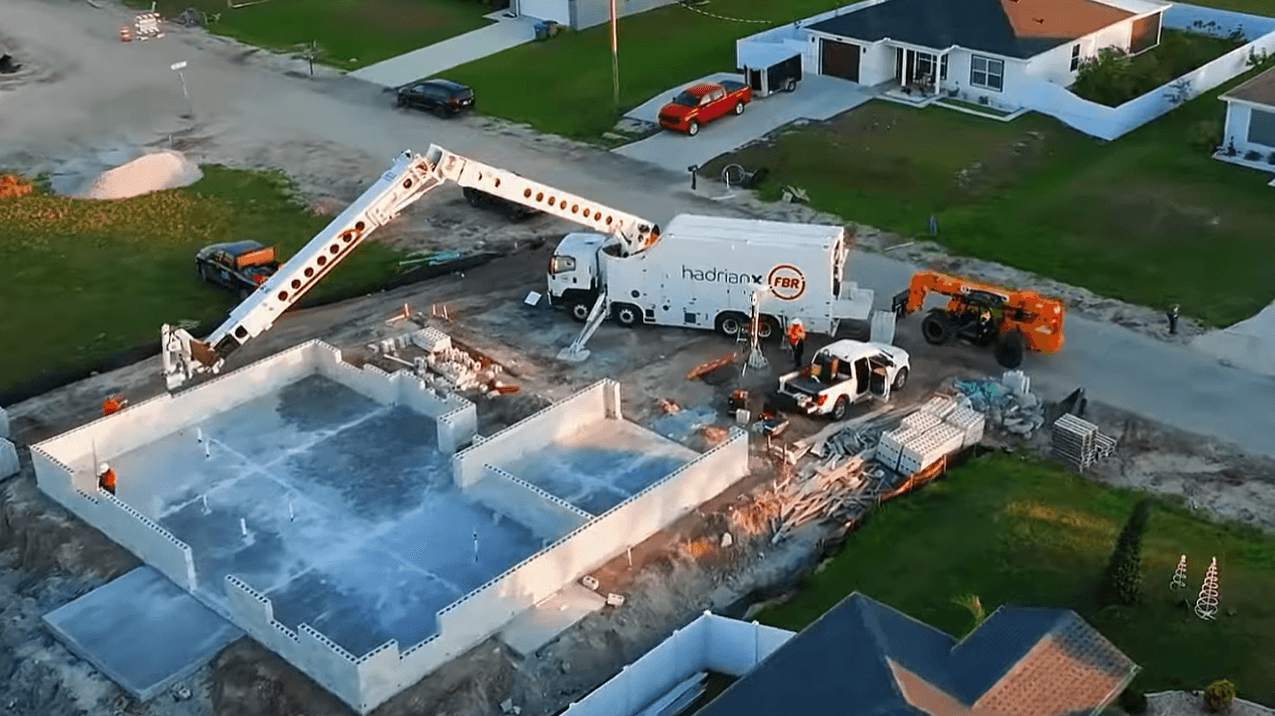
Australia's FBR completed nine homes in Florida in late 2024 using its Hadrian X robot. One home was completed in a single day with three personnel on site. Independent engineers certified all nine structures met building code standards. (Source: FBR company disclosure and CRH Ventures program. Not independently verified by a government body.)
This is not a laboratory result. It is a commercial demonstration with real buildings, real inspectors, and real buyers.
THE MARKET BEHIND THE MACHINES
The global bricklaying robot market is growing fast. The fully autonomous segment held 61.8% market share in 2024, per Coherent Market Insights. The shift from semi-automated to fully autonomous systems is accelerating.
The addressable market is enormous. The US is short 4.5 million homes, per Zillow. The Netherlands needs 100,000 new units annually but can build only 60,000. The UK needs 75,000 more bricklayers to meet its 300,000-home annual target. These are not projections. They are documented shortfalls.
Over two-thirds of bricklaying firms in the US report difficulty finding qualified labor, per a National Association of Home Builders survey. The pipeline problem is structural. It will not resolve through wage increases alone.
Key Players: Bricklaying Robot Landscape (2025)
| Player | Origin | Approach | Status (2025) | Key Differentiator |
|---|---|---|---|---|
| FBR Hadrian X | Australia | Autonomous boom truck | Commercial (US, AUS) | 500 blocks/hr; builds 3-story walls; Wall as a Service model |
| Construction Robotics SAM100 | USA | Semi-automated mason | Commercial (NA) | 3,000 bricks/day; works with human mason; 50% labor cost savings |
| Monumental | Netherlands | Multi-robot swarm (AGVs) | Pilot to commercial | $25M funded 2024; self-driving car AI; comparable cost to human labor |
| Buildroid AI | UAE/USA | BIM-simulation platform | Entering US (2026) | Nvidia Omniverse digital twin; multi-robot coordination; $2M seed |
Source: Company disclosures, TechCrunch (Feb 2024), The Robot Report (Jan 2026), Finance News Network (Dec 2024). All performance claims originate from company disclosures and have not been independently verified by third parties unless noted.
DEEP PROFILES: THE MACHINES DOING THE WORK
1. FBR — Hadrian X (Australia/USA)
Founded: 1994 (as Fastbrick Robotics) | HQ: Perth, Australia | Status: Commercial deployment, Florida WaaS program active
The Hadrian X is a truck-mounted robotic boom arm. It reads a 3D CAD model and lays masonry blocks autonomously. The boom arm extends to 32 meters. It can construct walls up to three stories high from street level.
The next-generation Hadrian X lays up to 500 blocks per hour. That equals approximately 120 square meters of wall per hour. Its predecessor managed 200 blocks per hour. This is a 70% speed improvement, per FBR. (FBR company disclosure; not independently audited.)
The system uses FBR's Dynamic Stabilisation Technology (DST). DST measures wind, vibration, and inertia in real time. It counteracts each variable automatically. This is what allows millimeter accuracy on an outdoor boom arm.
FBR does not apply traditional mortar. It uses a proprietary construction adhesive that cures in 45 minutes. The company claims bond strength exceeds mortar. This claim has not been independently verified.
In January 2024, FBR signed a binding agreement with CRH Ventures for up to 300 Hadrian X units. Each unit is valued at $2 million. A $40 million loan facility was established to support delivery. As of December 2024, CRH Ventures had a 45-day window to exercise a joint venture option. (FBR ASX disclosure; December 2024.)
2. Construction Robotics — SAM100 (USA)
Founded: 2007 | HQ: Victor, NY | Status: Commercially deployed across North America for nearly a decade
SAM100 is the first commercially available bricklaying robot for onsite masonry construction. It launched in 2015. It won the Most Innovative Product Industry Choice Award at the World of Concrete that year.
SAM100 is semi-autonomous. It picks up bricks, applies mortar, and places them using a robotic arm and laser-guided positioning. A human mason works alongside to smooth mortar and handle corners, doors, and windows.
Performance claims from Construction Robotics include 400% productivity increase and over 50% labor cost savings. These are company disclosures based on field deployments. They have not been independently verified by a third party.
At Shenandoah University in Winchester, Virginia, SAM100 set a world record. It laid 3,270 bricks in an eight-hour period. A typical mason averages 500 on a full workday. The rental cost is approximately $20,000 per month. Projects use roughly three times less labor with SAM100 deployed.
SAM100 works best on long, uninterrupted wall runs. Corners, window cutouts, and first-floor setups still require significant human intervention. Setup time on complex sites can reach 1.5 days. That reduces economics on short-duration projects.
3. Monumental (Netherlands)
Founded: 2021 | HQ: Amsterdam | Status: Deployed on commercial and social housing sites in Europe; $25M funded February 2024
Monumental builds a swarm. Three robots operate in coordination. One carries bricks. One delivers mortar. The third lays them. This multi-robot system is a different architecture from Hadrian X's single-arm approach.
The robots are compact. They fit through standard doorways. They navigate rough construction site terrain using self-driving car AI. This is the technology originally developed for autonomous vehicles. It allows Monumental's robots to steer around obstacles and workers without pre-mapping.
Monumental operates at roughly the same speed as a human mason. Its competitive argument is different. Speed is not the primary claim. Availability is. Contractors cannot hire enough bricklayers. Monumental deploys as many robots as needed.
Pricing is charged per brick laid, comparable to a human mason's rate. Contractors hire Monumental as a subcontractor. They do not purchase the equipment. This eliminates the capital barrier entirely.
The $25 million Series A in February 2024 was led by Plural and Hummingbird. The round included Northzone, Foundamental, and NP-Hard Ventures. Funding targets expanded manufacturing, more robot deployments, and handling a wider range of brick types.
4. Buildroid AI (UAE/USA) — The New Entrant
Founded: 2024 | HQ: UAE/US | Status: Emerged from stealth November 2025; US commercial deployments planned Q1 2026
Buildroid AI is the newest and most AI-forward player. It entered the US market in November 2025 after UAE pilot deployments. It raised $2 million in pre-seed funding led by Tim Draper of Draper Associates.
The core innovation is simulation-first deployment. Before any robot arrives on a job site, Buildroid runs thousands of Nvidia Omniverse-powered digital twin simulations. These optimize robot workflow, sequencing, and economics. The company argues low utilization rates have killed earlier automation attempts.
The platform is vendor-agnostic. It coordinates multiple block-laying robots (BLRs) and autonomous material-delivery robots (AMRs). BIM models from Autodesk Revit convert directly into robot instructions. Buildroid targets the $13 billion blockwork and partition-wall segment within the broader construction market.
Productivity Comparison: Human Mason vs. SAM100 vs. Hadrian X
| Metric | Skilled Human Mason | SAM100 (Semi-Auto) | Hadrian X (Fully Auto) |
|---|---|---|---|
| Daily output (bricks/blocks) | 300–500 bricks/day | 2,000–3,000 bricks/day | ~4,000–8,000 blocks equiv./day |
| Crew required | 2–4 masons | 1 mason + robot | 3 operators max |
| Operating hours | 8 hrs (fatigue-limited) | ~10 hrs | 24 hrs (continuous) |
| Precision | Manual variance | Laser-guided; low error | Sub-millimeter; CAD-driven |
| Labor cost vs. manual | Baseline | ~50% savings (CR claim) | Lower over volume (WaaS model) |
| Capital cost | Wages only | ~$500,000 purchase; ~$20K/month rental | $2M/unit; WaaS rental in US |
Source: Construction Robotics company data; FBR ASX disclosures; Bureau of Labor Statistics baseline; AZRobotics.com comparative analysis (2023). All robot performance figures are company-reported and have not been independently verified by a governmental body.
THE CULTURAL LIGHTNING ROD
Bricklaying is not just a trade. It is a 6,000-year-old craft. Brick was among the first manufactured building materials in human history. The skill is tactile, learned over years, and carries deep professional identity.
This is not abstract. When Construction Robotics deployed SAM100 on US sites, the MIT Technology Review noted the robot was getting "non-union help." That phrase captured the anxiety immediately. The robot did not replace the mason. It changed what the mason did.
The industry counter-argument is practical. There are not enough masons. The US construction sector needed 454,000 additional workers in 2025, per ABC. Bricklaying is among the hardest specialties to fill. The choice is often between a robot and an empty site, not a robot and a full crew.
Monumental's co-founder Salar al Khafaji observed that contractor reaction surprised the company. He expected robots to need to be cheaper than humans to get traction. Contractors were not price-sensitive. They were availability-constrained. "It turns out no one cares" about the cost comparison, he noted. (Source: Fortune, February 2024.)
The unions' concern is legitimate but increasingly mismatched with reality. Bricklaying injuries are endemic. Repetitive strain, back injuries, and falls represent decades of accumulated physical damage. Automation of the most repetitive tasks protects the workforce that remains.
THE REAL CHALLENGES: WHAT THE PRESS RELEASES OMIT
Bricklaying robots are the most investor-hyped segment in construction automation. They are also the most scrutinized. The challenges are real and documented.
Site geometry is the primary constraint. SAM100 is designed for long, uninterrupted wall runs. Corners, window surrounds, and door openings require human masons. On typical residential projects, this means robots handle perhaps 40 to 60 percent of total brickwork. The rest requires skilled labor anyway.
Setup time compounds the economics problem. On one documented project at Auburn University, SAM100 setup on a stage house required over a week before efficient operation began. Projects shorter than two weeks may see neutral or negative productivity gains from SAM100 deployment.
Hadrian X requires flat, accessible street-side access for its truck boom. On constrained urban sites, that is not always available. The system's performance is well-documented in open suburban construction. Its urban applicability is still being established.
Regulatory acceptance is uneven. FBR's Florida demonstration succeeded with code compliance certified by independent engineers. But building codes vary by state and municipality. What passes in Florida may require additional approval elsewhere. This creates friction for national scaling.
Challenges Matrix: Where Bricklaying Automation Stalls
| Challenge Category | Specific Barrier | Current Industry Response |
|---|---|---|
| Site complexity | Corners, openings, irregular layouts limit robot efficiency | Human-robot hybrid teams; robots handle straight runs only |
| Setup time / mobilization | SAM100 setup can take 1–2 days; impacts short-run economics | WaaS models reduce contractor burden; modular designs improve |
| Union & workforce resistance | Bricklayers unions in US/UK view automation as job threats | Framing as labor augmentation; co-deployment with human masons |
| Cultural significance | Bricklaying is a 6,000-year-old craft with strong artisan identity | Robots take repetitive loads; skilled masons retain quality control |
| Regulatory complexity | Building code compliance varies by state and country | FBR's Florida builds certified by independent engineers (2024) |
| Capital & financing barriers | Small contractors cannot afford $500K–$2M upfront costs | Rental/WaaS models emerging; FBR, Construction Robotics both offer |
Source: Academic research (Cal Poly, 2019); FBR disclosures; Construction Dive field reporting; industry surveys. Union and workforce resistance data from MIT Technology Review and ProBuilder industry coverage.
AI AND ROBOTICS: THE CONVERGENCE ACCELERATING EVERYTHING
Bricklaying robots existed before AI. SAM100 launched in 2015 using laser guidance and pre-programmed positioning. What AI brings is adaptation. The ability to handle unstructured environments, variable site conditions, and complex layouts is the unsolved problem in masonry automation.
Monumental used self-driving car AI to solve the navigation problem. Robots that can traverse rough terrain autonomously are fundamentally more deployable than those requiring flat, prepared surfaces. This single capability change opened residential and urban sites that were previously inaccessible.
Buildroid AI represents the next layer. Before robots arrive, simulation optimizes their behavior. Thousands of virtual deployments run before a single block is laid. This addresses the utilization problem that has plagued earlier systems. Idle robots are not productive robots.
Computer vision is maturing fast. Current systems detect brick positions, mortar consistency, and alignment deviations in real time. FBR's DST adjusts boom arm position dynamically against wind and vibration. The gap between factory robot precision and outdoor construction conditions is closing.
Generative AI is beginning to influence sequencing and layout optimization. Given a CAD model, AI systems can calculate the optimal brick-laying order to minimize robot movement, reduce material waste, and maximize daily throughput. This is not yet standard in deployed systems. It is in development at multiple players.
Multi-robot coordination is the frontier. Monumental's three-robot swarm is the current commercial example. Buildroid's platform is designed to scale this to multiple BLRs with autonomous material delivery robots. The vision is a site where robots handle all material logistics as well as placement.
AI and Robotics Technology Stack: What Is Enabling Masonry Automation
| Technology | Application in Masonry Robots | Impact |
|---|---|---|
| Computer vision / LiDAR | Real-time site mapping; brick detection and placement | Enables work on unstructured sites without pre-mapping |
| Autonomous navigation (SLAM) | Self-driving robot movement across rough terrain | Monumental uses AV-grade navigation; reduces operator burden |
| Digital twin / BIM integration | Pre-simulation of robotic workflow before site deployment | Buildroid AI runs thousands of Omniverse simulations; reduces wasted robot time |
| Dynamic stabilization (DST) | FBR's real-time wind and vibration compensation | Enables sub-millimeter accuracy outdoors on truck boom arm |
| Generative AI / path optimization | Optimal brick-laying sequencing from CAD model | Reduces material waste; maximizes daily throughput automatically |
| Multi-robot coordination | Swarm logistics (brick delivery + mortar + laying) | Monumental's 3-robot team; Buildroid's multi-BLR platform |
Source: Company technical disclosures, Fortune (Feb 2024), ENR (Dec 2025), The Robot Report (Jan 2026), FBR ASX filings. Technology capability claims are company-reported unless peer-reviewed citations are noted.
THE INVESTMENT SIGNAL
Capital is moving into masonry automation in structured, concentrated bets. Monumental raised $25 million in February 2024 from Plural, Hummingbird, and Northzone. FBR secured up to $40 million in loan facilities from CRH Ventures with a potential 300-unit order behind it.
Buildroid raised $2 million in pre-seed funding from Tim Draper in November 2025. The amount is modest. The signal is not. Draper's thesis was explicit: vendor-agnostic, BIM-native, simulation-first platforms are more scalable than single-robot hardware companies.
CRH Plc's involvement is the most consequential signal. CRH is one of the world's largest building materials companies. It operates in over 30 countries. Its venture arm putting $40 million behind a Hadrian X joint venture is a major materials company betting on robotic masonry at scale.
This is strategic positioning, not passive investment. If robotic block-laying becomes the default delivery method for residential walls, the company controlling both the robot and the block supply has enormous leverage.
THE VERDICT: POSTER CHILD WITH REAL WALLS TO CLIMB
Bricklaying automation is the most visible and most tested segment in construction robotics. The productivity numbers are real. SAM100's 3,000 bricks per day against a human's 500 is a documented field result, not a lab simulation.
FBR's Florida demonstration program completed nine certified homes. One was built in a day. These are not pilot projects. They are early commercial deployments with regulatory sign-off.
The barriers are real too. Site geometry, setup time, union friction, and regulatory variance all slow adoption. The economics on short or complex projects remain challenging. The transition from demonstration to mass deployment requires solving these problems at scale.
The AI and robotics convergence is moving faster than those barriers can build. Computer vision, autonomous navigation, BIM integration, and simulation-driven deployment are each advancing independently. Their combination makes each subsequent generation of masonry robot substantially more capable than the last.
The masonry robot market has the clearest visible productivity gap, the highest cultural stakes, and the most active competitive field in construction automation. It is not a solved problem. It is an accelerating race between technology maturity and construction industry inertia.
The question for masonry automation is not whether robots will lay bricks at scale. The question is which combination of hardware, software, and deployment model wins first.
KEY FINDINGS AT A GLANCE
| Finding | Implication |
|---|---|
| SAM100: 3,000 bricks/day vs. 500 for a mason | Documented productivity gap is real and commercially verified |
| FBR completed nine certified US homes (2024) | Autonomous bricklaying has passed regulatory proof-of-concept |
| Monumental raised $25M; uses self-driving car AI | AI convergence is closing the unstructured-site navigation barrier |
| CRH Ventures: potential $40M facility, 300 Hadrian X units | Major building materials players are making structural bets |
| Buildroid AI: simulation-first platform, US entry 2026 | BIM-native, multi-robot orchestration is the next competitive layer |
| 75,000 bricklayer shortfall in UK; 4.5M US housing gap | Labor scarcity forces adoption faster than cost ROI alone |
| Setup time and geometry constraints limit short-run economics | Robot deployment models (WaaS, per-brick pricing) are the unlock |
SOURCES & METHODOLOGY NOTE
Primary sources: FBR ASX filings and company disclosures (2022–2024); Construction Robotics company data; Fortune (February 2024); TechCrunch (February 2024); The Robot Report (January 2026); Engineering News-Record (December 2025); Finance News Network (December 2024); Bureau of Labor Statistics; National Association of Home Builders survey data; MIT Technology Review; Cal Poly Construction Management research (Madsen, 2019); Coherent Market Insights bricklaying robot market analysis; AZRobotics comparative analysis (2023). Where data originates from proprietary company models, member surveys, or industry bodies without independent third-party verification, this has been noted inline throughout the article. FBR financial performance data from FBR preliminary annual report (June 2024): $2.36M revenue, net loss after tax of $27.7M — included for context on commercialization stage.








Leave a comment