

A capital rush into humanoid intelligence
China’s robotics sector is heating up at breakneck speed. In September 2025, Shenzhen-based Zhipingfang — barely two years old — closed a new Series A round that vaulted its valuation past $1 billion. The company has now raised seven multi-hundred-million-yuan rounds in under a year from investors including Shenzhen Capital Group, Yunqi Capital, and PwC Capital — an unprecedented streak even in China’s funding-hungry robotics market.
Zhipingfang isn’t alone. Domestic leaders such as Zhiyuan Robotics, Unitree Technology, Fourier Intelligence, and Galaxy Robotics have all reached or surpassed the $1 billion threshold, with Zhiyuan’s valuation topping ¥18 billion ($2.5 billion). Analysts increasingly compare humanoid-robot valuations to those of the auto industry — a market long seen as a bellwether for large-scale embodied-intelligence adoption.
A $5 trillion vision
According to Morgan Stanley’s September report, global humanoid-robot deployment could reach one billion units by 2050, creating a $5 trillion market — twice the combined 2024 revenue of the world’s 20 largest automakers. This projection is fueling both investor optimism and policy momentum in Beijing. At the CEAI 2025 conference in March, China’s Ministry of Industry and Information Technology (MIIT) announced a three-year action plan for intelligent robotics (2025–2027), backed by a ¥20 billion industry fund to accelerate core-component R&D in areas such as multi-modal perception and end-to-end motion control.
IPO hopes and valuation anxiety
The wave of unicorn valuations has sparked debate over a potential bubble. Optimists argue that short-term inflation is a necessary catalyst to concentrate capital and accelerate industrial scaling. Higher valuations, they say, help startups maintain momentum and prepare for IPO thresholds.
The next litmus test may come from Unitree Technology’s planned IPO, guided by CITIC Securities. CEO Wang Xingxing called the listing process “a college-entrance exam for the company.” If successful, analysts expect Unitree to set a new valuation benchmark for China’s embodied-intelligence sector and trigger fresh funding activity across the board.
The valuation gap with the U.S.
Despite the domestic boom, Chinese robot companies remain undervalued compared with U.S. peers. Figure AI’s September Series C funding sent its valuation soaring from $2.6 billion to $39 billion — a fifteen-fold jump in just seven months. Physical Intelligence is reportedly raising new funds at a $5 billion valuation, with backers including Jeff Bezos, OpenAI, and Thrive Capital.
By contrast, China’s top robotics companies hover around the $1 billion mark. Investors note that if these firms were based in the U.S., their valuations could easily be five to ten times higher. The gap reflects differences in venture ecosystems: American capital is abundant but targets fewer companies, concentrating on high-visibility integrators and humanoid projects. China’s ecosystem, meanwhile, spans a broader supply chain from core components to AI models, dispersing capital across hundreds of startups.
Moreover, U.S. investors reward long-term potential and global reach, often funding companies without immediate commercial revenue. Chinese funds tend to be more pragmatic, anchoring valuations to demonstrable product deployments and quantifiable returns.
Commercial momentum: ¥1.3 billion in orders
Between July and October 2025, China’s humanoid-robot companies announced orders worth over ¥1.3 billion ($180 million), marking a clear shift from prototypes to production.
-
Zhipingfang signed a ¥500 million strategic agreement with HKC’s subsidiary Huizhi IoT to deploy 1,000 AlphaBot wheel-type robots across semiconductor display plants — the world’s first large-scale embodied-intelligence deployment in that sector. Its robots are already operational at Dongfeng Liuzhou Motor and Jingneng Microelectronics, handling assembly, inspection, and testing tasks that boost quality consistency and reduce labor dependence.
-
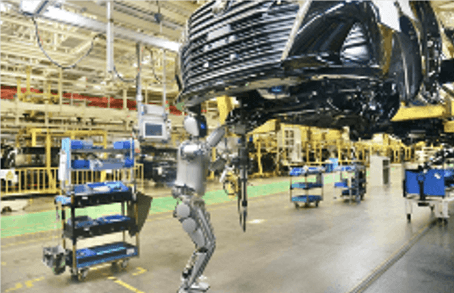
UBTech has secured China’s largest single humanoid-robot order to date — ¥250 million from a major automaker — and another ¥90 million project with Miyi Automotive. More than 300 UBTech Walker robots will be deployed in a 2,100-acre logistics hub to handle inspection, labeling, and warehouse operations. The Walker series is already used by NIO, BYD, and Zeekr, with total contract value exceeding ¥246 million.
-
Zhiyuan Robotics is deploying hundreds of its A2-W robots at Fulin Precision’s powertrain plants, delivering thousands of materials daily across 15 feeding points. It recently expanded into consumer electronics, signing a multi-hundred-million-yuan framework deal with Longqi Technology to introduce its Sprite G2 robots on tablet-assembly lines.
The domestic supply-chain advantage
China’s accelerating commercialization is underpinned by its maturing supply chain. High-precision reducers and servo motors — once import-dependent — are now cost-competitive thanks to domestic R&D. Local joint modules have achieved performance levels approaching international standards and are even exported to the U.S., enabling Chinese manufacturers to scale humanoid production without foreign bottlenecks.
Outlook: between hype and inevitability
China’s embodied-intelligence race is still in its early chapters. No dominant technical path or business model has yet emerged, and the market remains fiercely fragmented. Leading companies are advancing rapidly but remain vulnerable to new entrants with breakthrough designs. Investors are becoming more discerning, favoring sustainable growth over speculative valuation.
Still, in an industry where even a small lead in hardware or deployment can translate into outsized capital rewards, the momentum behind China’s robot revolution shows no sign of slowing.



Leave a comment