


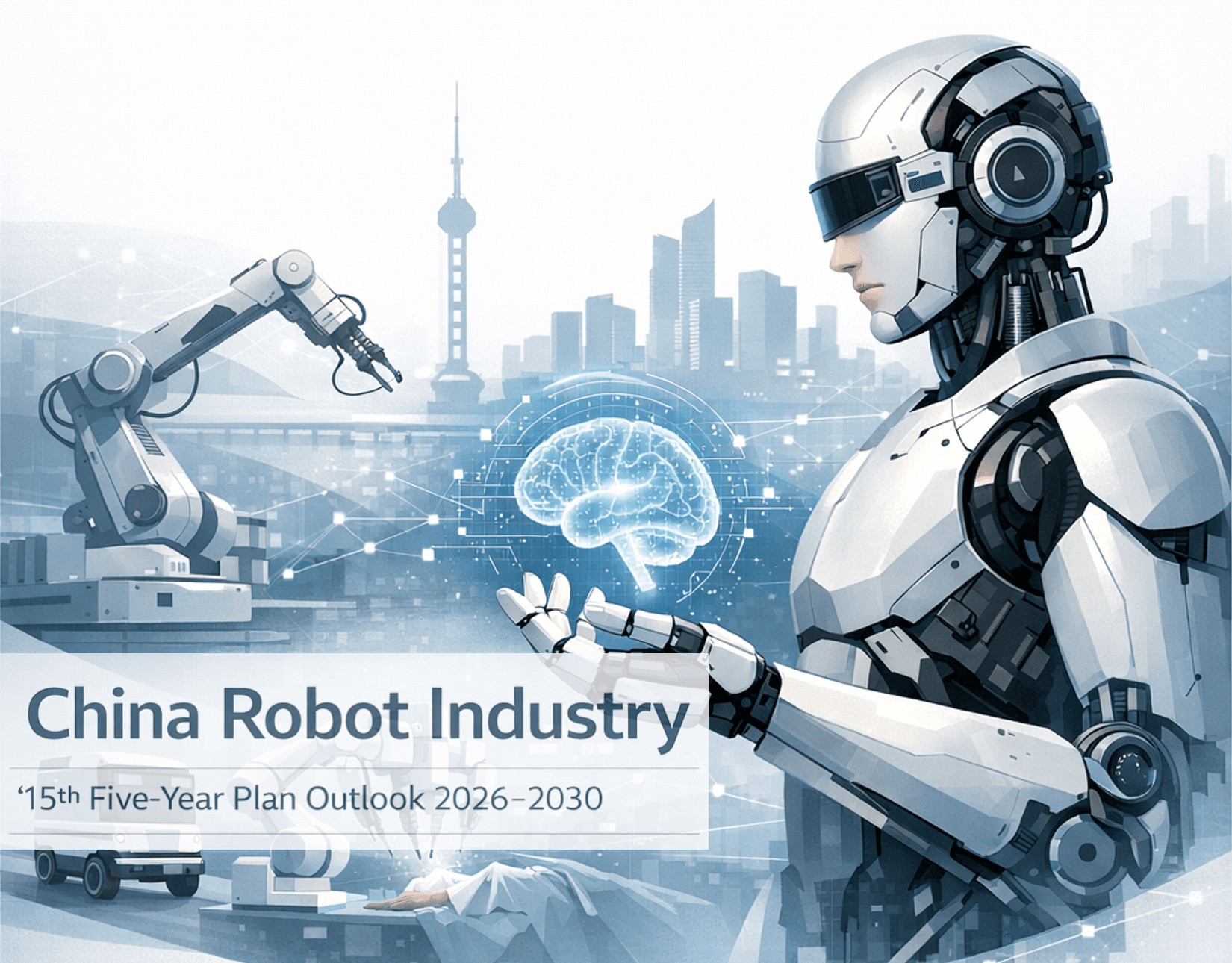
What global robotics industry needs to understand about China's five-year blueprint.
1. The Plan's Core Signal: From Niche Subsidy to Strategic Infrastructure
The term 'artificial intelligence' appears more than 50 times in the plan document. Embodied intelligence now commands its own dedicated inset box (Box 3, Item 02) among the plan's ten priority future-industry tracks, alongside integrated circuits, biomanufacturing, and commercial spaceflight.
The inset language is operational rather than aspirational. The plan directs authorities to:
coordinate the layout of embodied intelligence training grounds
promote virtual-real fusion collaborative training and model evolution
develop integrated 'big brain / small brain' embodied models and algorithms
tackle key technologies in the body and core components
accelerate the upgrade and deployment of humanoid robots and other form-factor products
This is directive procurement language. It commits state investment, land, and procurement mandates to a specific technology pathway.
Chapter 13 of the plan also establishes an 'AI+' cross-cutting action programme covering science and technology, industrial development, consumer upgrades, social welfare, governance, and green development — making robotics and embodied intelligence a connective thread across the entire economic modernisation strategy rather than a single-ministry programme.
2. The Baseline: What China Has Already Built
The 15th FYP builds on substantial existing momentum. Understanding the plan requires first understanding the infrastructure it accelerates from.
Industrial Robotics
China installed 295,000 industrial robots in 2024 — 54% of the global total — with an operational stock exceeding 2 million units.
Domestic brands have grown market share significantly, though high-precision segments remain partially import-dependent.
Humanoid Robots
2025 has been formally designated China's 'first year of humanoid robot mass production' by MIIT. More than 140 domestic manufacturers released over 330 distinct models during the year.
Chinese firms shipped approximately 90% of global humanoid robot units in 2025. AgiBot led with around 5,168 units; Unitree shipped over 4,200.
More than 150 humanoid robot companies now operate in China.
Training Data Infrastructure
Over 40 state-funded robot training centres are generating millions of real-world task-completion data entries. Unlike cloud-AI training data, embodied intelligence models improve through physical task repetition — these centres are producing proprietary scenario-specific datasets unavailable to foreign competitors.
3. Strategic Priorities at a Glance
| Dimension | Strategic Priority | Key Measures & Context |
| Strategic Positioning | Embodied intelligence elevated to a named future-industry priority alongside quantum tech, 6G, and brain-computer interfaces | First mention in Premier Li Qiang's Government Work Report; AI referenced 50+ times in the full plan document |
| Technology R&D | 'Big brain / small brain' model development; virtual-real fusion training infrastructure | 40+ state-funded training centres; national simulation and pilot platforms mandated |
| Standards | National standard system released; IEC international standards leadership being pursued | MIIT Standardization Committee; 120+ institutions in standards development; eldercare robot IEC leadership |
| Application Deployment | Move from demonstrations to real manufacturing, healthcare, and high-risk industrial operations | EV, semiconductor, healthcare, eldercare, mining, and hazardous-environment sectors explicitly targeted |
| Supply Chain Localisation | Domestic substitution of high-precision components now a top-level FYP mandate, not a ministry sub-target | Ball screws, servo motors, gear/transmission devices named explicitly; threat to Japanese and European suppliers |
4. Technology: The 'Brain' Problem Takes Centre Stage
If China's 14th FYP (2021–2025) addressed supply-chain self-reliance in robot 'bodies' — actuators, reducers, servo drives — the 15th FYP pivots decisively toward the cognitive layer.
The Big Brain / Small Brain Architecture
Chinese robotics policy now organises around a two-tier cognitive model: a 'big brain' handling environmental understanding and high-level decision-making (analogous to foundation AI models), and a 'small brain' managing real-time motor control and low-latency physical response. The FYP explicitly funds model development across both tiers and their integration — a research agenda that directly competes with Boston Dynamics, Figure AI, Agility Robotics, and European humanoid startups.
Virtual-Real Fusion Training
A core bottleneck for embodied AI is the gap between simulation and physical reality. The plan funds national platforms combining physics-accurate simulation with real-robot data collection, targeting the transition between laboratory performance and factory-floor reliability.
Core Component Localisation
The plan explicitly names high-precision ball screws, high-parameter gear and transmission devices, and advanced sensors as domestic breakthrough targets — a direct competitive signal toward Japanese and European precision-engineering suppliers that currently hold significant market positions in China's robotics production chain.
5. Standards Strategy: The 5G Playbook, Applied to Robots
Running parallel to the FYP is China's rapid move to establish domestic and international standards for humanoid robots and embodied AI — a strategy with direct precedent in 5G and high-speed rail.
In December 2025, MIIT established a dedicated Humanoid Robot and Embodied Intelligence Standardization Technical Committee (HEIS). By 1 March 2026, the committee — involving over 120 research institutions, enterprises, and end-users — released the Humanoid Robot and Embodied Intelligence Standard System (2026 Edition), covering:
Basic and common standards (terminology, architecture, interoperability)
Neuromorphic and intelligent computing (brain-cerebellum specifications, data lifecycle, model training and deployment)
Limbs and components (actuators, sensors, mechanical interfaces)
Complete machines and systems integration
Application standards (scenario-specific deployment and maintenance protocols)
Safety and ethics (lifecycle compliance requirements)
China is simultaneously leading formulation of IEC international standards for eldercare robots and actively shaping global norms for robot safety, interoperability, and data governance. The strategic logic mirrors the 5G campaign: establish the domestic standard first, build industrial scale around it, then promote it as the de facto international norm — requiring foreign manufacturers selling into China, and eventually globally, to comply with Chinese-origin specifications.
6. Deployment Priorities: Where Robots Are Expected to Work
The FYP explicitly redirects China's robotics programme away from headline demonstrations toward measurable economic deployment. Priority sectors include:
Advanced Manufacturing
New energy vehicles, semiconductors, and aerospace: pushing domestic robots into core process steps (precision welding, wafer handling) currently served by Japanese and European systems.
Traditional manufacturing: broadening the automation frontier in industries where robot density remains below sector averages.
Healthcare and Eldercare
China's demographic trajectory — a rapidly ageing population with a shrinking working-age cohort — makes eldercare robotics a structural demand rather than a discretionary market. Rehabilitation, companionship, and assisted-living platforms are explicitly targeted.
High-Risk Industrial Operations
Mining, hazardous chemicals, and nuclear facilities: the plan targets meaningful reduction in human exposure to dangerous conditions. The special-purpose robot market is anticipated to exceed RMB 100 billion by 2030.
Commercial and Logistics Services
Warehouse automation, last-mile logistics, and food service: 'robot-as-a-service' deployment models are supported as a route to faster commercial adoption at scale.
7. The Provincial Amplifier
Central FYP targets are amplified by provincial competition. Several dynamics are already visible entering the plan period:
Guangdong, China's largest provincial economy, has designated embodied AI a 15th FYP-period priority alongside 6G and quantum technologies.
Shenzhen committed a dedicated RMB 10 billion AI and Robotics Industry Fund in early 2025.
Beijing's Yizhuang development zone has set a formal ambition to become a globally leading embodied intelligence robotics industrial hub.
This provincial competition — backed by local subsidies, land grants, and procurement mandates — has historically caused deployment to significantly exceed central plan projections in sectors from solar panels to electric vehicles. Observers applying only the central FYP targets are likely to underestimate the aggregate pace.
8. Competitive Implications for International Industry
For European Component Manufacturers
The explicit FYP targeting of ball screws, servo drives, and precision transmission components for domestic substitution represents a medium-term demand risk for German, Italian, and Swiss precision-engineering exporters. The question is not whether substitution will occur, but at what speed and quality level.
For Japanese Robot Manufacturers
Japan supplies an estimated 35–45% of China's high-value robotics components and holds dominant positions in industrial robot segments where Chinese domestic players have been slower to reach quality parity. The FYP's component localisation targets, combined with national procurement preferences, represent a structural revenue risk over the 2026–2030 period.
For US Robotics and AI Companies
The more pressing concern is systemic rather than product-specific. When a single national framework simultaneously funds foundation model research, builds physical training environments, mandates government procurement, and shapes international standards, the resulting deployment velocity is difficult to match through market-driven investment cycles alone. The 15th FYP is China's explicit attempt to shift the AI competition from the cloud — where the US holds structural advantages — to the physical economy, where deployment scale, data generation, and standards-setting create compounding advantages.
For Global Manufacturers Evaluating Robot Procurement
Companies assessing robotics purchasing — particularly in automotive, logistics, and healthcare — should expect continued rapid performance-per-cost improvement from Chinese humanoid and collaborative robot platforms over the plan period. Procurement evaluations conducted today against 2024 specifications may be materially out of date by 2027.
Key Takeaways
Embodied intelligence has been formally elevated to a top-tier national industrial priority in China's 15th Five-Year Plan — the first time this category appears at this level in Chinese policy.
The plan's Box 3, Item 02 language is directive and specific: it commits infrastructure investment to training grounds, simulation platforms, and model development rather than setting aspirational targets.
China's national standards framework for humanoid robots (released 1 March 2026) mirrors the 5G strategy: establish domestic norms first, scale around them, then export as international defaults.
Provincial competition will amplify central targets. Historical precedent in solar and EVs suggests aggregate deployment will outpace central plan projections.
The competitive risk for international players is primarily systemic: the coordinated integration of model research, physical infrastructure, procurement mandates, and standards-setting into a single national programme creates a pace of development difficult to replicate through market-driven cycles.
Sources and Methodology
This briefing draws on the publicly released 15th Five-Year Plan outline (March 2026), official statements from MIIT and the Ministry of Science and Technology, the Humanoid Robot and Embodied Intelligence Standard System (2026 Edition) released 1 March 2026, Premier Li Qiang's Government Work Report to the NPC, and analysis from The Diplomat, China Briefing, TechNode, and official PRC state media. All figures cited reflect publicly available data as of 13 March 2026.
Stay ahead with real-time robotics and AI news in our Industry Briefing







Leave a comment