

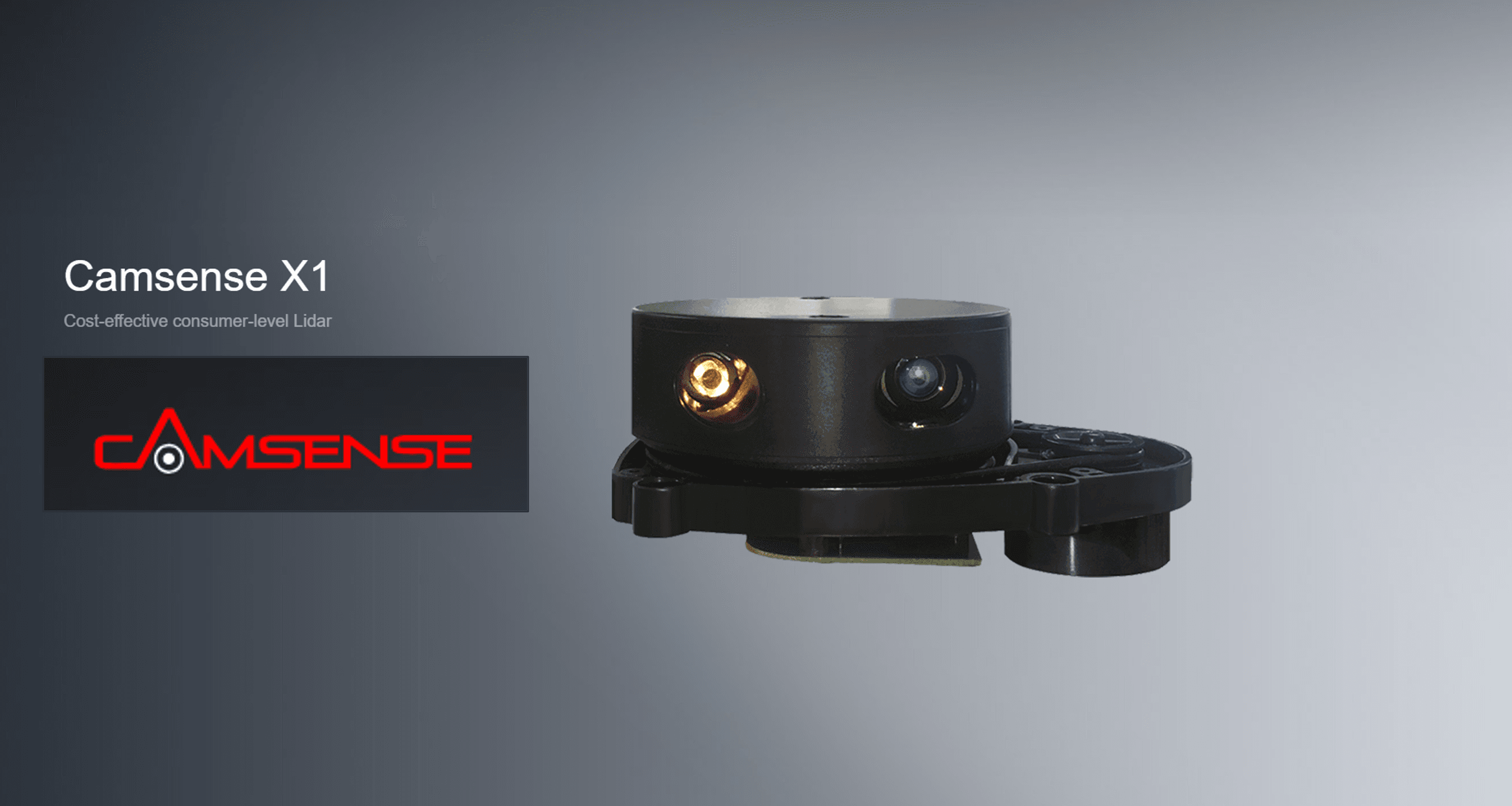
The Company at a Glance
Founded: 2014 Headquarters: Shenzhen, China
Core Business: Spatial perception solutions for robotics, XR, and industrial applications
Key Products: 2D/3D LiDAR sensors, dToF modules, Camsense C1/C2 visual ASICs, XR/6DoF tracking systems
Main Clients: Xiaomi, Dreame, Roborock, 360 Smart Life, and other major cleaning robot OEMs
Cutting Edge of Camsense’s Technology
Camsense’s technological edge lies in its ASIC-level integration and optical-mechanical co-design—a combination rarely achieved by consumer-grade LiDAR manufacturers.
Its C1/C2 visual processing chips consolidate image recognition and ranging algorithms into a single silicon layer, drastically lowering BOM cost and latency. The company’s dToF (direct Time-of-Flight) modules extend effective range and precision for next-generation 3D sensing, while its XR/6DoF tracking systems have entered the headset and interactive entertainment sectors.
This vertical integration—from laser emission modules to algorithms—gives Camsense the potential to move beyond a component supplier toward becoming a complete spatial-perception platform provider.
Scale Without Profit: The Paradox of Camsense
Camsense dominates the 2D LiDAR segment used in robot vacuums—shipping around 8 million units annually, equivalent to over 50% market share.
But its financials tell another story: revenue grew from RMB 146 million (2022) to RMB 433 million (2024), yet it still posted cumulative losses exceeding RMB 60 million.
Gross margins fell from 17.8% to 13.2%, even as production capacity expanded from its Shenzhen base to a new plant in Huizhou, whose utilization slid from 93% to about 75%.
Why Can’t Scale Bring Profit?
1. Weak Pricing Power.
Robot OEMs such as Xiaomi and Ecovacs hold the upper hand in procurement, forcing component suppliers into “volume for price” strategies. LiDAR modules have become standardized, making cost the only differentiator.
2. The Middle-Tier Trap.
As mid-range robot models shift to vision-based vSLAM and 3D perception, demand for 2D LiDAR grows slower and margins shrink. Camsense’s dToF and 3D sensors are still scaling.
3. Expansion Drag.
New production lines, depreciation, and R&D for its ASIC chips raise fixed costs, while yield rates and utilization lag behind growth.
4. Client Concentration.
Top customers account for a large share of revenue; procurement cycles and inventory adjustments create profit volatility.
Competitors Landscape
Camsense faces intense competition from both domestic and global sensor makers:
| Segment | Competitors | Region | Notable Strengths |
|---|---|---|---|
2D/3D LiDAR for service robots | Benewake, Slamtec, Hesai, Livox (DJI) | China | Mature ecosystem, strong OEM relations |
Consumer & Automotive LiDAR | RoboSense, Innovusion, Hesai | China | Long-range dToF and hybrid solid-state LiDAR |
Global industrial LiDAR | SICK, Velodyne, Ouster, LeddarTech | Germany / US / Canada | Precision, reliability, automotive certification |
XR & Spatial Tracking | Pimax, AntVR, HTC Vive, Meta Reality Labs | Global | Software-defined 6DoF ecosystems |
While Camsense leads in low-cost, high-volume 2D LiDAR, its global peers command higher margins through proprietary software stacks, vertical integration, or automotive-grade certifications.
Strategic Outlook
To break free from the commodity trap, Camsense must:
- Increase high-margin product share — dToF and 3D LiDAR, XR tracking, and industrial sensors.
- Leverage self-developed C1/C2 chips to integrate perception algorithms and offer turnkey “perception-as-a-system” solutions.
- Diversify customers beyond consumer robotics into industrial, automotive, and healthcare perception markets.











Leave a comment