

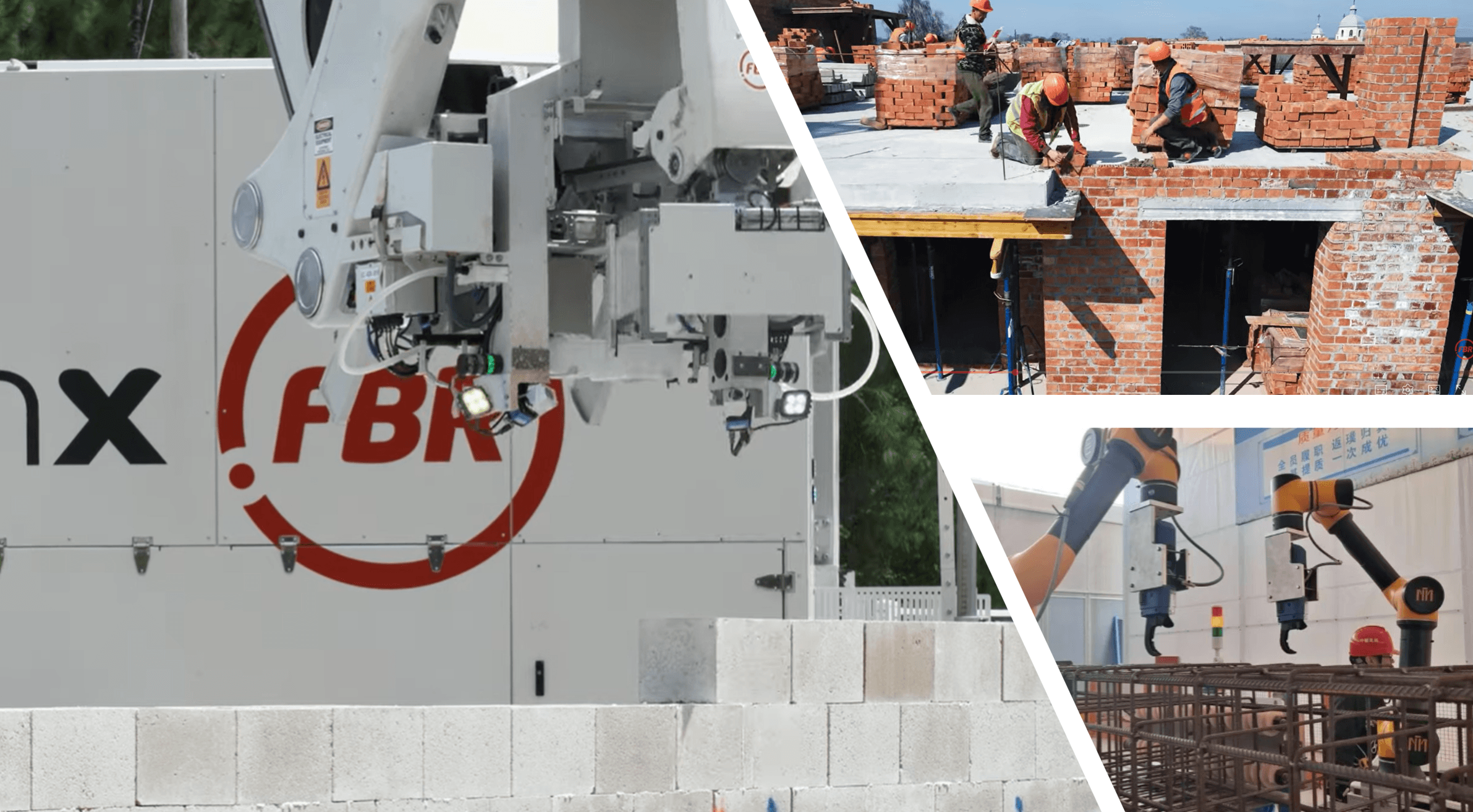
Construction robots are moving from lab demos to real-world deployment. Australia’s FBR, with its Hadrian X brick-laying robot, has proven that a truck-mounted, fully automated system can complete a home’s walls within a day. In China, JITRI Intelligence is experimenting with rebar-tying and welding robots to replace heavy manual work. Together, they signal a new phase where automation addresses labor shortages, safety risks, and productivity gaps. Experts agree: construction sites won’t be “robot-only” soon—but targeted robotic systems will become as indispensable as power tools, transforming how the world builds.
The Rise of Robotic Builders
Construction sites have long resisted automation. Yet the combination of chronic labor shortages, rising material costs, and digital design tools is shifting the balance. Robots that can physically manipulate bricks, rebar, or welding torches are no longer experimental curiosities—they are entering contracts and tender documents. According to McKinsey, AI-driven productivity tools can reduce total construction hours by 10–30 percent, offering a clear commercial incentive to automate the hardest and most repetitive jobs.
FBR’s Hadrian X: Precision Bricklaying at Industrial Speed
In Perth, Australia, FBR (Fastbrick Robotics) has spent more than a decade developing the Hadrian X, a fully automated bricklaying system. Mounted on a truck chassis, the robot can place up to 360 blocks per hour and handle large-format blocks weighing up to 45 kg. Using its patented Dynamic Stabilisation Technology, Hadrian compensates for vibration and wind in real time, maintaining millimeter-level accuracy even in outdoor environments.
Recent trials in the United States demonstrated complete exterior and interior wall construction for single-family homes within a day—an unprecedented pace. FBR now markets the concept as Walls-as-a-Service (WaaS): a turnkey delivery model where customers purchase completed walls rather than machines. This approach aligns with how contractors think—around schedules, not hardware.
China’s JITRI Intelligence: Robots for Rebar, Welding, and Logistics
Across the Pacific, JITRI Intelligence (affiliated with the Jiangsu Industrial Technology Research Institute) is taking a different path. Its robots target some of the most labor-intensive site tasks:
- Automated rebar-tying cells capable of securing each knot in just 3–4 seconds, improving both consistency and safety.
- Portable welding robots with laser-arc hybrid sensing for seam tracking and adaptive parameter control, deployable within 20 minutes on site.
- Autonomous mobile robots (AMRs) that move materials between floors via elevators, using LiDAR + vision SLAM and centralized fleet coordination.
These systems reflect China’s large-scale, standardized project environment, where high throughput and tight schedules favor specialized robotic modules over humanoid generalists.
Expert View: Robots Won’t Replace Workers—They’ll Redefine the Work
Global experts converge on one point: the “robotic jobsite” will not eliminate human labor but re-segment it. Routine, high-risk, or precision-critical tasks—bricklaying, welding, inspection, logistics—are first in line for automation.
As an Autodesk executive noted in a recent podcast, “Robots will become the new power tools.” McKinsey’s construction outlook similarly predicts a decade of hybrid operations, where human-robot collaboration, digital twins, and on-site data capture form the backbone of productivity gains.
The Emerging Business Models
The most successful robotics ventures are not selling machines—they’re selling performance.
FBR’s WaaS treats wall construction as a measurable service. JITRI’s integrators are moving toward per-unit or per-area pricing, turning robots into operational assets rather than capital purchases. This model reduces barriers for contractors and aligns incentives: efficiency, not hardware ownership, becomes the metric of success.
Roadmap: From Single Tasks to Connected Ecosystems
Over the next three years, construction robotics will evolve in three stages:
- Single-Task Deployment (2025-2026): Focus on high-ROI processes—bricklaying, rebar, welding, on-site logistics.
- System Integration (2026-2027): Link robots to BIM systems, elevators, and material supply chains; introduce per-output billing contracts.
- Data-Driven Expansion (2027-2028): Use fleet-management and digital-twin analytics to coordinate multi-robot sites, enabling night-shift or semi-autonomous operation.
This stepwise evolution echoes McKinsey’s guidance: “Automation succeeds where productivity is measurable, repeatable, and integrated.”
A New Industrial Species on the Jobsite
The global construction industry is entering its robotic century. Whether it’s FBR’s high-speed bricklaying trucks in Australia or JITRI’s rebar and welding systems in China, robots are proving that automation and craftsmanship can coexist. They won’t replace builders—but they will redefine what it means to build.
Source references:










Leave a comment