


Background: A Market Under Structural Pressure
North America's warehousing sector is running short of workers. The U.S. Bureau of Labor Statistics recorded over 380,000 unfilled warehousing positions in Q1 2026, with average hourly wages for order pickers and material handlers rising 14.3% cumulatively between 2022 and 2025. The total annual cost of a human picker in a North American operation — wages, benefits, training, absenteeism, and turnover replacement — now routinely exceeds $52,000.
Against this backdrop, the global AMR market is expanding at a sustained clip. Estimates across major research firms converge in the range of $4.5–6.3 billion for 2025, with CAGRs projected between 14% and 23% through 2031–2034 depending on scope definition. Warehouse and logistics accounts for roughly 33% of all AMR deployments by revenue. Yet despite this growth, Interact Analysis estimates that by 2030, only 13% of warehouses globally will have deployed even one fulfillment AMR — meaning the vast majority of facilities are still in pre-automation mode.
This is the market context in which Big Joe Autonomous Solutions arrived at Automate 2026 with four new products.
Big Joe: From 1951 Pallet Truck to 2026 Autonomous Fleet
Big Joe Forklifts, founded in 1951 and headquartered in Madison, Wisconsin, built its North American reputation on compact, economical walk-behind stackers and pallet trucks suited for retail back rooms and narrow-aisle warehouses. The brand became a familiar name in mid-market and light-industrial material handling across the continent.
The company has since repositioned through two successive technology shifts. The first was electrification: Big Joe moved away from internal combustion equipment toward lithium-ion integrated platforms, and designed its UL 2580-certified lithium-ion battery in-house and integrated it into the chassis architecture from the ground up, enabling tighter packaging, smaller turning radii, and native support for opportunity charging without full battery swaps.
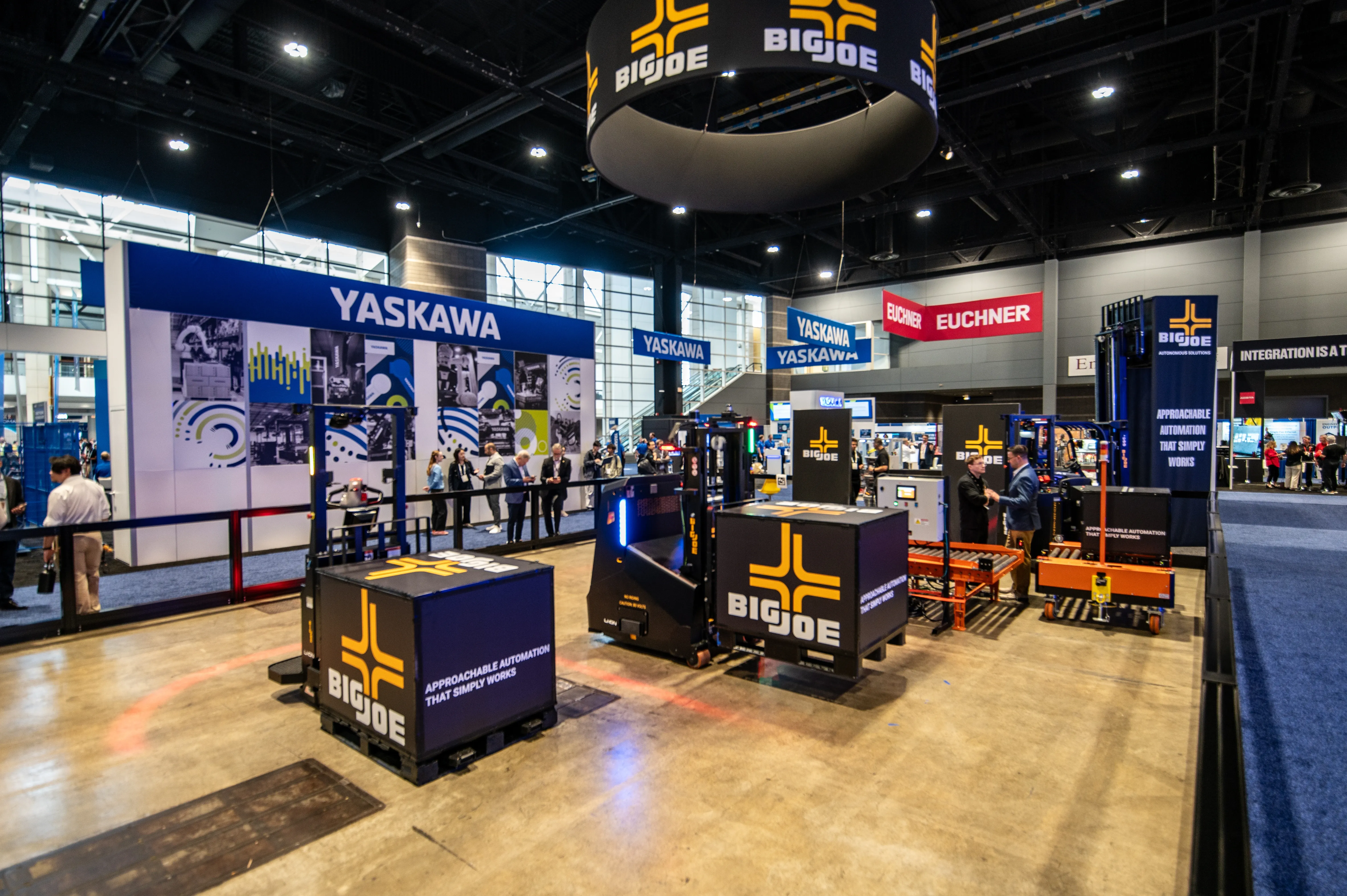
The second shift is autonomy. At Automate 2026 in Chicago (Booth #606), Big Joe Autonomous Solutions debuted four new vehicles on June 22, 2026: the AP44, ASC40, ATC100, and ACV40. Each runs on Big Joe's proprietary lithium battery system and is designed, according to the company, to deploy without major facility layout changes or infrastructure modifications.
The Four Products: Specifications and Use Cases
AP44 — Autonomous Pallet Truck | 4,400 lb. Capacity
The AP44 operates across three distinct modes within the same facility and the same shift. In manual mode, it functions as a standard electric pallet truck operated by a person. In semi-autonomous mode, an operator engages the load; pulling down on the control handle returns the unit to manual control at any point, while releasing the handle and confirming via the onboard UI returns it to autonomous mode — allowing the vehicle to handle transport and drop-off independently. In fully autonomous mode, no operator involvement is required; the vehicle executes horizontal transport missions end-to-end.
The multi-mode design addresses a specific operational constraint common in mid-sized distribution centers: the need to run some tasks autonomously and others with human involvement, without maintaining separate vehicle fleets for each. The AP44 allows facilities to graduate toward automation task-by-task rather than committing to a full fleet replacement or a single operating mode.
ASC40 — Autonomous Counterbalanced Stacker | 4,000 lb. Capacity
The ASC40 is designed exclusively for autonomous operation — there is no manual mode. Its use case is narrow: repetitive pick-and-place operations in pallet staging, racking, and line-side replenishment at lift heights between 3 and 3.5 feet (0.9–1.0 m).
The exclusion of a manual mode is a deliberate engineering constraint. By removing the hardware and software overhead required to support human operation, Big Joe was able to optimize the ASC40's footprint for tight aisles and staging areas where a standard counterbalanced stacker would be too wide to operate. The trade-off is inflexibility: the ASC40 cannot substitute for a human-operated vehicle when the task changes.
This positions the ASC40 as a high-repetition, single-task automation tool rather than a general-purpose vehicle. It fits facilities where a specific workflow runs the same way every shift — the narrower the use case, the higher the utilization rate and the faster the payback period.
ATC100 — Autonomous Tugger | 10,000 lb. Tow Capacity
The ATC100 handles point-to-point transport of carts, components, and in-process materials. At 10,000 lbs. of tow capacity, it covers the heaviest horizontal transport use case in Big Joe's autonomous lineup.
The vehicle supports mixed human-machine operations: autonomous vehicles and workers can share the same workspace, and an operator can take manual control of the ATC100 at any time. This is relevant for manufacturing environments where autonomous tugger routes cross high-traffic human zones, and where complete segregation of robot and human pathways is not feasible or cost-effective.
Autonomous tuggers address one of the more repetitive and physically undemanding tasks in a warehouse or plant — running fixed routes between production lines, staging areas, or loading docks. The repetitiveness is precisely what makes the task automatable and what makes the labor cost of keeping humans on the route difficult to justify over a multi-year horizon.
ACV40 — Autonomous Three-Wheel Forklift | 4,000 lb. Capacity
The ACV40 is a three-wheel counterbalanced forklift designed for indoor warehouse applications. Like the ATC100, it supports both autonomous and manual operation, allowing a human operator to take the seat when the task requires judgment or dexterity that the autonomous system cannot handle.
Big Joe positions the ACV40 as a direct autonomous replacement for traditional IC and electric forklifts in applications where automation has historically been difficult to achieve. Three-wheel forklifts are common in narrow-to-mid-aisle environments where four-wheel vehicles cannot turn; the ACV40 brings autonomous capability to that form factor.
Technical and Strategic Observations
Battery integration as a platform advantage. All four new vehicles use Big Joe’s UL 2580-certified lithium battery system. The company has positioned battery design and integration as a core competency rather than a procurement dependency. For autonomous vehicles specifically, battery integration matters more than it does for conventional equipment: runtime predictability, charge management across a mixed fleet, and battery data integration with fleet management software are all harder to optimize when battery and vehicle come from separate vendors with separate software stacks.
The 'no facility modification' claim deserves scrutiny. Big Joe states that all four products can deploy without major facility layout changes or infrastructure modifications. This claim is standard for AMR vendors selling into brownfield environments, and it is largely accurate for the navigation and power systems. However, operational integration — connecting vehicle fleet management with existing WMS or ERP systems, defining mission parameters, and training staff on exception handling — is not trivial, and deployment timelines in practice depend heavily on the facility's existing digital infrastructure.
The three-mode design of the AP44 is a market positioning choice. The ability to run manual, semi-autonomous, and fully autonomous modes on the same vehicle lowers the adoption barrier for facilities that are not ready to commit to full autonomy. It also protects Big Joe's existing pallet truck installed base: customers upgrading from a conventional Big Joe pallet truck to an AP44 can continue operating it manually until they are ready to activate the autonomous functions, rather than purchasing separate autonomous equipment while retiring functional conventional equipment.
The ASC40's autonomous-only design signals a different buyer. A facility purchasing the ASC40 is signaling that it has already identified a specific, repetitive workflow that runs consistently enough to justify a robot with no manual fallback. This is a more sophisticated automation buyer than the facility purchasing an AP44 for flexible task augmentation. The two products serve different stages of the automation adoption curve.
Market Context: Where Big Joe Fits
The North American industrial AMR market is contested by a range of players operating at different price points and capability levels. At the high end, vendors such as Seegrid, OTTO Motors, and Cyngn serve manufacturing and 3PL operators running high-volume, complex operations. At the entry level, user-directed pallet movers and simple AMR tuggers from a range of new market entrants at aggressive price points have entered the North American market at aggressive price points.
Big Joe occupies a position in between: an established North American brand with a seventy-year dealer network, its UL 2580-certified battery design, and a product range designed for mid-market manufacturing and distribution environments. The Automate 2026 launch expands its autonomous portfoliofour new products — replacing the earlier BPM44 (launched March 2023), covering the primary horizontal and vertical material movement use cases at payload capacities between 4,000 and 10,000 lbs.
The company also introduced Big Joe Financial Services (BJFS) in January 2026, providing dealers and end-users with financing options for equipment. For autonomous systems, which carry higher upfront capital cost than conventional equipment, in-house financing is a meaningful part of the sales infrastructure — it shifts the conversation from purchase price to total cost of ownership and payback period.
Summary
The four products Big Joe Autonomous Solutions launched at Automate 2026 represent a coherent expansion of a mid-market autonomous material handling portfolio. The AP44's multi-mode design addresses adoption-curve friction. The ASC40's autonomous-only constraint targets high-repetition staging workflows in tight spaces. The ATC100 brings 10,000-lb. autonomous towing to manufacturing plant routes. The ACV40 extends autonomous capability to a three-wheel forklift form factor that previously had limited automation options.
The underlying market pressure — persistent labor shortages in North American warehousing, rising operator costs, and a growing but still underpenetrated AMR adoption base — provides the demand-side context. Big Joe's established dealer network, its proprietary UL 2580-certified battery platform, and brand recognition in mid-market material handling provide the supply-side infrastructure. Whether the four new products generate the sales volumes to establish Big Joe as a tier-one player in North American warehouse autonomy will depend on deployment performance, integration support, and how quickly the company can extend its dealer network's capability to sell and service autonomous equipment.
RobotToday covers robotics and automation across North American and global markets.
Tags: Big Joe · Autonomous Forklift · AMR · Warehouse Automation · Automate 2026 · Lithium Forklift · North America






Leave a comment