


When people talk about AI at a global technology conference, attention goes to humanoid robots, foundation models, and autonomous systems. At the 2026 World Artificial Intelligence Conference (WAIC) in Shanghai, one of the most consequential AI deployments drew almost no attention at all.
It wasn’t a robot. It wasn’t a keynote. It wasn’t even on the exhibition floor. It operated quietly behind every cross-language conversation at the event — for the third consecutive year, WAIC ran on an AI-powered multilingual conference platform delivering real-time interpretation across its forums and sub-sessions.
While robots on the show floor demonstrated the future of embodied intelligence, AI had already reshaped a different industry: conference infrastructure itself. For robotics professionals that may be the more useful story — because the platform in the background runs on the same primitives a service robot needs to work in an airport or a hospital.
The end of a twenty-year conference model
For decades, multilingual conferences have followed one architecture: a speaker presents, human interpreters work inside soundproof booths, audio is distributed over infrared, and participants collect wireless receivers at the door. From IEEE conferences to government summits to ISO standards meetings, the experience has been remarkably consistent.
Companies such as Bosch built highly reliable ecosystems around this workflow. The hardware became the standard not because it was novel, but because it was dependable — and in rooms where a communication failure is unacceptable, reliability beats novelty every time. That architecture has served the industry well for more than twenty years.
Today AI is challenging it — not by improving the receiver, but by making the receiver optional.
From hardware infrastructure to software infrastructure
A modern AI-powered conference platform changes how multilingual communication is delivered. Instead of routing speech through interpreter booths, infrared transmitters, and physical receivers, the workflow folds automatic speech recognition, neural machine translation, cloud delivery, and mobile playback into a single software stack. A participant scans a QR code, picks a language, and receives translated audio or captions on their own phone.
The hardware disappears; the infrastructure becomes software — the same shift as cloud computing displacing servers, or streaming displacing physical media. The contest is no longer vendor versus vendor, but hardware-centric infrastructure versus AI-native platform.
As AI matures, it stops being the product and becomes the infrastructure. The best systems disappear into the workflow.
The AI language-infrastructure landscape
The category is crowded and global. Players differ less on whether they use AI than on how much human interpretation stays in the loop. eNewie — the platform behind WAIC — sits among a field of Western and European incumbents, not alone.
A field, not a monopoly: AI-era interpretation platforms (2026)
Positioned by delivery model and how much human interpretation remains.
Platform | Base | Core model | Delivery | Human interp. | Representative use |
|---|---|---|---|---|---|
Bosch Conference Systems | Germany | Traditional conference hardware | IR receiver + booth | Required | Government, standards, diplomatic |
Interprefy | Switzerland | Remote interpretation + AI | Mobile / browser | Optional | Corporate summits, hybrid events |
Wordly | USA | AI-native translation | QR code + browser | None | Enterprise events, kickoffs |
KUDO | USA | AI + human interpretation | Cloud platform | Hybrid | International organizations, NGOs |
Interactio | Lithuania | Remote simultaneous interpretation | Browser | Hybrid | EU institutions, associations |
eNewie | China | AI-native conference platform | Mobile + cloud | Hybrid / AI | WAIC, China-based global conferences |
Positioning compiled by RobotToday from vendor product documentation. Columns describe each vendor’s primary offering, not the only configuration it supports.
How big is the market underneath this?
The shift is not a rounding error. Analysts size the adjacent markets in the low single-digit billions today, with the AI-native slice growing two to three times faster than the category — and Asia-Pacific fastest of all. The three lenses below overlap in scope but point the same way.
Three lenses on the same shift
Current size → analyst forecast. Definitions differ; read each with its year and source.
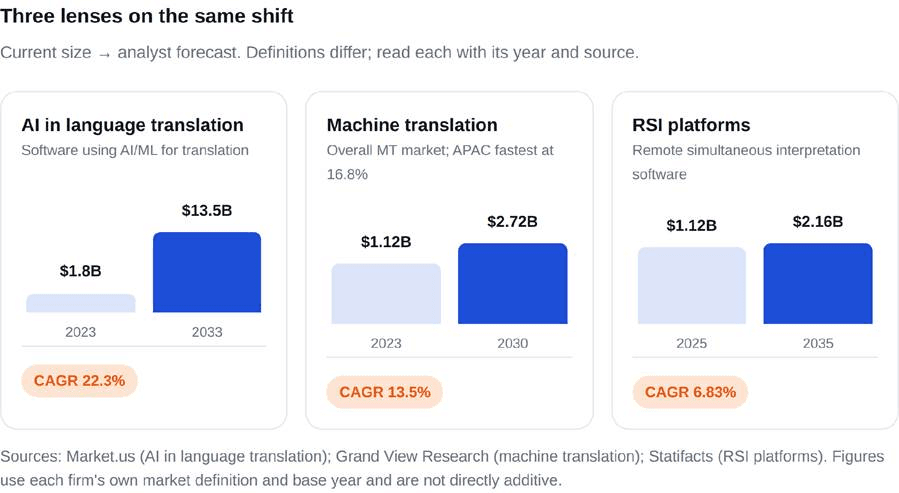
Sources: Market.us (AI in language translation, $1.8B→2033 $13.5B, 22.3% CAGR); Grand View Research (machine translation, $1.12B→2030 $2.72B, 13.5% CAGR, APAC fastest 16.8%); Statifacts (RSI platforms, $1.12B 2025→2035 $2.16B, 6.83% CAGR). Definitions and base years differ; figures are not additive.
The read across all three: the base is modest, but growth concentrates in the AI-native, software-delivered layer — compounding fastest in Asia, exactly where a WAIC-scale deployment happens.
WAIC as a production stress test
A demo is easy; running continuously through a major conference is not. WAIC is an unusually demanding environment — thousands of attendees across parallel tracks, terminology that changes room to room, delegates who expect low latency and stable output. For a language platform, that is not a demo but production.
Vendors now advertise sub-second latency (eNewie cites 0.03s — a figure that, as the next section shows, measures network transport, not comprehension). The more telling signal is duration: the same platform supporting the same event for years running means organizers are selecting on reliability, not novelty. Industrial AI is judged by whether it keeps working after the cameras leave.
The Reality Check: where cloud AI hits the physical wall
The case for AI-native platforms is real — but a serious read separates what software removes from what physics still imposes. Three constraints keep the interpreter booth alive, and each is an engineering limit, not a marketing caveat.
1 · The latency paradox
The 0.03-second figure vendors cite is network transport latency — moving a packet, not understanding a sentence. Real interpretation latency is set by something no network fixes: the model must wait for enough meaning before it can translate. For reordering-heavy pairs — Chinese or Japanese into English, where the decisive verb or negation lands last — it must buffer whole clauses first, the problem interpreters call chunking. That pushes usable latency into the seconds (commonly ~1.5–3s), and forcing it lower trades directly against accuracy. Ultra-low latency and semantic completeness are in tension by design.
2 · The Wi-Fi constraint
The old infrared band is also a moat: a private channel indifferent to crowd size. Move delivery onto attendees’ phones over congested venue Wi-Fi, and every listener’s connection becomes a failure point. In a ten-thousand-person hall, network contention — not model quality — is the likeliest thing to drop a translation mid-session. Software removed the receiver; it did not remove physics.
3 · Hallucination and the compliance wall
WAIC is adversarial for a language model precisely because it is where new vocabulary is coined — “embodied intelligence,” model names, quantum terms — the tokens most likely to be misrecognized or confidently mistranslated. And for closed-door corporate or diplomatic sessions, routing live audio to the cloud is itself the obstacle: data-residency and confidentiality rules can disqualify an AI-native pipeline before accuracy is even discussed. Which is why high-stakes deployments today remain human-in-the-loop — AI recognizes and pre-translates; human interpreters correct in real time.
Not replacement — a trade-off
Two architectures optimized for different failure costs.
Dimension | Traditional hardware (Bosch) | AI-native platform (eNewie) |
|---|---|---|
Core strength | Physically isolated, near-zero network dependence, deterministic latency, compliance-safe | Very low marginal cost, no receivers to ship, near-unlimited language scaling, fast to deploy |
Fatal weakness | High total cost, heavy logistics and staffing, capped by the number of physical booths | Depends on venue network, exposed to hallucination and chunking latency, friction on each attendee’s phone |
Best fit | G20 / diplomatic summits, closed boardrooms, legal proceedings | Large parallel forums, sub-sessions, cross-border kickoffs, technical symposia |
The question is not which architecture wins, but which kind of failure the organizer can least afford.
Why this matters to robotics
Conference interpretation and robotics look unrelated, but they are built from the same components: turning live, accented, overlapping speech into text, resolving meaning from context, generating a reply in another language and speaking it back — all inside the sub-second window before the interaction feels broken. It is the same pipeline, tuned for a different enclosure.
One stack, two bodies
The capabilities a WAIC interpretation platform ships today are the capabilities a service robot needs to work in public.
Shared capability | In a conference platform | In a service robot |
|---|---|---|
Streaming speech recognition | Transcribe a speaker in real time, mid-sentence | Hear a traveler over terminal noise |
Context-aware translation | Hold domain terminology across a technical session | Map “gate,” “boarding,” “transfer” to intent |
Low-latency inference | Deliver audio before the speaker moves on | Reply before the person walks away |
Cloud–edge coordination | Heavy models in cloud, playout on each phone | Heavy models in cloud, response on the unit |
Speech synthesis / output | Natural translated voice or captions | Spoken answer in the visitor’s language |
The interpretation platform is this stack with a phone as its output device; the service robot is the same stack with a chassis, sensors, and a voice.
The overlap is already in deployed hardware — LG’s multilingual guide robots at Seoul’s Incheon Airport, its CLOi ServeBot moving from hotels into hospitals. Strip away the chassis and the hard part is exactly the speech-to-translation-to-speech loop running behind a conference hall. And a platform gets to run that loop against thousands of concurrent users and shifting terminology, for days under a hard reliability bar, long before most robots face that exposure — the language layer of embodied AI, debugged in public at scale.
The failure modes transfer just as cleanly. When the venue network buckles, translation stops — and a robot that offloads all speech and reasoning to the cloud goes mute the moment it hits a dead zone; that is the concrete case for edge AI, on-device models that keep understanding when the network doesn’t. The latency wall transfers too: “wait for the clause to finish before you act” is the same constraint a vision-language-action (VLA) model faces turning speech into motion — cross a second of delay and the machine reads as frozen. The conference hall is simply the earlier, more forgiving place to hit both.
The rise of invisible AI
Most attendees barely noticed the deployment — which may be its clearest sign of success. Across industries, the fastest-maturing AI is becoming invisible: factories inspect, warehouses schedule, hospitals draft documentation, all in the background. Conference language services are on the same path. When AI works, it stops being the exhibit and becomes the plumbing.
Is Bosch really being replaced?
Not today. Traditional systems remain indispensable where certified human interpretation is mandatory — diplomatic, high-security, and legal settings. What is changing is the basis of the decision: organizers now weigh the trade-off above — cost, scale, and flexibility against deterministic reliability and compliance. The conversation is moving from equipment to platform, the same move enterprise IT made when software became the value and hardware became a commodity.
The real question is not whether AI replaces Bosch tomorrow, but whether AI-native language infrastructure becomes the default architecture for international events this decade. If WAIC is an early indicator, that transition has already started — quietly, in the background, where mature infrastructure belongs.
Editor’s note
RobotToday encountered this deployment first-hand at WAIC 2026 — the nearest AI service to our own position at the venue. Our interest is the pattern: the most consequential AI deployments increasingly attract the least attention. Humanoid robots remain a powerful symbol of progress, but AI’s largest commercial impact may arrive through invisible infrastructure — systems that change how industries operate, not how technology is demonstrated. Conference language services look like one of those early indicators.
Sources & data
Market sizing: Market.us (AI in Language Translation); Grand View Research (Machine Translation); Statifacts (RSI Platform Market).
Service-robot deployments: LG multilingual robots at Incheon International Airport; LG CLOi ServeBot for hospitality & healthcare.
Platform positioning: Compiled from vendor product documentation, including eNewie. Vendor performance claims (e.g. latency) are reported as stated and not independently verified.




Leave a comment