


How continuous finite-capacity scheduling decomposes lead time, attributes delay to specific constraints, and balances due-date performance against throughput in high-mix manufacturing.
Most Advanced Planning and Scheduling (APS) systems can tell you when an order is projected to finish. Few can explain why.
That distinction becomes critical in high-mix, low-volume manufacturing, where schedules change daily — machine downtime, material shortages, labor constraints, engineering changes, expedited orders, and outside-processing delays all move the plan within hours of its release.
Skody AI is built not simply to generate a finite-capacity schedule, but to continuously answer the operational questions planners, supervisors, and production managers ask throughout the day:
Why is this order late?
Which resource is causing the delay?
How much of the lead time is actual work versus waiting?
If I expedite this job, which others become late?
If I add capacity, where will it have the greatest impact?
To answer those questions, Skody continuously recomputes the production schedule from the current state of the factory.
The Problem with Traditional APS
Most scheduling systems operate from a static snapshot of ERP data. A schedule is generated, reviewed, released to the floor — and immediately begins drifting from reality. Materials arrive late. Machines go down. Operators report less progress than expected. Priority jobs are inserted.
The result is that planners spend more time investigating schedule problems than solving them. When a customer asks why an order is late, the answer often requires manually tracing the routing, reviewing machine queues, checking material status, and reconstructing the chain of events that produced the delay — work that is frequently obsolete by the time it is finished.
Lead-Time Decomposition
The job-timeline view below illustrates Skody’s approach. Rather than presenting only a completion date, the platform decomposes projected lead time into its underlying causes. The breakdown reveals a pattern common in high-mix environments: actual work content is a small fraction of total lead time.
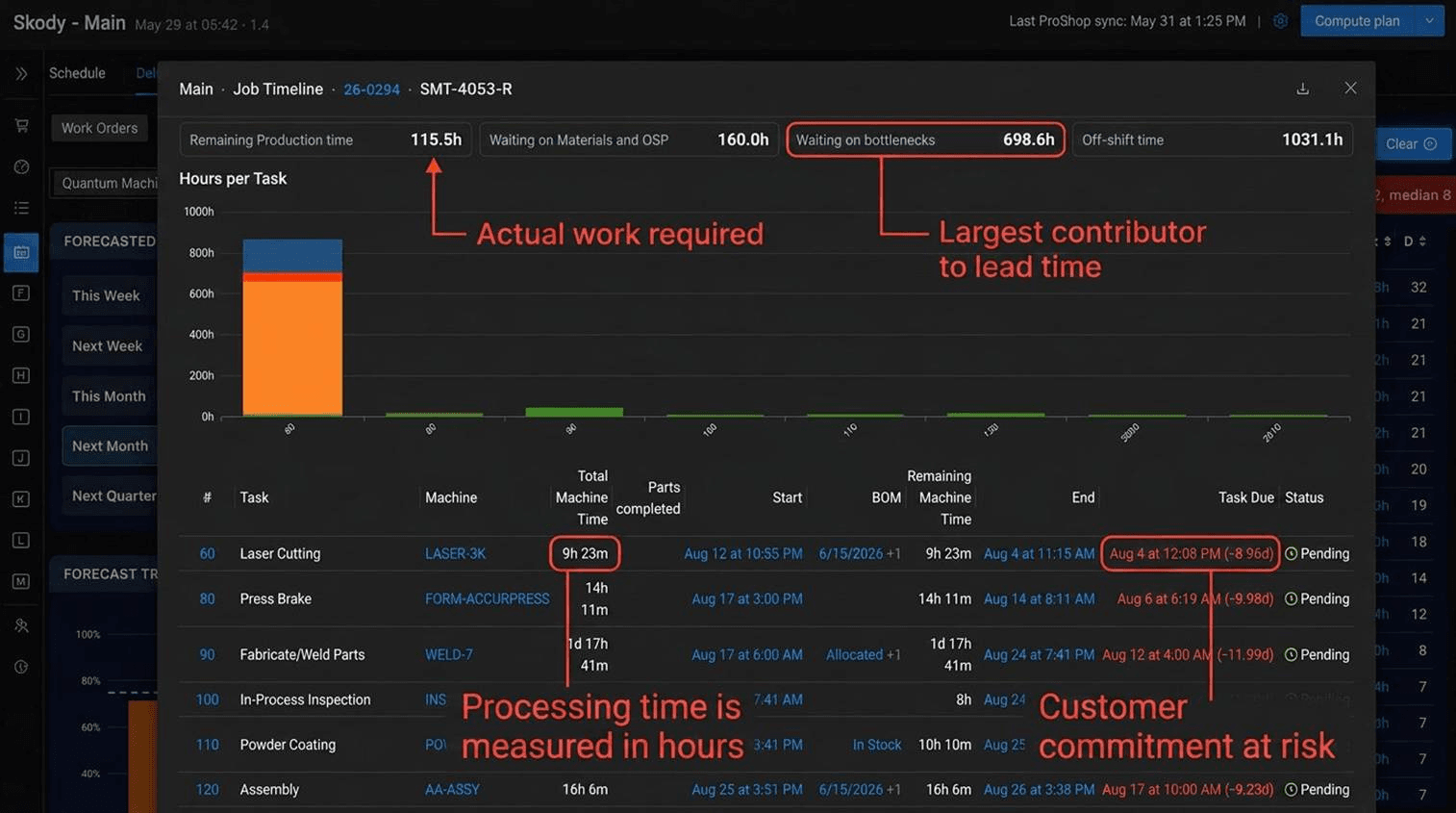
A Skody job-timeline view decomposing projected lead time into its operational causes.
For the job shown:
Remaining production time: 115.5 hours
Waiting on materials and outside processing: 160.0 hours
Waiting on bottlenecks: 698.6 hours
Off-shift time: 1,031.1 hours
The job is not late because of processing time — only 115.5 hours of work remain. The largest contributor to delay is waiting on constrained resources. Without this decomposition, a planner sees only that the order will miss its date; with it, the planner understands the operational cause.
Order-Level Bottleneck Attribution
Traditional APS identifies bottleneck resources at the factory level. Skody extends the concept to the order level: for every job, it calculates how much waiting time is being introduced by upstream and downstream constraints. In the example, bottleneck waiting accounts for 698.6 hours of lead time — competition for shared resources, not the work itself.
The status column flags individual operations that have already passed their task due date; here, several are running eight to twelve days late against their commitments. That visibility at the operation level — not just the order level — is what lets planners identify which constraints to address first, and answer questions such as:
Which resource contributes the most delay?
How much lead time would overtime recover?
Which jobs are competing for the same constrained machine?
What is the true cost of inserting a rush order?
Beyond Visibility: Optimizing for Due Dates and Throughput
Identifying why an order is late is diagnostic. Changing the outcome is where a scheduling system earns its place on the floor.
Finite-capacity scheduling exists to do more than produce a feasible schedule — it exists to produce the best schedule the factory’s current constraints allow. “Best” is defined against the two objectives discrete manufacturers weigh most heavily, and which frequently pull in opposite directions:
Customer delivery performance — meeting committed due dates
Factory throughput — keeping constrained resources productive
Skody evaluates machine availability, labor, material readiness, due dates, and routing dependencies together, then sequences work to balance those objectives rather than maximizing one at the expense of the other. Maximizing utilization alone can starve a late order; protecting a single due date alone can idle an expensive resource. The schedule reflects that trade-off explicitly.
Because the platform recalculates continuously from live conditions, that balance is maintained as the day changes rather than fixed at the moment the plan was built. The closest analogy is navigation: a GPS does not hand over a route once and fall silent — it recalculates as conditions change. When a machine goes down, a material delivery slips, or a rush order is inserted, Skody re-projects completion dates against commitments, surfaces which orders are now at risk, and identifies the recovery actions available — overtime, alternate work centers, or resequencing work already in the queue.
This is a different operating model from traditional APS, which builds from a static snapshot and depends on planners to rebuild the plan once reality diverges. The result is not better visibility into a fixed plan. It is a schedule that adapts to current factory conditions while continuously balancing due-date performance against resource utilization.
Looking Forward
As manufacturers face labor shortages, supply-chain disruption, and rising customer expectations, schedule quality increasingly depends on visibility into current factory conditions. The next generation of manufacturing software will not be judged solely by its ability to generate schedules — but by its ability to explain them, and to act on what it finds.
Knowing that an order is late is useful. Knowing exactly why — and what to do about it — is far more valuable.
Three Sigma case study: https://skody.ai/case-studies/three-sigma-technologies








Leave a comment