

As robotic dexterous hands evolve, their degrees of freedom soar—and so does the number of modules they require. Tesla, for instance, has already pushed the articulation in a single robotic hand to 22 degrees of freedom, employing micro screw designs.
In the view of some research institutions, once Tesla’s robots enter both B2B and consumer markets, two challenges become more pronounced: reducing joint noise and curbing temperature rise over long operation. Against this backdrop, micro ceramic screw solutions—characterized by lightweight construction, high strength, low noise, and minimal heat generation—emerge as a promising alternative. They can significantly reduce motion noise and thermal buildup, offering clear advantages over conventional micro screw technologies. In compact, high-precision applications such as humanoid robot hands, ceramic screw routes may well become a leading direction.
Why Ceramic Screws Matter
Ceramic ball screws typically adopt a hybrid structure. Their production divides into two core domains: crafting the ceramic balls, and machining the metal nut-screw assembly. While the screw and nut remain metallic, traditional steel balls are replaced by ceramics like silicon nitride due to the latter’s exceptional hardness and, conversely, their processing difficulty. The hybrid approach balances performance and manufacturability.
The real technical heart lies in the ceramic balls. Their fabrication is far more intricate than that of steel balls, demanding stages such as powder preparation, forming, sintering, precision finishing, polishing, and rigorous inspection and selection. Starting with ultra-high purity fine powders of Si₃N₄ or ZrO₂, tight control over purity, particle size, and uniformity is essential. In turn, this enables excellent consistency in diameter, roundness, surface finish, and crush load.
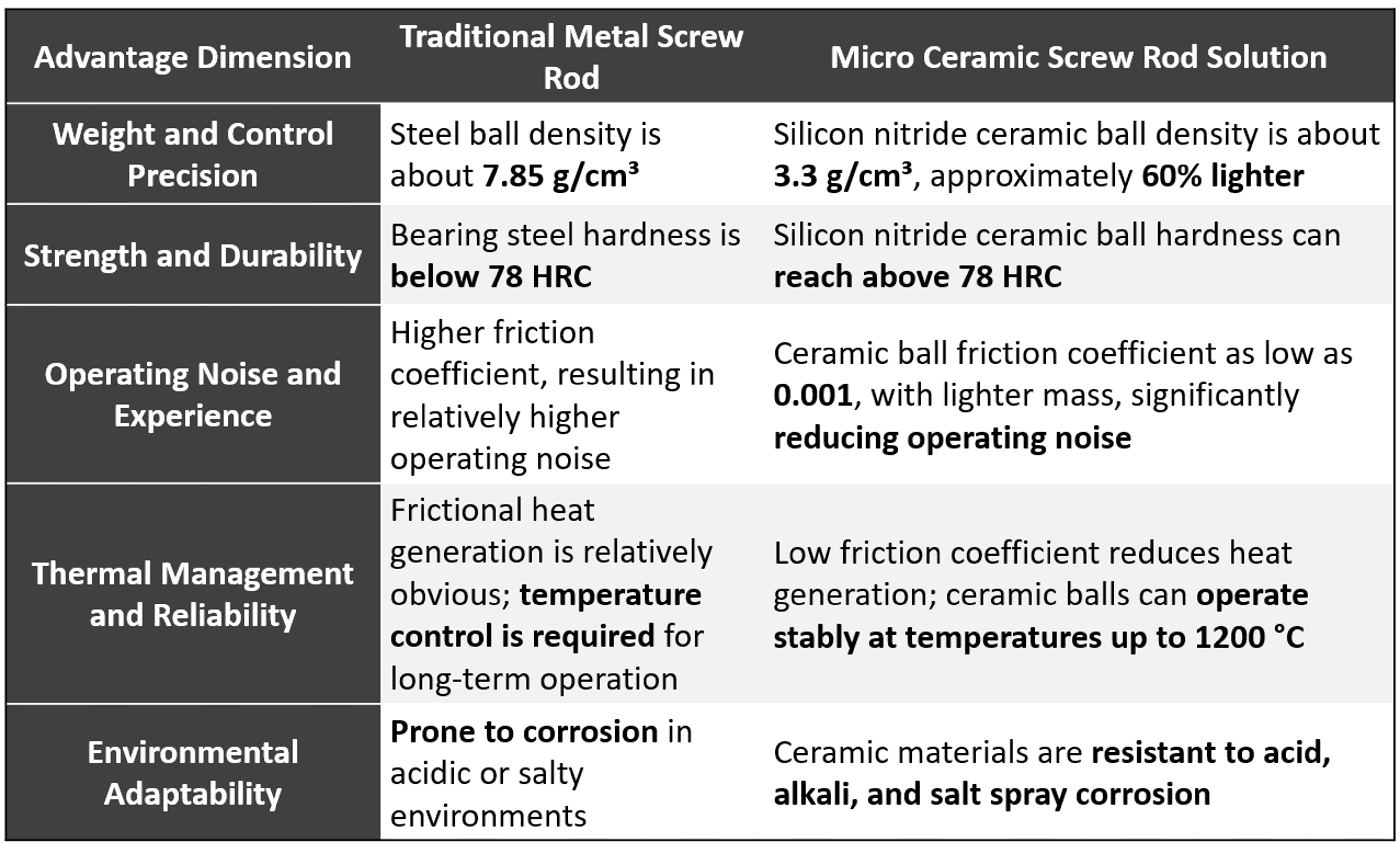
Compared to traditional metallic screws, micro ceramic screws offer multiple performance advantages:
-
Lightweight superiority Silicon nitride ceramic balls have a density of ~3.3 g/cm³—about 60% lighter than bearing steel. This mass reduction substantially lowers the inertia of robotic fingertips, enabling faster and more precise movements. It also eases the burden on actuators, optimizing energy efficiency and overall structural design.
-
High strength & wear resistance Ceramic balls can achieve hardness above 78 HRC, surpassing many bearing steels. Their superior wear resistance ensures extended lifecycle under frequent start-stop and high-cycling conditions.
-
Low noise, smooth operation With ball-to-rail friction coefficients as low as ~0.001 and minimal mass-induced vibration, ceramic screw assemblies operate much more quietly and stably than their metallic counterparts. This improvement is pivotal for user-facing robots in office or home environments, where low noise enhances user experience and acceptance.
-
Thermal and environmental resilience Ceramic screws feature outstanding thermal stability and environmental tolerance. Their low friction minimizes heat generation during operation, and silicon nitride can remain stable up to around 1200 °C. Moreover, ceramic materials resist corrosion from acids, alkalis, and salt spray, broadening potential use in harsh industrial or outdoor settings.
Challenges in Mass Production
The path to commercializing micro ceramic screws is steep. The process integrates “precision ceramic ball manufacture” with “ultraprecision machining of metal components,” pushing both technological and cost barriers.
Key difficulties include:
Raw material purity and particle control Impurities can introduce pores or cracks, while nonuniform particle sizes cause density inconsistencies across balls. ** Sintering & forming complexity** From powder compaction to shrinkage during sintering, achieving stress-free, dimensionally uniform spherical parts at scale is nontrivial. Maintaining consistency across thousands of parts in a run is critical to performance uniformity.
Hard, brittle material machining Ceramic’s hardness and brittleness make grinding highly challenging. Diamond grinding wheels and CNC diamond tools are required, with high risk of chipping or cracking. The yield rate is a decisive cost factor. The mating metallic raceways must also undergo ultra-precision finishing to micron-level tolerances, removing damage layers and creating ideal surface textures for fluid film formation.
While the manufacturing difficulty leads to higher short-term costs compared to steel balls, the long-term market outlook is promising. Industry analysts estimate that with broad adoption in robotics, 1 million units could yield a market valuation of around ¥10.4 billion (RMB) for upstream components.
For example, from publicly available data at MISUMI, a 2 mm silicon nitride ceramic ball currently costs about ¥18.87 each. In high-volume production, that price might drop by 75% to ~¥4.72. If a micro screw uses ~50 balls, and a robot hand employs 22 such screw modules per hand (≈ 44 modules per robot pair), total ball count approaches ~2,200. The scale effect then becomes significant.
Industry Players & Progress
Firms capable of volume-producing high-quality micro ceramic screws tend to have deep expertise in both advanced ceramic materials and ultraprecision machining.
Lixing Corporation Since 2023, it has developed key ceramic ball processing equipment. In 2024, it began collaborative R&D with the Chinese Academy of Sciences, and in 2025, it recruited talent from leading global Si₃N₄ firms while upgrading to dust-free precision workshops. The company is now developing high-speed, high-temperature, lubrication-free ceramic ball solutions for humanoid robot hands. It is scaling supply for micro screws (0.4–0.8 mm) and working with downstream clients for custom designs. Reportedly, small-scale ball screw orders are ramping up; full capacity is expected within 6–18 months.
National Ceramic Materials This company has matured in powder preparation and ceramic ball production. Its silicon nitride balls feature uniform microstructure, boosting fatigue life and reliability under high loads. As automotive and other sectors increasingly adopt ceramic ball screws, its sales have rapidly grown.







Leave a comment