

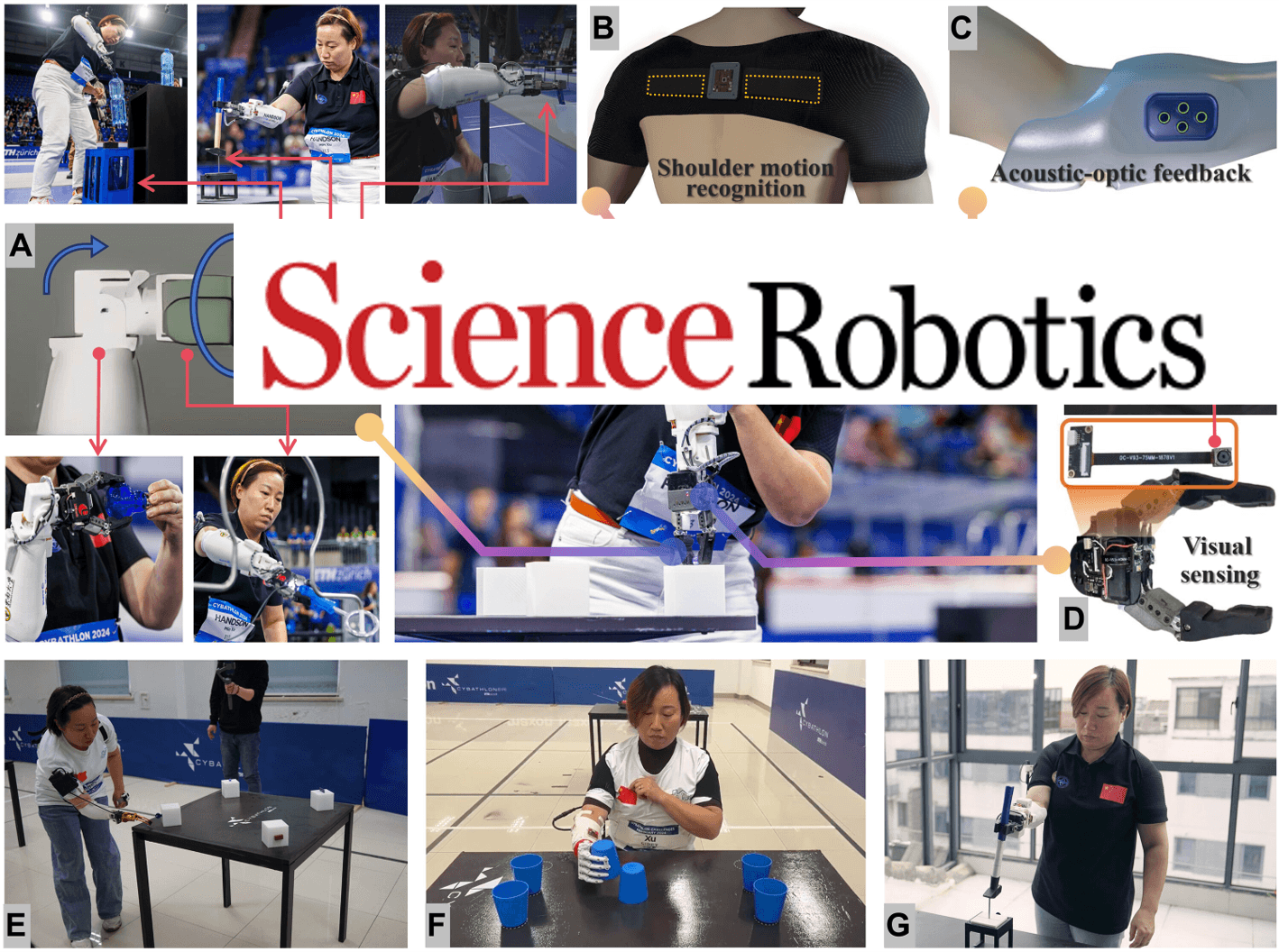
Science Robotics (Sept. 17, 2025) published a landmark study by Xuhui Hu, Aiguo Song, and Min Xu documenting how innovations in prosthetic control and feedback technology enabled an upper-limb amputee to win first place at Cybathlon 2024.
At the Swiss Arena, Min Xu, pilot for Team HANDSON, stunned spectators with a commanding performance in the arm prosthesis discipline—despite being a novice user who had not worn an active prosthesis for nearly three decades. Xu, who lost her arm in an industrial accident in 1992, had abandoned prosthetic use due to comfort issues. Yet, through close collaboration with the research team, she adapted quickly to a system that merged cutting-edge hardware, sensory feedback, and hybrid control interfaces.
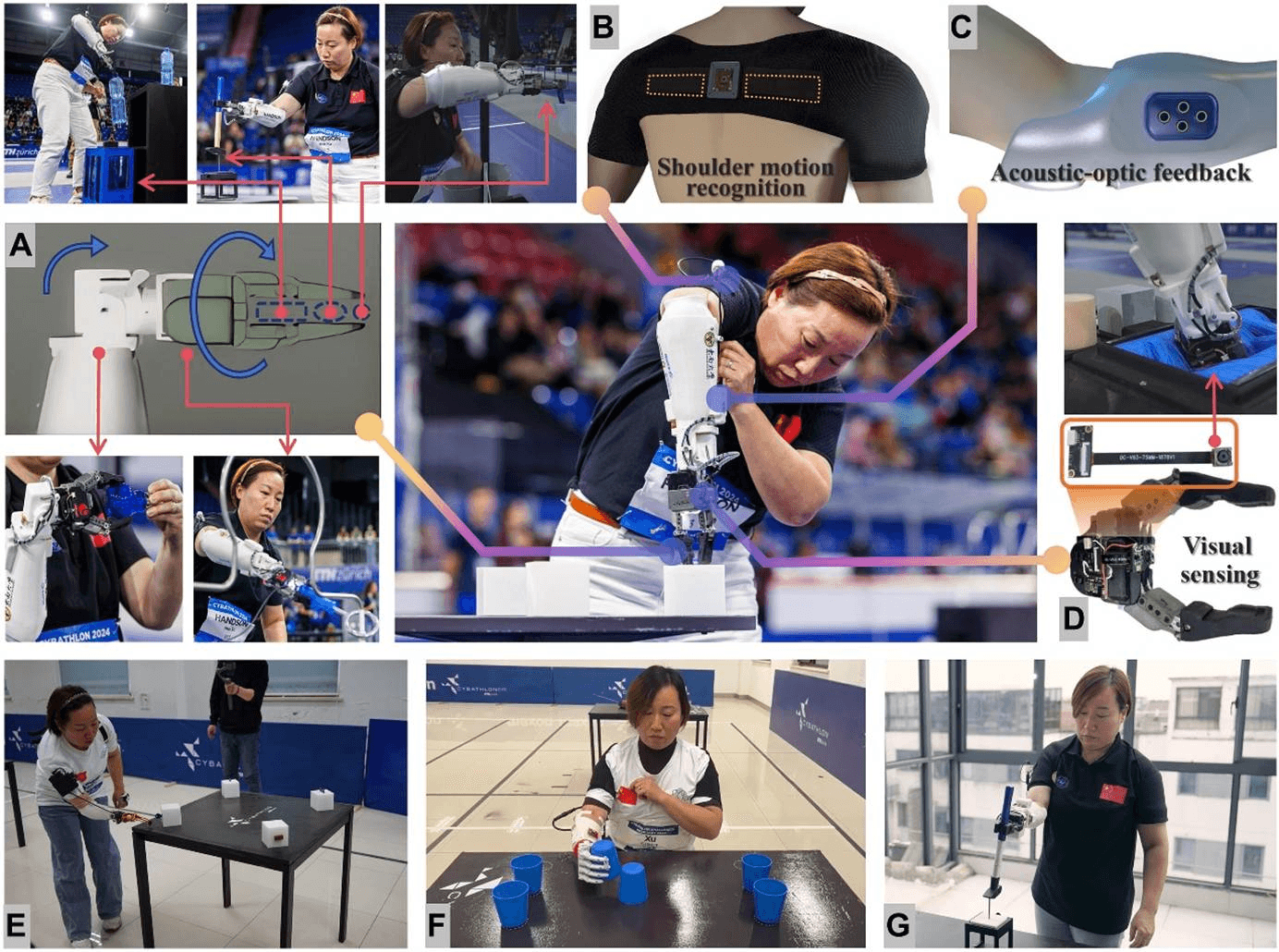
Key Innovations Behind the Victory
- Mechanical Redesign for Versatility:
The team replaced a five-fingered prototype with a two-fingered gripper optimized for strength and precision. Reinforced proximal phalanges provided heavy-load stability, while distal phalanges delivered delicate manipulation. An advanced wrist module integrated active rotation with passive flexion, easing everyday tasks such as screwing in light bulbs. - Multisource Control Interface:
To overcome limitations of myoelectric signals alone, the team pioneered a hybrid body-driven/myoelectric control scheme. Stretchable fabric sensors detected shoulder motions to actuate the hand, while dual-site myoelectric sensors enabled independent wrist rotation. This approach improved reliability and reduced compensatory movements across varied postures. - Vision-Assisted Sensory Feedback:
A monocular palm camera linked to an embedded vision module provided real-time object recognition. Feedback was conveyed through a multimodal system: illuminated panels on the socket guided directional cues, and audio signals marked phases of grasping. This innovation allowed Xu to complete the notoriously difficult “haptic bag task,” which requires blind identification and retrieval of objects—becoming the only competitor to do so successfully.
Lessons From Competition
The team’s development journey included setbacks. During the 2024 Cybathlon Challenges, they failed a grip-and-rotation task they believed impossible—only to watch other teams succeed. This humbling experience catalyzed a redesign that prioritized functional compatibility over complexity, ultimately enabling Xu to excel under pressure in the final competition.
Impact and Outlook
The victory illustrates how prosthetics research is moving from lab demos to real-world usability, bridging clinical needs and engineering advances. By combining dexterous control, reliable intent recognition, and intuitive sensory feedback, the HANDSON prosthesis showcased a model for how technology can restore independence and redefine quality of life for amputees.
The research underscores Cybathlon’s role as a catalyst for cross-disciplinary collaboration in assistive robotics, driving progress that extends far beyond the competition. Looking forward, the team aims to refine their system for daily life applications, targeting greater comfort, robustness, and mass accessibility.
As prosthetics evolve into fully integrated human-machine systems, breakthroughs like Xu’s Cybathlon win mark an important milestone on the path toward empowered, independent living for millions with upper-limb loss.






Leave a comment