


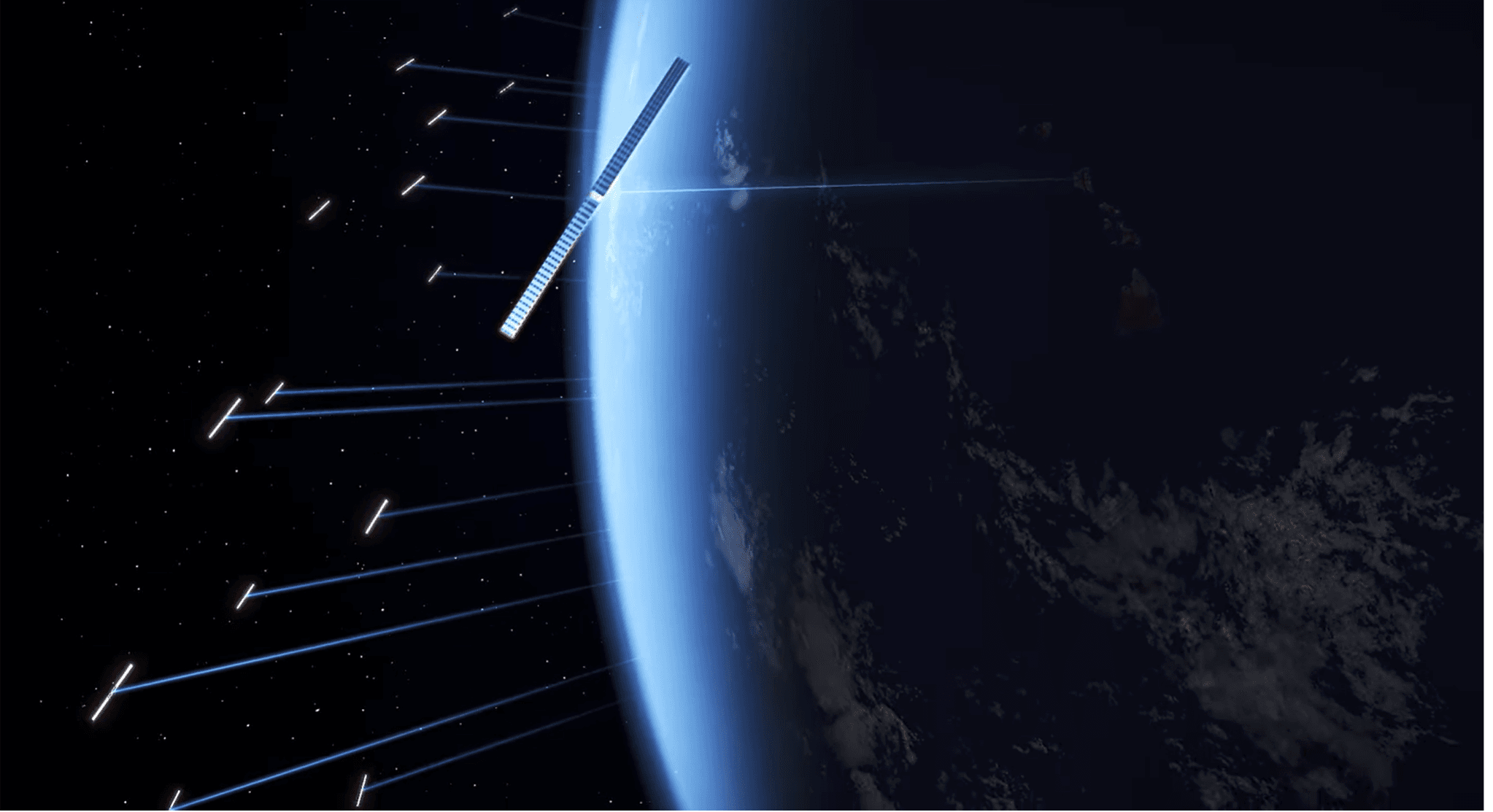
AI Space Data Centers: The Next Frontier for Computational Infrastructure
Why the robotics industry should pay attention to orbital computing
The Problem on the Ground
The AI boom has a power problem. By 2030, data centres running AI workloads are projected to consume roughly 945 TWh of electricity annually — equivalent to Japan's entire national grid. For the robotics industry, which depends on cloud inference, simulation, and large-model training to power everything from manipulation policies to autonomous navigation, this energy ceiling is not an abstract concern. It is a constraint on what robots can do, and how cheaply they can do it.
Space data centres are being positioned as a structural answer.
What Orbital Computing Actually Offers
The physics case is straightforward. In low Earth orbit (LEO), solar panels generate energy at roughly eight times the efficiency of ground-based installations, with no day-night cycle disruption. Waste heat radiates passively into the vacuum — around three times more efficiently than terrestrial cooling systems. There is no real estate cost, no water usage, and no grid dependency.
The ambition is already taking institutional shape. Leading Western startups have collectively raised hundreds of millions of dollars in the past eighteen months, while Big Tech and Chinese state-backed operators are moving in parallel.
What Orbital Computing Actually Offers
The physics case is straightforward. In low Earth orbit (LEO), solar panels generate energy at roughly eight times the efficiency of ground-based installations, with no day-night cycle disruption. Waste heat radiates passively into the vacuum — around three times more efficiently than terrestrial cooling systems. There is no real estate cost, no water usage, and no grid dependency.
The ambition is already taking institutional shape. Leading Western startups have collectively raised hundreds of millions of dollars in the past eighteen months, while Big Tech and Chinese state-backed operators are moving in parallel.
Who Is Building — Western Startups
| Company | Stage | Key Milestone | Technology Approach |
|---|---|---|---|
| Starcloud | Unicorn | $170M Series A closed 30 Mar 2026 (valuation $1.1B); fastest-ever YC unicorn; FCC application for 88,000-satellite constellation; first H100 satellite launched Nov 2025, first orbital AI training completed | Commercial GPU (H100/Blackwell) + solar arrays; target 5 GW orbital supercomputing |
| Aetherflux | Series A | $50M Series A (total $60M); founded by Robinhood co-founder Baiju Bhatt; commercial node launch planned 2027 | "Galactic Brain": space solar power + infrared laser power transmission, local compute nodes |
| Sophia Space | Seed | $10M Seed round closed Feb 2026; CEO Rob DeMillo formerly of NASA JPL | TILES flexible thin-film architecture (1m×1m passive-cooling modules, 92% energy to compute); SOOS orbital OS for thermal management |
| Lonestar Data Holdings | Early | $6.6M raised Jan 2026; first data centre deployed on lunar surface via IM-2 mission (2025) | Lunar data centre for disaster recovery and data sovereignty; cislunar orbit target 2028, lunar surface expansion 2030s |
Who Is Building — Big Tech
| Company | Project | Stage | Key Details |
|---|---|---|---|
| SpaceX / xAI | Orbital Data Centre | Regulatory filing | FCC application Jan 2026 for 1-million-satellite constellation integrated with Starlink; Musk states space will be lowest-cost AI compute within 2–3 years; IPO target confirmed at $1.5T valuation |
| Project Suncatcher | Prototype development | Announced Nov 2025 with Planet Labs; 2 prototype satellites (Trillium TPU v6e) targeting early 2027 launch; 1.6 Tbps inter-satellite laser links; 81-satellite cluster planned | |
| Blue Origin | Project Sunrise | Regulatory filing | FCC application for large-scale constellation; Bezos states costs will undercut ground infrastructure within 20 years; New Glenn launch vehicle + TeraWave backhaul |
| Amazon | Project Kuiper + AWS | Early integration | First Kuiper satellites launched 2025; Australian service mid-2026; gigawatt-scale space data centre capacity indicated |
Who Is Building — China
| Entity | Programme | Status | Scale & Progress |
|---|---|---|---|
| ChinaSat | StarCompute | In-orbit verified | World's first 12-satellite computing constellation launched May 2025 (5 POPS); Qwen3 LLM deployed Nov 2025; 2,800-satellite / 1,000-POPS target by 2030 |
| Zhejiang Lab | Three-Body Constellation | In-orbit verified | 12 satellites in orbit (80B-parameter model onboard); 1,000-satellite target by 2030 |
| CAS Institute of Computing | TianSuan Plan | R&D | Aurora POPS-class spaceborne AI payload under development; 400,000-POPS space supercomputing target by 2030 |
What It Can Do — and for Whom
For the robotics sector specifically, several use cases stand out:
Edge inference at planetary scale. Robots operating in remote or infrastructure-sparse environments — agricultural, maritime, mining, disaster response — could access low-latency inference via LEO satellites rather than routing through congested terrestrial cloud nodes. This is particularly relevant as embodied AI models grow in size and require more frequent cloud calls.
Large-scale simulation and training. The compute-intensive work of training manipulation policies, generating synthetic datasets, and running physics simulations is power-limited on the ground. Orbital compute clusters, if cost-competitive, could absorb these workloads at scale.
Data sovereignty and resilience. Lonestar Data Holdings has already deployed a data centre on the lunar surface via the IM-2 mission, targeting disaster recovery and jurisdictional data storage — a niche but growing concern for enterprise robotics deployments operating across regulatory boundaries.
The Economics: Not There Yet
Orbital compute currently costs approximately three times more per watt than terrestrial alternatives, according to engineering models from firms including Varda. Commercialisation at competitive price points is contingent on SpaceX Starship achieving its target launch cost of below $100 per kilogram — down from roughly $500 today. Most projections place the cost-crossover point in the 2028–2029 window.
Technical hurdles remain material: radiation hardening of commercial GPUs for long-duration LEO operations, debris risk from mega-constellations, precision thermal management, and scaling laser inter-satellite links beyond current demonstrations.
The broader market reflects the longer-term conviction: BIS Research projects the in-orbit data centre market will reach $1.77 billion by 2029, scaling to $39.1 billion by 2035 at a CAGR of 67.4%.
The Verdict
Space data centres will not displace terrestrial cloud infrastructure for the robotics industry in the near term. But they represent a credible structural hedge against the energy and capacity constraints already beginning to slow AI infrastructure buildout on the ground. The 2026–2027 period — when Starcloud's second satellite launches and Google's Project Suncatcher prototypes reach orbit — will be the decisive commercial validation window. Robotics companies with long infrastructure planning cycles should be watching closely. The geopolitical dimension adds urgency: China's constellations are already operational, while the United States leads on private capital and mega-constellation planning. The orbital compute race is underway on both sides simultaneously.
Sources: BIS Research (2025–2026); FCC filings (SpaceX, Starcloud, Blue Origin); TechCrunch; SpaceNews; GeekWire; China Daily. Funding figures reflect latest official announcements as of April 2026.






Leave a comment