
ISEE

ISEE

"AI Advanced Autonomous Yard Truck Solutions"

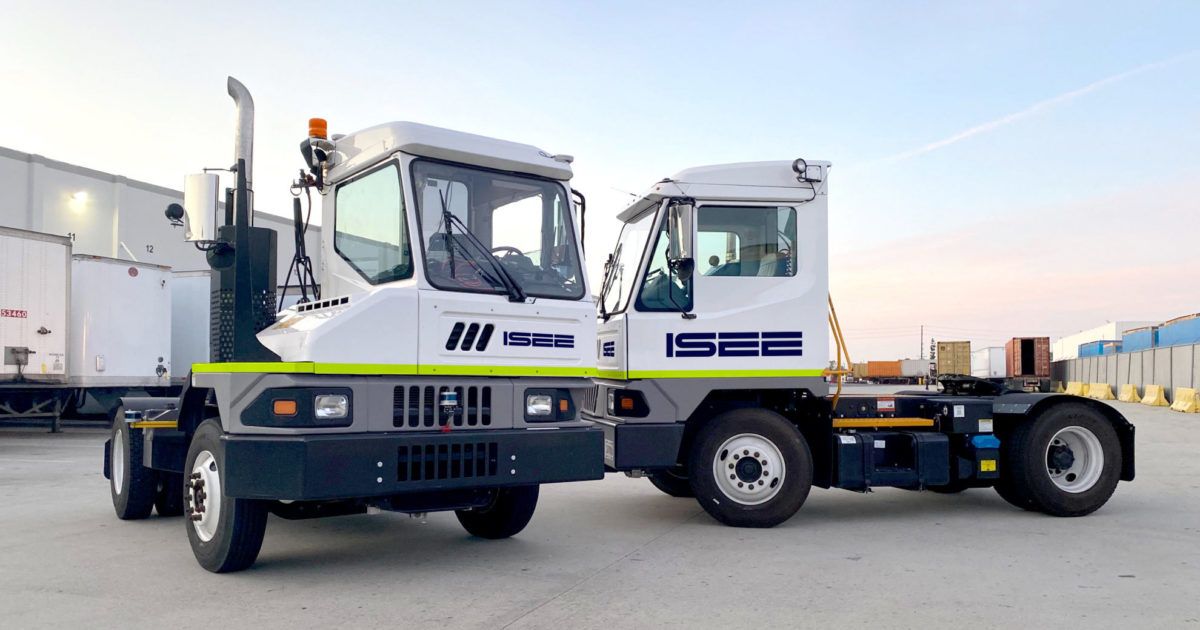
MIT-spinoff building AI-powered autonomous yard trucks that achieve fully driverless trailer moves in active logistics hubs for Fortune 100 customers.

Visit Website

Company Overview

ISEE (founded 2017, headquartered in Cambridge, MA) is an MIT-spinout autonomous driving technology company building humanistic AI for self-driving yard trucks and terminal tractors. Co-founded by Yibiao Zhao and Chris Baker — former MIT AI researchers in collaborative robotics — ISEE is the first company to achieve fully driverless yard operations in mixed-traffic environments with multiple trucks running simultaneously at active customer sites. Its platform has completed hundreds of thousands of autonomous trailer moves for customers including Maersk, BMW, and Fortune 100 logistics operators.

In 2025 ISEE and TICO announced an industry-first fully integrated autonomous yard truck partnership. ISEE also unveiled an AI-powered automatic trailer auto-coupling system requiring no trailer modification. Total funding exceeds $69 M including a $40 M Series B raised in 2022.

Capabilities & Activities

Primary type & automation activities this supplier delivers:

Applications & Industries

Product Categories

Products & Solutions

ISEE Autonomous Yard Truck System

AI-powered fully autonomous yard truck platform achieving driverless trailer moves in mixed-traffic logistics hubs with no infrastructure modification.

Partnership & Notable clients

Associating Events

Contact ISEE

WEBSITE

https://www.isee.ai/

EMAIL

[email protected]

HEADQUARTERS

501 Massachusetts Avenue
Cambridge , Massachusetts  02139

United States

Company Facts

Founded

2017

Primary Role

Software/Algorithm

Company Size

-

Primary Region

North America

Annual Sales

-

Funding Stage

-

Funding Total

-

Listed in RobotToday Supplier Discovery. Verified Profile

Related Coverage

Hyundai's Louisiana Steel Mill to Supply Materials for Robots and SpaceX Rockets

Hyundai's Louisiana Steel Mill to Supply Materials for Robots and SpaceX Rockets

Hyundai Motor Group Executive Chair Chung Euisun announced that steel from the upcoming Hyundai Steel mill in Louisiana could be utilized beyond automotive applications, potentially in Atlas humanoid robots and SpaceX rockets. This vision was shared during the groundbreaking ceremony for the Hyundai-Posco Louisiana Steel plant, which will initially focus on automotive steel production. The $5.8 billion electric arc furnace facility is set to be Hyundai Steel's first production base in the U.S., with an annual capacity of 2.7 million metric tons, including 1.8 million tons dedicated to automotive steel and 900,000 tons for other uses. Chung's comments reflect a long-term strategy to diversify the mill's output, aligning with Hyundai's plans to deploy Atlas robots in U.S. manufacturing operations by 2028. Looking ahead, Hyundai is cautious about deploying Atlas within the steel mill, emphasizing the need for extensive testing. Chung also highlighted the company's efforts to enhance Atlas' development by reorganizing its structure to accelerate technology adoption and improve capabilities in critical components like actuators and grippers. No further timeline was disclosed at the time of publication.

All News
New Short Film 'Road Rage' Features Autonomous Car as Villain in San Francisco

New Short Film 'Road Rage' Features Autonomous Car as Villain in San Francisco

The upcoming short film 'Road Rage' portrays a murderous autonomous vehicle as the antagonist, tapping into societal fears surrounding AI on the roads. Set in San Francisco, the film features a ridehail driver named Joa, who faces off against an aggressive robotaxi named Roboride after a minor road-rage incident escalates dangerously. This film reflects the growing anxieties about autonomous vehicles, which have transitioned from futuristic concepts to real entities in American cities. The narrative highlights concerns over AI job displacement and the implications of machines making decisions traditionally reserved for humans, as exemplified by Joa's struggle against the robotaxi that threatens his livelihood. As production awaits $40,000 in funding through Kickstarter, the film aims to blend classic car chase aesthetics with modern technology. Viewers should watch for how 'Road Rage' addresses the complexities of human interaction versus AI, particularly in the context of the ridehail industry, where robotaxis are increasingly competing with human drivers like Joa.

Autonomous Cars Entertainment Film Report Transportation
Pentagon Reports 11 Percent Cost Increase for F-35 Joint Strike Fighter Variants

Pentagon Reports 11 Percent Cost Increase for F-35 Joint Strike Fighter Variants

The Pentagon has announced that the costs for all three variants of the F-35 Joint Strike Fighter are rising by approximately 11 percent. The average flyaway cost for the F-35A has increased to $92 million for production lots 18 and 19, up from $82.5 million, while the F-35B and F-35C have also seen price hikes to $121.4 million and $110.8 million, respectively. This increase in costs is significant as it reflects ongoing challenges faced by the F-35 program, including inflation, rising raw material prices, and supply chain issues. Lockheed Martin, the manufacturer, has indicated that these factors have contributed to the rising costs, which are projected to exceed $50 billion over the program's lifespan due to upgrades and increased spare parts. Looking ahead, the Pentagon plans to acquire 148 aircraft each in lots 18 and 19, totaling 296 aircraft. The F-35 program continues to evolve with modernization efforts, including enhancements to the engine and a new power management system, although some upgrades are behind schedule. No further timeline was disclosed at the time of publication.

Air Warfare Pentagon Air Force Europe F-35 F-35 Joint Strike Fighter
Public Opposition Surges Against FCC's Military-Grade Drone Proposal

Public Opposition Surges Against FCC's Military-Grade Drone Proposal

The Federal Communications Commission (FCC) has concluded the comment period for its proposal that may limit the import and sale of specific foreign-produced drones. An analysis by Pilot Institute revealed that out of 3,824 public comments, 3,770, or approximately 98.6%, opposed the proposal, highlighting significant dissent among stakeholders. This overwhelming opposition is crucial as it reflects the concerns of individuals and organizations directly affected by the proposed regulations. The FCC's initial assessment suggested that the economic and supply-chain impacts would be minimal, but Pilot Institute's findings challenge this notion, indicating potential adverse effects on small businesses and public safety operations. Looking ahead, the FCC must consider these public comments as it deliberates its next steps. The analysis underscores the importance of stakeholder input in shaping regulations that could significantly impact various sectors, including agriculture and public safety. No further timeline was disclosed at the time of publication.

DJI Drone News Drone News Feeds Drones in the News LiDAR News
Tesla Reveals New Details About Cybercab, Including Age Restrictions for Passengers

Tesla Reveals New Details About Cybercab, Including Age Restrictions for Passengers

Tesla's recent private event for the Cybercab showcased a stark departure from its typical large-scale launches, with CEO Elon Musk notably absent. The Cybercab promises to be a fully autonomous vehicle utilizing cameras and AI, but details were sparse, primarily shared through PDFs and updates to the 'Robotaxi' app. A significant point of contention is the restriction on minors under 13 from riding in the Cybercab, while those aged 8 to 17 can use the Model Y SUVs, albeit with adult supervision. The implications of these restrictions highlight Tesla's cautious approach to safety amid ongoing investigations by the National Highway Traffic Safety Administration into the Cybercab's rollout. The absence of standard child seat anchors in the Cybercab raises concerns, especially as Tesla aims to ensure the safety of all passengers. The vehicle's safety features, including automatic crash responses, are designed to mitigate risks, but the decision to limit child passengers reflects the company's hesitance to fully embrace its autonomous technology in all scenarios. Looking ahead, Tesla must navigate regulatory scrutiny and public perception as it seeks to validate the safety of the Cybercab. The company's commitment to innovation in autonomous driving will be closely monitored, particularly in light of recent recalls related to electronic door latches. No further timeline was disclosed at the time of publication.

Transportation autonomous vehicles avs cybercab robotaxis Tesla
Robotics Startups Invited to Apply for the 2026 Robotics Startup Radar Program

Robotics Startups Invited to Apply for the 2026 Robotics Startup Radar Program

The Robot Report has announced the opening of submissions for the 2026 Robotics Startup Radar, aimed at identifying innovative robotics startups. Startups that are five years old or younger and offer novel full systems, enabling technologies, or unique business approaches are encouraged to apply. The deadline for submissions is Tuesday, October 6, 2026. This initiative is significant as it provides a platform for emerging robotics companies to showcase their technology and gain visibility among potential investors and industry experts. Last year, the Radar featured 100 promising startups across various sectors, including autonomous mobility and industrial automation, highlighting the diversity and potential of the robotics landscape. Looking ahead, the editorial team will evaluate all submissions, but inclusion is not guaranteed. The program, sponsored by Maxon Precision Motors and PTC, offers a valuable opportunity for young businesses to connect with influential figures in the robotics industry. No further timeline was disclosed at the time of publication.

News Startups Robotics Startup Radar
U.S. Air Force Requests Anti-Aircraft Gun Systems for Global Base Defense

U.S. Air Force Requests Anti-Aircraft Gun Systems for Global Base Defense

The U.S. Air Force is actively seeking anti-aircraft gun systems to enhance the defense of its overseas air bases against drones and cruise missiles. This Request for Information (RFI) is part of a broader initiative to improve ground-based air defenses, a role traditionally held by the Army, as the Air Force currently lacks such systems. This initiative is crucial as recent conflicts have highlighted vulnerabilities in the U.S. air defense capabilities for foreign installations, particularly in light of potential threats from adversaries like China and Russia. The RFI emphasizes the need for a Ground-Based, Medium-Caliber Gun Weapon System that can effectively engage subsonic cruise missiles and unmanned aircraft systems, ensuring persistent defense for U.S. Air Force operations. Looking ahead, the Air Force aims for these systems to be rapidly deployable and transportable, utilizing its fleet of transport aircraft. The evaluation will focus on the cost-effectiveness of munitions and the integration of advanced sensors for reliable target acquisition. No further timeline was disclosed at the time of publication.

Land Air Air Forces Short-Range Air Defense Systems (SHORADS) U.S. Air Force
Wing Strengthens Engineering Leadership with New Appointments Ahead of 2027 Expansion

Wing Strengthens Engineering Leadership with New Appointments Ahead of 2027 Expansion

Wing has appointed Brandon Jones as Chief Autonomous Systems and Applications Officer and Paul Gojenola as Chief Hardware Development and Manufacturing Operations Officer. These strategic appointments aim to enhance Wing's engineering capabilities as the company prepares to serve 40 million Americans and expand internationally by 2027. The significance of these leadership changes lies in Wing's commitment to scaling its residential drone delivery services. With Jones overseeing autonomy and Gojenola managing hardware development, Wing is positioned to meet the increasing demand for drone delivery solutions. Their combined expertise is expected to drive innovation and operational efficiency in the company's delivery network. Looking ahead, Wing's focus will be on executing its ambitious plans for 2027. The company aims to expand its reach and enhance its technology leadership in the drone delivery sector. No further timeline was disclosed at the time of publication.

Business and Finance Corporate News Drone News Drone News Feeds News Adam Woodworth Wing CEO
Genesis BBQ Group Leverages AI and Robotics for Global Expansion Strategies

Genesis BBQ Group Leverages AI and Robotics for Global Expansion Strategies

Genesis BBQ Group is implementing AI, data, and robotics to enhance store operations and ensure product quality as it accelerates global expansion. The company introduced three growth strategies—'AX Transformation,' 'Globalization 2.0,' and 'Sustainable Platform'—during its 31st anniversary event at Chicken University in Icheon, Gyeonggi Province. The AX Transformation strategy aims to integrate data from various operational areas to boost efficiency and decision-making, while also introducing food technology and robotics. This initiative is expected to alleviate the operational burden on franchisees, allowing them to concentrate on food quality and customer service. Additionally, BBQ plans to standardize operations across its international outlets. Globalization 2.0 focuses on expanding BBQ's international presence with tailored business models for each market, ensuring core standards while adapting to local preferences. The Sustainable Platform initiative will combine AI, robotics, and green technologies to create sustainable food-and-beverage models, including smart stores and automated cooking systems. No further timeline was disclosed at the time of publication.

All News
WRC 2026 Robot Systems: 149 Companies That Build Robots

WRC 2026 Robot Systems: 149 Companies That Build Robots

149 of the 248 classified WRC 2026 exhibitors build finished robots. 93 build humanoid or legged machines. The audited humanoid sales number is one unit.

ROBOTTODAY Weekly July 20 – 24, 2026

ROBOTTODAY Weekly July 20 – 24, 2026

Your weekly robotics briefing: AGIBOT unveils four new robots at WAIC 2026, the NDAA bars Chinese humanoids from the U.S. military, SoftBank eyes Gravis Robotics for its Roze vehicle, and Anduril reveals its Thunder autonomous attack tiltrotor at Farnborough.

US Restrictions on Chinese Humanoid Robots: The Full Map

US Restrictions on Chinese Humanoid Robots: The Full Map

Every US restriction on Chinese humanoid robots — NDAA Sec. 163, GUARD Act, the 1260H list — plus the supply-chain math and a 4-tier map of decoupling.

FUTURE WARFARE | The Geopolitical Competitive Landscape

FUTURE WARFARE | The Geopolitical Competitive Landscape

Military robotics is no longer a U.S.-centric story. Global defence spending crossed $2.75 trillion in 2026; defence-tech VC hit a record $49.1 billion in 2025; and a multipolar robotics order is crystallising in real time — with China’s 15th Five-Year Plan institutionalising civil-military fusion, Europe’s €381 billion defence budget financing its own AI champions, and Turkey and Israel reshaping the export market with affordable, combat-proven systems. Part Five of the Future Warfare Series maps the country-by-country competitive landscape, the collapsing regulation race, and the investment forces reshaping who builds — and who controls — the autonomous weapons of the next decade.

FUTURE WARFARE | Cross-Domain Integration - Integration How Land, Sea, Air and Software Are Converging Into a Single Kill Chain

FUTURE WARFARE | Cross-Domain Integration - Integration How Land, Sea, Air and Software Are Converging Into a Single Kill Chain

Cross-domain robotics is reshaping modern warfare as drones, UGVs, AI targeting systems, and autonomous logistics converge into a single networked kill chain across land, sea, air, and software.

GLOBAL ROBOTICS INDUSTRY Comprehensive Sector Overview

GLOBAL ROBOTICS INDUSTRY Comprehensive Sector Overview

A comprehensive global robotics industry overview for 2025, analyzing 14 key market segments — from industrial and humanoid robots to logistics AMRs, military systems, and service robots — with expert market sizing, US case studies, five-year forecasts, and bilingual English-Chinese analysis for executives and investors.

FUTURE WARFARE | Land - Unmanned Ground Vehicles — From Logistics Mules to Front-Line Robots

FUTURE WARFARE | Land - Unmanned Ground Vehicles — From Logistics Mules to Front-Line Robots

Ukraine fielded 15,000 unmanned ground vehicles in 2025 — surpassing its own procurement targets by over 100 percent. A single UGV held a front-line position for 45 days. Up to 90 percent of supplies to Pokrovsk now move by robot, not truck. The U.S. Army cancelled its $3 million Robotic Combat Vehicle and is starting over. China is deploying $3,000 robot dogs in PLA urban-warfare exercises. This article maps the emerging UGV battlefield — from Ukraine’s garage-built logistics fleet to the Pentagon’s stalled combat-vehicle ambitions, and from Ghost Robotics’ Vision 60 to the quadruped proliferation problem no treaty has yet addressed.

EU Bets €1.5B on Drones and AI: Inside EDIP's 2026–2027 Defence Industry Programme

EU Bets €1.5B on Drones and AI: Inside EDIP's 2026–2027 Defence Industry Programme

The EU's €1.47 billion European Defence Industry Programme (EDIP) 2026–2027 targets drones, counter-UxS systems, AI-enabled autonomy, and loitering munitions across six major funding calls — allocating over €232 million directly to unmanned systems and related electronics supply chains.

Palettisation automatisée : comment Liebherr booste la productivité

Palettisation automatisée : comment Liebherr booste la productivité

Liebherr-Verzahntechnik GmbH has announced the launch of a new range of modular and scalable palletizing solutions aimed at enhancing industrial productivity. This initiative comes in response to the growing need for optimization in production lines, which has become a strategic priority for manufacturers. The company’s recent communication highlights how these innovative solutions are designed to meet the evolving demands of the industry. By implementing these advanced palletizing systems, Liebherr aims to help businesses streamline their operations and improve efficiency in their manufacturing processes.

À la une Actualités IA Industriel Robotique automatisation industrielle.
FUTURE WARFARE | The Autonomy Spectrum

FUTURE WARFARE | The Autonomy Spectrum

How modern weapons shattered the concept of human control — from kill-switch confirmation to AI systems that select targets independently.

EKA Mobility Secures $57 Million from NIIF’s India-Japan Fund to Drive Leadership in Electric Commercial Vehicles

EKA Mobility Secures $57 Million from NIIF’s India-Japan Fund to Drive Leadership in Electric Commercial Vehicles

EKA Mobility raises $57 M from the India-Japan Fund (NIIF) to accelerate electric commercial vehicle growth and electrification leadership in key markets.

