


IC Automation
Solon OH system integrator founded 2016 specializing in robotic assembly, vision-guided handling, and end-of-line automation.
Contact IC Automation
WEBSITE
https://i-c-automation.com/PHONE
+1 440-544-6850HEADQUARTERS
United States

Company Facts
Founded
2016
Primary Role
System Integrator
Company Size
-
Primary Region
North America
Annual Sales
-
Funding Stage
-
Funding Total
-

Comau Develops Automated Order Preparation System for Decathlon's E-commerce Fulfillment
Comau SpA has announced the design and validation of an order-preparation system specifically tested in Decathlon's e-commerce fulfillment operations. This system is part of the MASTERLY initiative aimed at transitioning to flexible, customized manufacturing systems. Utilizing Comau's MyCo collaborative robot and a ROS 2-based software architecture, the system autonomously handles picking, handling, and palletizing tasks across various product flows. The significance of this development lies in its alignment with Comau's commitment to enhancing next-generation manufacturing through reconfigurability and human-centric automation. The integration of intelligent robotics and digital technologies is expected to create logistics operations that can adapt to changing production demands while ensuring operational continuity and scalability. This project also highlights Comau's strategic focus on intralogistics, bolstered by acquisitions that enhance their capabilities in delivering integrated solutions. Looking ahead, Comau anticipates that the knowledge and functionalities validated during this project will contribute to the evolution of its MyCo platform and its broader portfolio of advanced intralogistics capabilities. The collaboration with Decathlon and other technology partners underscores the importance of addressing production challenges such as variability and supply chain disruptions through advanced automation solutions. No further timeline was disclosed at the time of publication.
Cobot Arms Collaborative Robots Logistics Markets / Industries News Robots / Platforms
General Robotics Achieves Milestone with GRID for Automating Robot Development Lifecycle
General Robotics has announced a significant advancement for GRID, its robot intelligence platform. This platform is designed to automate the entire lifecycle of robot development and deployment, enhancing efficiency and effectiveness in the process. GRID operates as an agentic system, continuously improving itself and the robots connected to it, which is crucial for the future of robotics. The importance of this development lies in GRID's ability to auto-engineer its processes, including robot onboarding and skill deployment. This capability not only streamlines operations but also allows for rapid adaptation to new tasks and environments, making it a vital tool for industries relying on robotic automation. As companies increasingly seek to integrate advanced robotics into their operations, GRID positions itself as a leader in this transformative technology. Looking ahead, stakeholders in the robotics and automation sectors should monitor further developments from General Robotics regarding GRID. The potential for this platform to redefine how robots are developed and deployed could have far-reaching implications for various industries. No further timeline was disclosed at the time of publication.
AI agents Computing News agentic ai artificial intelligence fanuc
Palladyne AI and Fanuc America Collaborate on AI-Enhanced Robotics for Industry
Palladyne AI and Fanuc America have established a strategic partnership to advance AI-driven robotic automation tailored for manufacturing, warehousing, and logistics sectors. This collaboration aims to integrate Fanuc's industrial robots with Palladyne IQ, focusing on enhancing motion planning, adaptive behavior, and human-assisted learning capabilities. The significance of this partnership lies in addressing challenges faced by manufacturers and logistics operators, such as skilled labor shortages and the need for increased productivity. By combining their technologies, the companies aim to create more adaptable robotic systems that can efficiently respond to dynamic environments, ultimately streamlining deployment processes across various operations. Looking ahead, the collaboration will also emphasize joint customer validation and the development of standardized deployment workflows, which are expected to simplify the introduction of robotic automation. No further timeline was disclosed at the time of publication.
AI AI Funding & Investment Capital Markets Robotics automation Fanuc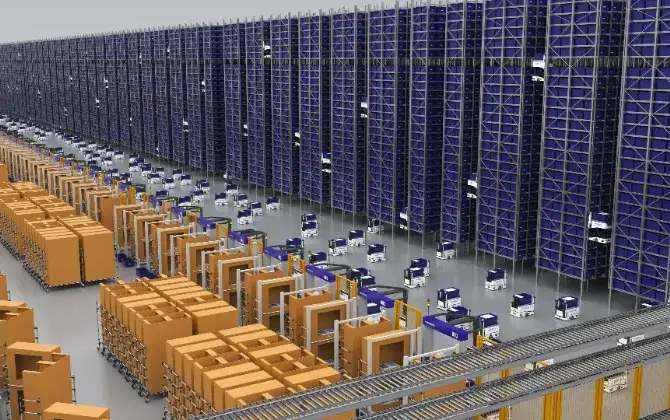
Hai Robotics Chosen for Largest Deployment of Rack-Climbing Warehouse Robots Worldwide
Hai Robotics has been selected to implement automation technology for a new large-scale e-commerce fulfillment center operated by a major European fashion retailer. This project features the HaiPick Climb system, marking the largest deployment of rack-climbing warehouse robots globally, with over 1,500 units set to enhance operational efficiency. The significance of this deployment lies in its potential to revolutionize warehouse automation, establishing a new benchmark in the industry. The retailer's expansion of its partnership with Hai Robotics underscores the reliability of the HaiPick Climb solution in managing high-volume online orders, with a throughput exceeding 24,000 totes per hour across a 30,000m² automated fulfillment operation. Looking ahead, the project exemplifies the increasing trend towards scalable robotic automation in large-scale fulfillment operations. No further timeline was disclosed at the time of publication, but the successful integration of over 1,500 HaiPick Climb robots is expected to enhance the retailer's capacity for omnichannel fulfillment significantly.
Warehouse Automation E-commerce Fulfillment Robotic Systems Logistics Supply Chain Management
Palladyne AI and FANUC America Form Strategic Partnership to Enhance Robotic Automation
Palladyne AI and FANUC America have announced a strategic collaboration aimed at advancing intelligent robotic automation. This partnership will integrate FANUC America's extensive industrial robot portfolio with Palladyne AI's innovative physical AI software platform. The collaboration is significant as it seeks to simplify the deployment of robotic systems, enhance their adaptability, and broaden the scope of automation across various sectors, including manufacturing, warehousing, and logistics. By leveraging both companies' strengths, the partnership aims to address the growing demand for efficient automation solutions. Looking ahead, industry stakeholders should monitor the developments from this collaboration, particularly how the integration of AI with robotics will impact operational efficiencies in the targeted sectors. No further timeline was disclosed at the time of publication.

China’s Dexterous Hand Industry, 2026 Part 3 — The Players
Five vendor archetypes, MIR’s composite top ten, eight company profiles and six field deployments — every firm linked to the RobotToday supplier directory.

China’s Dexterous Hand Industry, 2026 Part 2 — The Technology
Linkage, tendon, direct drive or hybrid — and why hardware is converging while the DL1–DL5 manipulation scale decides who wins. Part 2 of 3.

China’s Dexterous Hand Industry, 2026 Part 1 — The Demand Picture
MIR Databank puts China dexterous hand shipments above 30,000 units in 2026, yet only 3.5% of 2025 demand came from factory production. Part 1 of 3.
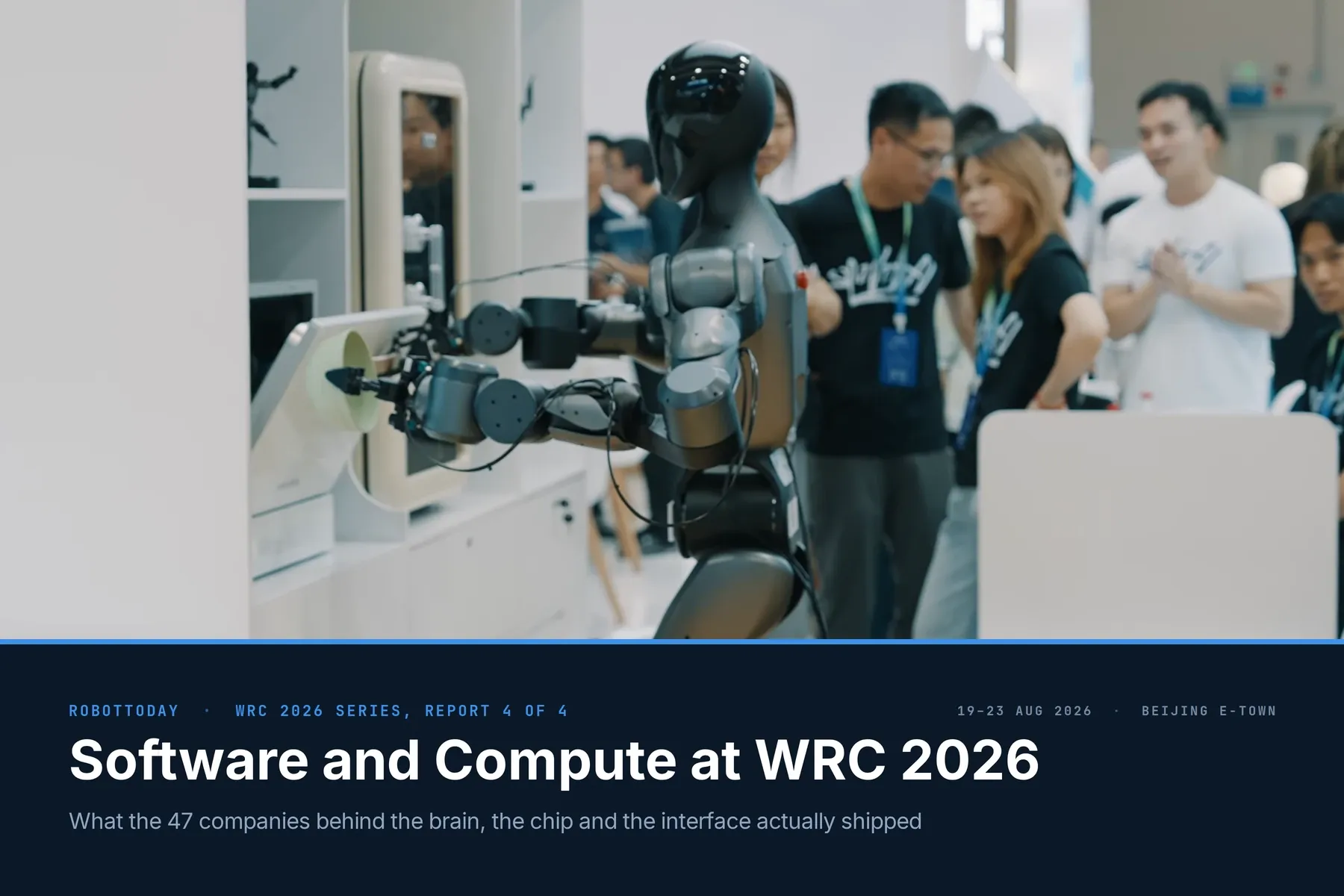
Software, Compute and Interaction at WRC 2026
47 WRC 2026 exhibitors supply robot software, compute or interaction — but only 19 call themselves software companies. Five open artefacts, licence-checked.
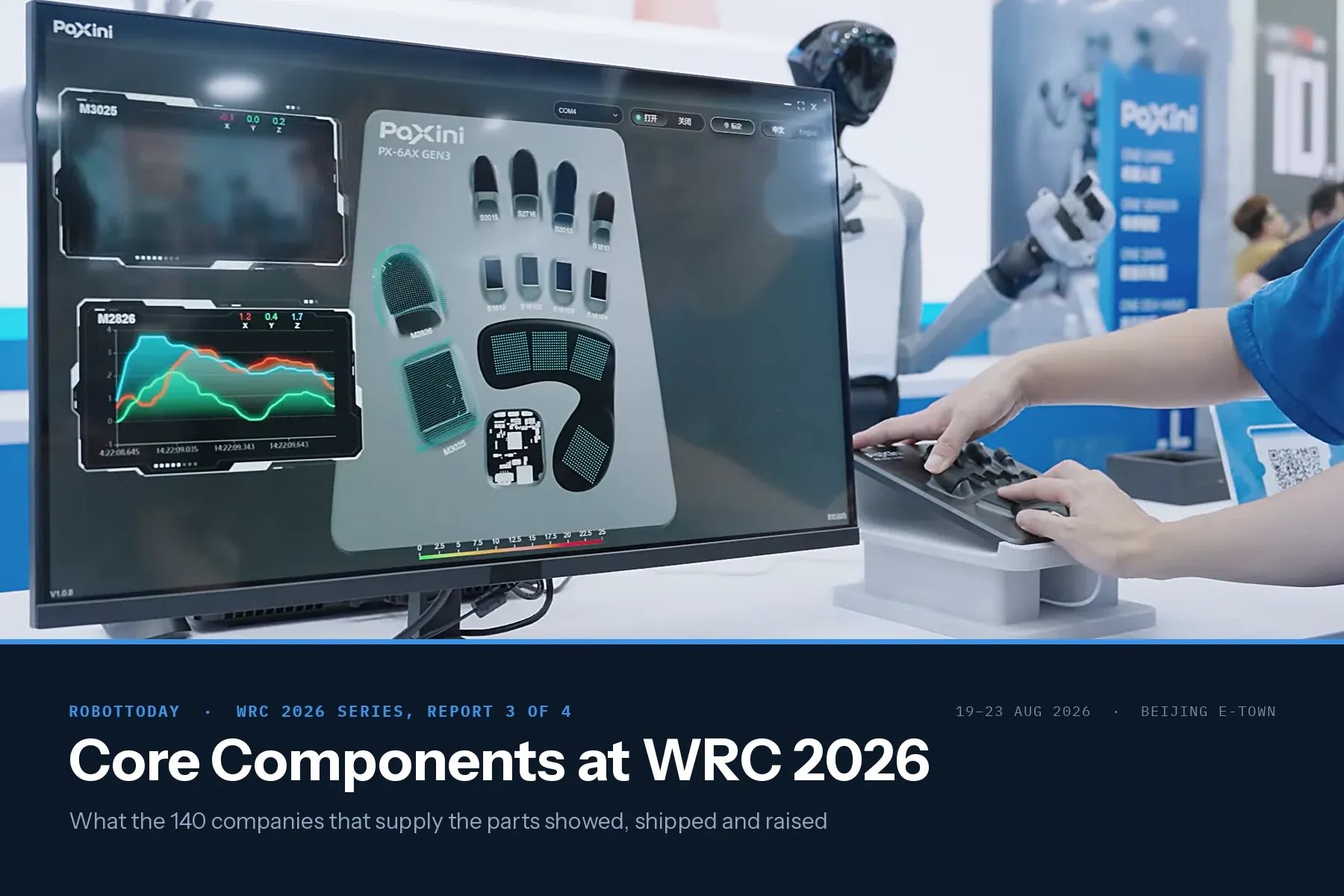
WRC 2026 Core Components: 137 Robot Parts Suppliers
The third report in the WRC 2026 series. Report 1 mapped all 248 exhibitors by category and Report 2 covered the 139 that build finished robots. This one covers the 137 that build what goes inside them.
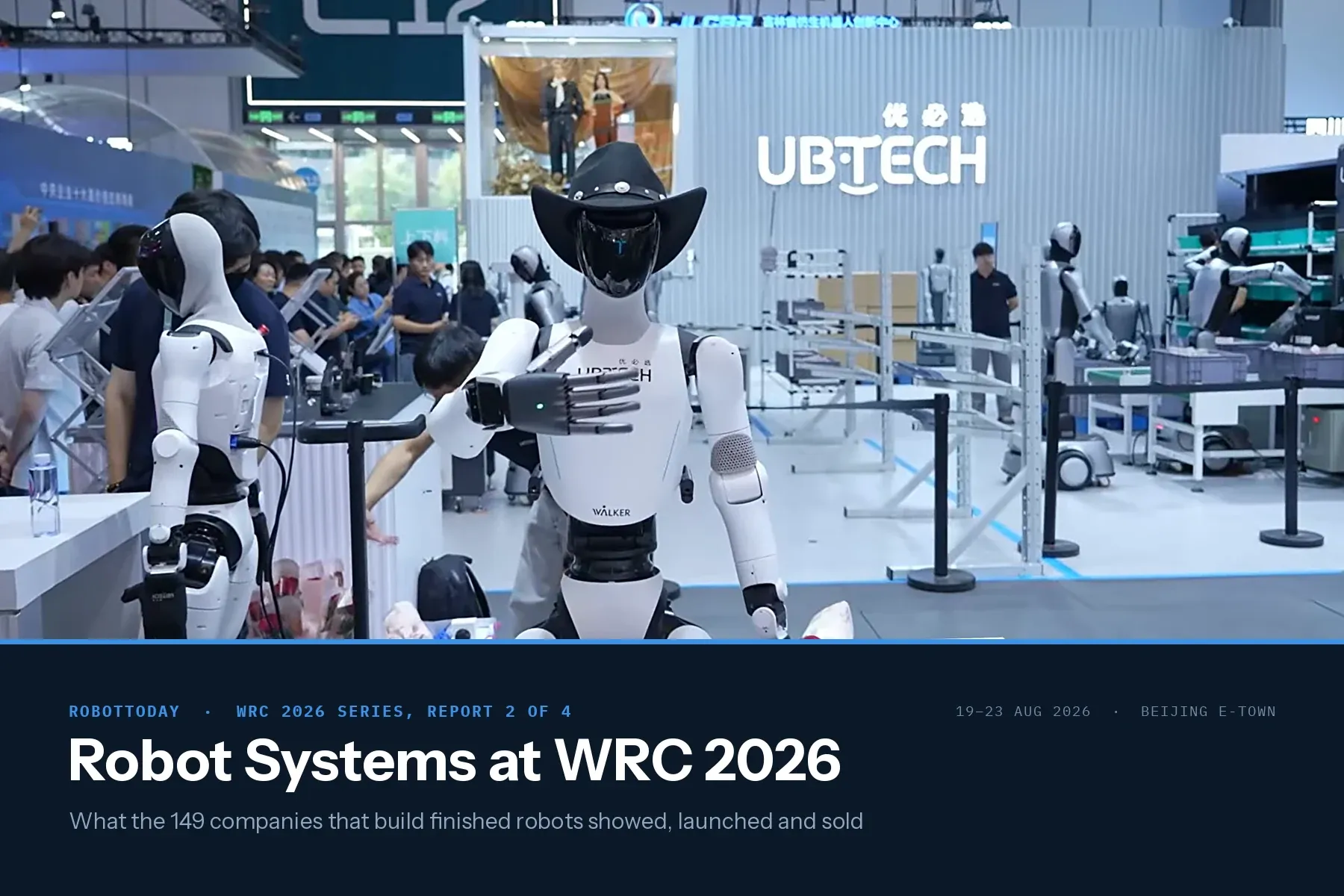
WRC 2026 Robot Systems: 149 Companies That Build Robots
149 of the 248 classified WRC 2026 exhibitors build finished robots. 93 build humanoid or legged machines. The audited humanoid sales number is one unit.

ROBOTTODAY Weekly August 10 – 14, 2026
Your weekly robotics briefing: Unitree's IPO is swamped by retail demand, the US puts 100% tariffs on imported drones, LG and Nvidia commit to a 2027 humanoid, and Uber and Pony.ai bring 2,000 robotaxis to Europe.

Inside Saga Robotics: UVC Light vs. Crop Disease
Saga Robotics CPO Damian Flynn on the Thorvald platform's UVC treatment system, its jump from UK strawberries to California wine grapes, and why he's “incredibly bullish” on applying automation and robotics into industries “most chaotic environment.”

Underactuated Robotics Russ Tedrake — RSF Specialist Shelf · Book S3 of 6
Legged robots fall over for control reasons, not mechanical ones. Tedrake's free MIT 6.832 notes explain why, and what a controller must do about it.

Barclays Report Predicts $200 Billion Market for Humanoid Robots by 2036
Barclays has released an in-depth report forecasting that the humanoid robot market could reach $200 billion by 2036. This projection highlights the optimistic expectations for future human-robot collaboration and underscores the significant potential of humanoid robots as the next generation of intelligent terminals. The report emphasizes that the core feature of Automation 3.0 is the transition from 'programmatic automation' to 'cognitive automation,' with humanoid robots being key enablers of this shift. Unlike previous automation generations that focused on repetitive tasks, the third phase addresses complex tasks in unstructured environments, where humanoid robots excel due to their human-like form and advanced perception capabilities. Key factors driving market growth include declining costs and enhanced perception abilities. The localization and mass production of core components like motors and sensors are rapidly reducing overall costs, making humanoid robots transition from 'high-end toys' to 'practical tools.' The report also notes a gradual market penetration path, starting with large-scale deployment in manufacturing and logistics before moving into retail and consumer applications. No further timeline was disclosed at the time of publication.
Humanoid Robots Automation 3.0 AI Market Trends Robotics Technology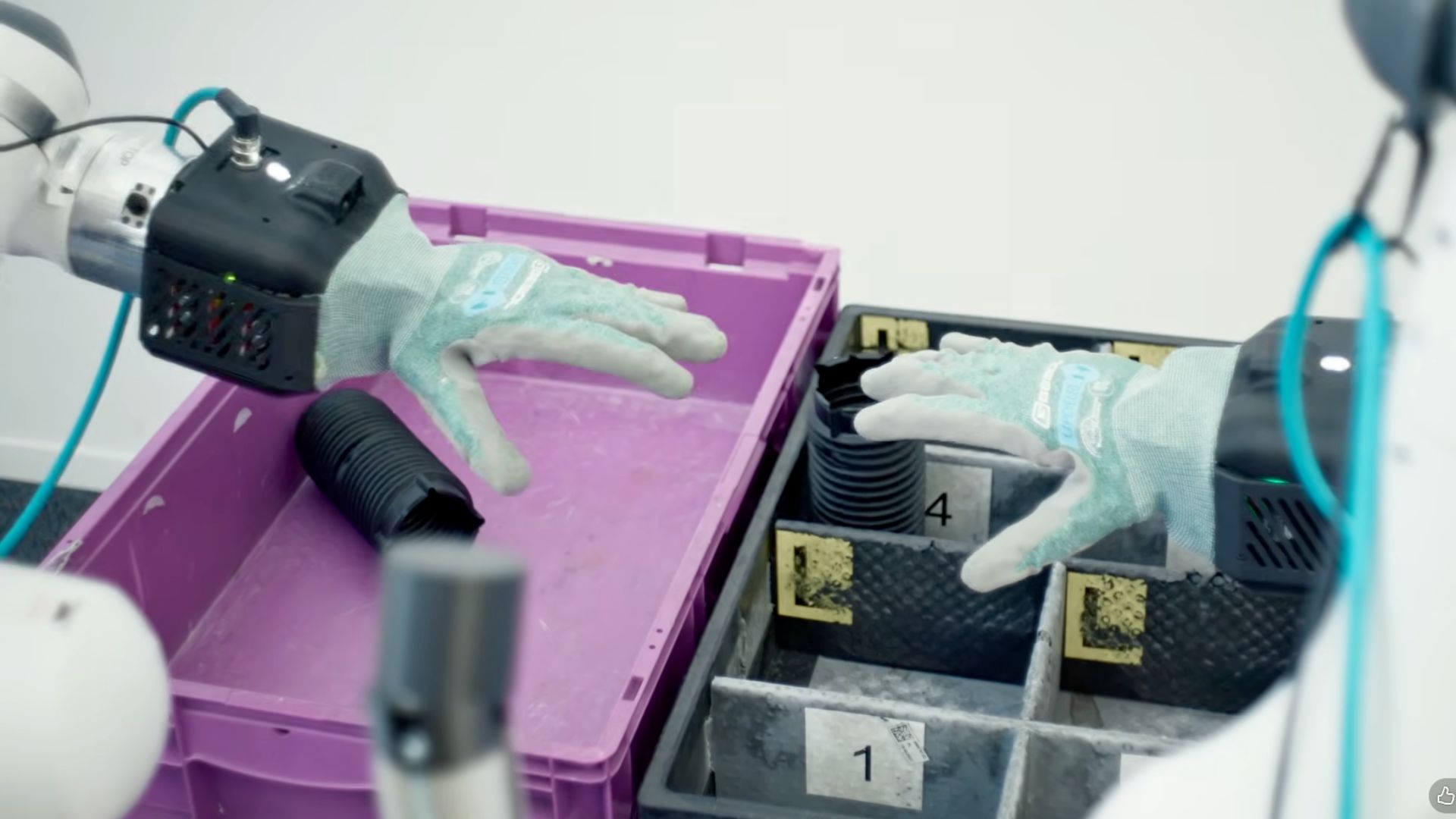
Mimic Robotics Introduces FLUX-mimic for Efficient Robot Learning from Video Demonstrations
Mimic Robotics has launched FLUX-mimic, a cutting-edge Video-Action Model developed with Black Forest Labs, enabling robots to learn intricate industrial tasks from video demonstrations. This innovative system significantly reduces the amount of training data required, allowing for faster and more efficient robot training in factory settings, including deployments at Audi. The importance of FLUX-mimic lies in its ability to streamline robot training processes, which traditionally demand extensive demonstration data. By utilizing a generative video foundation model, FLUX-mimic can fine-tune manipulation tasks with as little as 30 minutes of data, compared to the 30 hours often needed by conventional systems. This advancement is expected to shorten deployment cycles from months to weeks, enhancing operational efficiency. Looking ahead, the collaboration with Audi will test FLUX-mimic's performance in real-world factory environments, particularly for high-dexterity tasks. The focus on automating complex manipulations could lead to broader applications in manufacturing and logistics, making robotic automation more adaptable to evolving production needs. No further timeline was disclosed at the time of publication.
AI and Robotics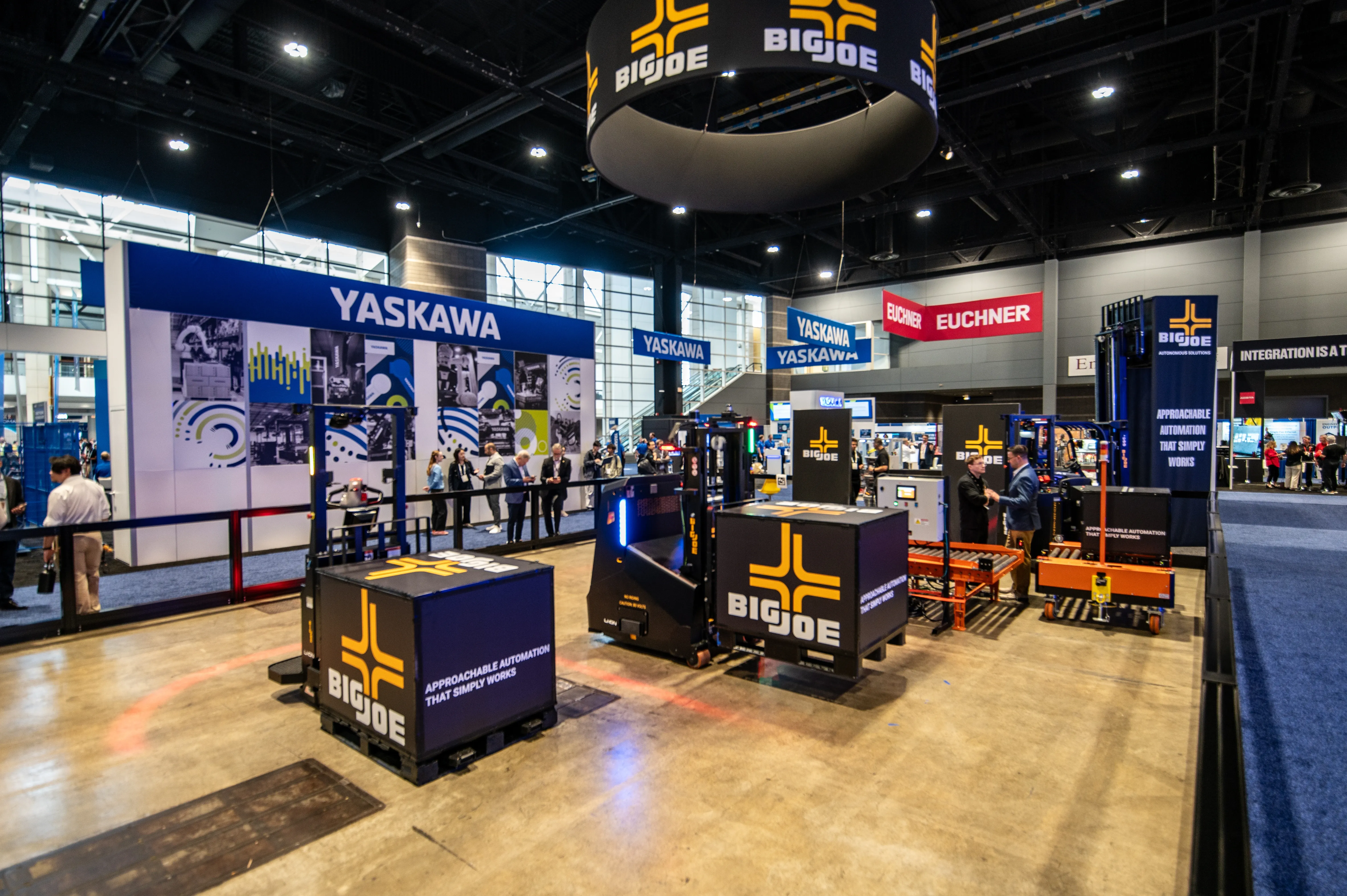
Big Joe's Four-Product AMR Push at Automate 2026: What It Reveals About the North American Warehouse Automation Market
RobotToday analyzes Big Joe's four new autonomous vehicles launched at Automate 2026 — AP44, ASC40, ATC100, ACV40 — in the context of North America's warehouse labor shortage and AMR market growth.

Luming Robotics Unveils Intelligent Solutions at WAIC 2026 in Shanghai
From July 17 to 20, 2026, the World Artificial Intelligence Conference (WAIC 2026) took place in Shanghai, showcasing significant advancements in the AI sector. Luming Robotics presented its latest embodied intelligence practices, emphasizing real-world applications and industrial collaboration. The company introduced its Prime R0 embodied brain and data collection capabilities, demonstrating a comprehensive technology system that spans 'scenarios, data, and models.' The importance of this event lies in the shift towards practical applications of embodied intelligence, moving beyond mere technical demonstrations. Luming Robotics highlighted the three developmental stages of embodied intelligence: industrial, commercial, and domestic. The industrial sector, characterized by clear task boundaries and quantifiable ROI, serves as the optimal starting point for scaling and iterating embodied intelligence technologies. Looking ahead, Luming Robotics announced a collaboration with Mitsubishi Electric Automation (China) to develop industrial assembly scenarios, marking a significant step towards autonomous task understanding and environmental adaptation. No further timeline was disclosed at the time of publication.
Embodied Intelligence Industrial Robotics Data Collection AI Technology
Study on Task Sequence Planning and Trajectory Optimization for Rebar Tying Robot End-Effectors
A recent study published in the Journal of Field Robotics focuses on task sequence planning and trajectory optimization specifically for the end-effectors of rebar tying robots. This research addresses the complexities involved in automating the rebar tying process, which is critical in construction and infrastructure projects. The significance of this study lies in its potential to enhance the efficiency and accuracy of rebar tying robots, thereby improving overall productivity in construction. By optimizing task sequences and trajectories, the research aims to reduce operational costs and time, which are essential factors in large-scale construction projects. Looking ahead, the implications of this research could lead to advancements in robotic automation within the construction industry. As the demand for efficient construction methods grows, further developments in trajectory optimization and task planning for rebar tying robots will be crucial. No further timeline was disclosed at the time of publication.
RESEARCH ARTICLE
RoboDK to Demonstrate New CAM Software That Cuts Robotic Machining Deployment Time by Up to 40% at Automate Chicago 2026
RoboDK is set to demonstrate its advanced capabilities in CAD-to-robot machining and collision-free motion planning at an upcoming event. Utilizing a Mecademic robot, the company will present a production-ready setup that highlights the efficiency and precision of its technology. This showcase aims to illustrate how RoboDK's software can streamline robotic machining processes, enhancing productivity and safety in manufacturing environments. The event is scheduled for later this month, providing an opportunity for industry professionals to witness firsthand the innovations in robotic automation and their practical applications in real-world scenarios.


