

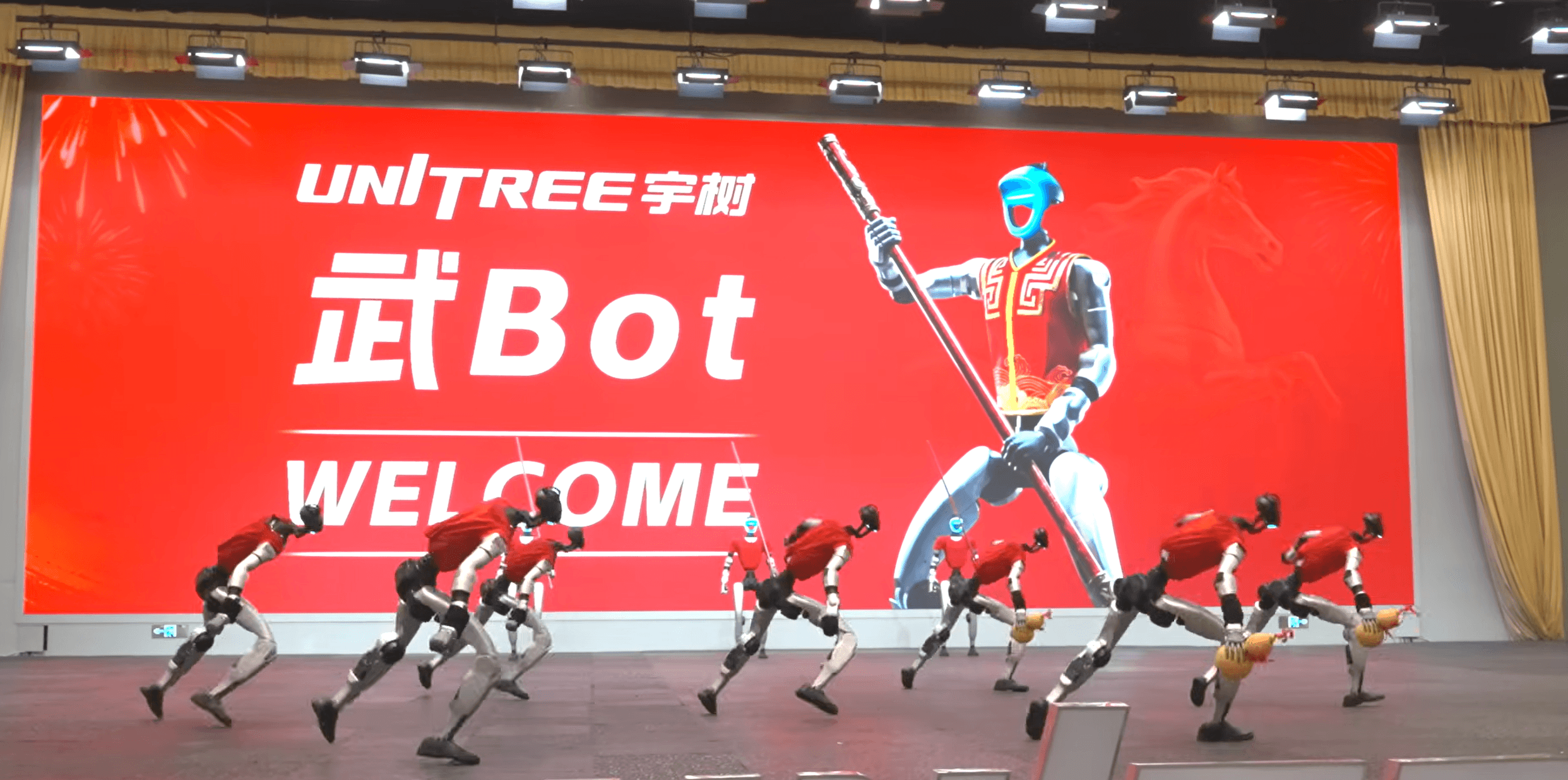
Unitree Robotics has filed for a listing on the Shanghai Stock Exchange STAR Market, disclosing financials that mark a sharp break from the loss-making norm of the humanoid robot sector. The company posted ¥1.7 billion in revenue for 2025 and ¥600 million in adjusted net profit — figures that, if sustained, would make it the most commercially viable public robotics company in China by most conventional measures.
The filing has cleared two rounds of SSE inquiry. The company targets ¥4.2 billion in gross proceeds, implying a minimum market cap of roughly ¥42 billion at 10% float. Its most recent pre-IPO round, closed in June 2025, valued Unitree at ¥12.7 billion.
KEY FINANCIALS AT A GLANCE
| 2025 Revenue (full year est.) | ¥1.7 billion |
| 2025 Adj. Net Profit (est.) | ¥600 million |
| 2025 Operating Cash Flow (est.) | ¥670 million+ |
| Gross Margin (2025) | 60.27% (vs 44.22% in 2023) |
| Humanoid Robot Shipments (2025) | 5,500+ units — #1 globally |
| Quadruped Robot Cumulative Sales | 30,000+ units — #1 globally |
| Humanoid Revenue Share (Q1–Q3 2025) | 51.53% (vs 1.88% in 2023) |
| Production-to-Sales Rate | >95% |
| IPO Target Proceeds | ¥4.2 billion |
| R&D Allocation of Proceeds | 85% (¥3.57 billion) |
| Embodied AI Model Investment | ¥2.02 billion (48% of total R&D) |
| Planned Annual Capacity (post-build) | 75,000 humanoid + 115,000 quadruped |
Technology: Full-Stack Self-Development, Racing for the "Brain"
Unitree's commercial pitch rests on vertical integration. The company self-develops core motion algorithms, reinforcement learning systems, motor drivers, energy management software, high-torque motors, harmonic reducers, dexterous hands, and LiDAR sensors. That stack gave it the ability to iterate fast on hardware without dependence on outside suppliers for critical components — a structural advantage in a supply-constrained market.
The hardware record is documented. In 2021 its quadruped achieved a 4.7 m/s sprint, a world record at the time. In 2023 its H1 humanoid completed the first full-backflip by an electrically driven humanoid robot. By 2025 its G1 model recorded a running speed above 5 m/s, again a verified global best. At the 2026 Spring Festival Gala broadcast nationally — the third consecutive year Unitree appeared on the programme — its robots executed parkour sequences, aerial flips from ramp launches, and continuous obstacle-course runs.
"Motion is the prerequisite for work. Only when motion is stable and rich enough does doing actual work follow naturally." — Wang Xingxing, CEO, February 2026
That philosophy explains the sequencing: Unitree built locomotion first, then began layering intelligence. The prospectus now reflects a hard pivot toward AI models as the next competitive battleground.
Model Development: Two Open-Source Releases, One Industrial Pilot
Unitree has shipped two foundational models since September 2025. The first, WMA (World Model – Action), released in September 2025, focuses on physics-grounded prediction for robot decision-making. The second, UnifoLM-VLA-0 (Vision-Language-Action), released in January 2026, scored 98.7 on the LIBERO simulation benchmark — the highest published score in the VLA category, ahead of OpenVLA, InternVLA, and the π0 series from Physical Intelligence.
Developer feedback has been positive on both counts. UnifoLM-VLA-0 is described by practitioners as one of the most engineering-complete open-source VLA bases currently available — meaning it is reusable as infrastructure, not just a research artefact. That distinction matters for ecosystem development and for the downstream data flywheel Unitree is building.
A third model, the industrial-grade UnifoLM-X1-0, is in small-scale validation inside Unitree's own factory, reportedly performing standardised assembly tasks including joint motor installation. No commercial release timeline has been announced.
The prospectus targets a general-purpose humanoid foundation model within three years. The stated development roadmap covers: (1) a closed-loop system linking cloud training, edge inference, and real-robot data collection; (2) improved world-model simulation enabling scene prediction and task pre-rehearsal; and (3) multi-modal sensor fusion across vision, LiDAR, and force sensors to sharpen physical interaction accuracy.
The ¥2.02 billion allocated to embodied AI models and foundational technology represents 48% of total planned R&D spend from IPO proceeds. That figure directly addresses a recurring external criticism — that Unitree is a hardware specialist with limited AI depth.
Market Position: Dual-Category Leader, Shifting Revenue Mix
Unitree holds the largest global market share in both quadruped and humanoid robots by unit shipment. The quadruped position is mature: over 30,000 units sold cumulatively, with the installed base now spanning leading technology companies and university research institutions across North America, Europe, and Asia.
The humanoid position is newer and moving faster. Revenue from humanoid products crossed 50% of total sales in Q1–Q3 2025, overtaking quadrupeds for the first time. The G1 model is the primary driver. Shipment volume of 5,500+ units in 2025 represents a scale that no other humanoid manufacturer has publicly confirmed.
International revenue remains material. From 2022 to 2024, overseas sales consistently exceeded 50% of total revenue. In 2025 the overseas share declined as domestic demand accelerated — but absolute overseas revenue still grew 109.9% year-on-year. The company operates a global sales and service network and lists entry into top-tier technology companies and research institutions as a key commercial signal.
Gross margin expansion from 44.22% in 2023 to 60.27% in 2025 reflects two structural factors: in-house component manufacturing reducing input costs, and the G1 humanoid commanding a higher ASP than the quadruped line. The production-to-sales rate above 95% indicates demand is not being manufactured by inventory buildup — units shipped are units ordered.
IPO Structure: Capital for Capacity and Cognition
The offering covers a minimum of 40.45 million new shares at approximately 10% float. At ¥42.02 billion implied market cap, the valuation represents a significant step up from the ¥12.7 billion last private round. Whether institutional investors accept that premium will depend on how they model the AI transition — and whether Unitree's open-source strategy generates ecosystem returns or simply subsidises competitors.
Proceeds allocation breaks down as follows: 85% (¥3.57 billion) directed to R&D including embodied AI models, robot body development, and new product lines; the remainder to a smart manufacturing facility targeting annual output of 75,000 humanoid and 115,000 quadruped robots — a combined 190,000+ units per year, roughly 34x the 2025 humanoid shipment volume.
That capacity target is aggressive. Meeting it requires not just capital expenditure but sustained order intake at a scale the market has not yet demonstrated. The credibility of the capacity build rests entirely on whether demand grows alongside supply — a core risk that the prospectus does not quantify.
Context: First Integrated Robotics Listing on A-Share Markets
No integrated humanoid or quadruped robot manufacturer currently trades on A-share markets. Existing publicly listed robotics exposure in China is concentrated in component suppliers — motors, reducers, sensors. Unitree's listing would provide direct equity access to a full-stack robot builder for the first time.
The filing arrives as China's 15th Five-Year Plan provisions for embodied intelligence take effect, directing policy support and procurement frameworks toward domestically developed general-purpose robots. That policy context supports near-term revenue visibility for industrial deployments — but also creates expectations of government-aligned pricing that may compress margins over time.
Unitree is not the only company racing toward an AI model capability. Boston Dynamics, Agility Robotics, Figure AI, and Physical Intelligence in the US, and Fourier Intelligence, UBTECH, and Agibot in China are all investing heavily in VLA or similar frameworks. The LIBERO benchmark lead is real but not permanent. The more durable competitive advantage is Unitree's data flywheel: 30,000 quadrupeds and 5,500 humanoids in active deployment generate real-world interaction data that pure-model companies cannot replicate from simulation alone.
The most valuable thing Unitree is building with its 35,500-unit installed base is not robots. It is training data that closed-lab competitors cannot buy.
Wang Xingxing founded Unitree in 2016 after leaving DJI within three months of joining. The company has taken ten years to reach ¥1.7 billion in revenue. The next phase — turning a hardware company into a platform company — will be harder and will take longer than the prospectus timeline implies.
Sources: Unitree STAR Market Prospectus; SSE Pre-review Disclosures







Leave a comment