


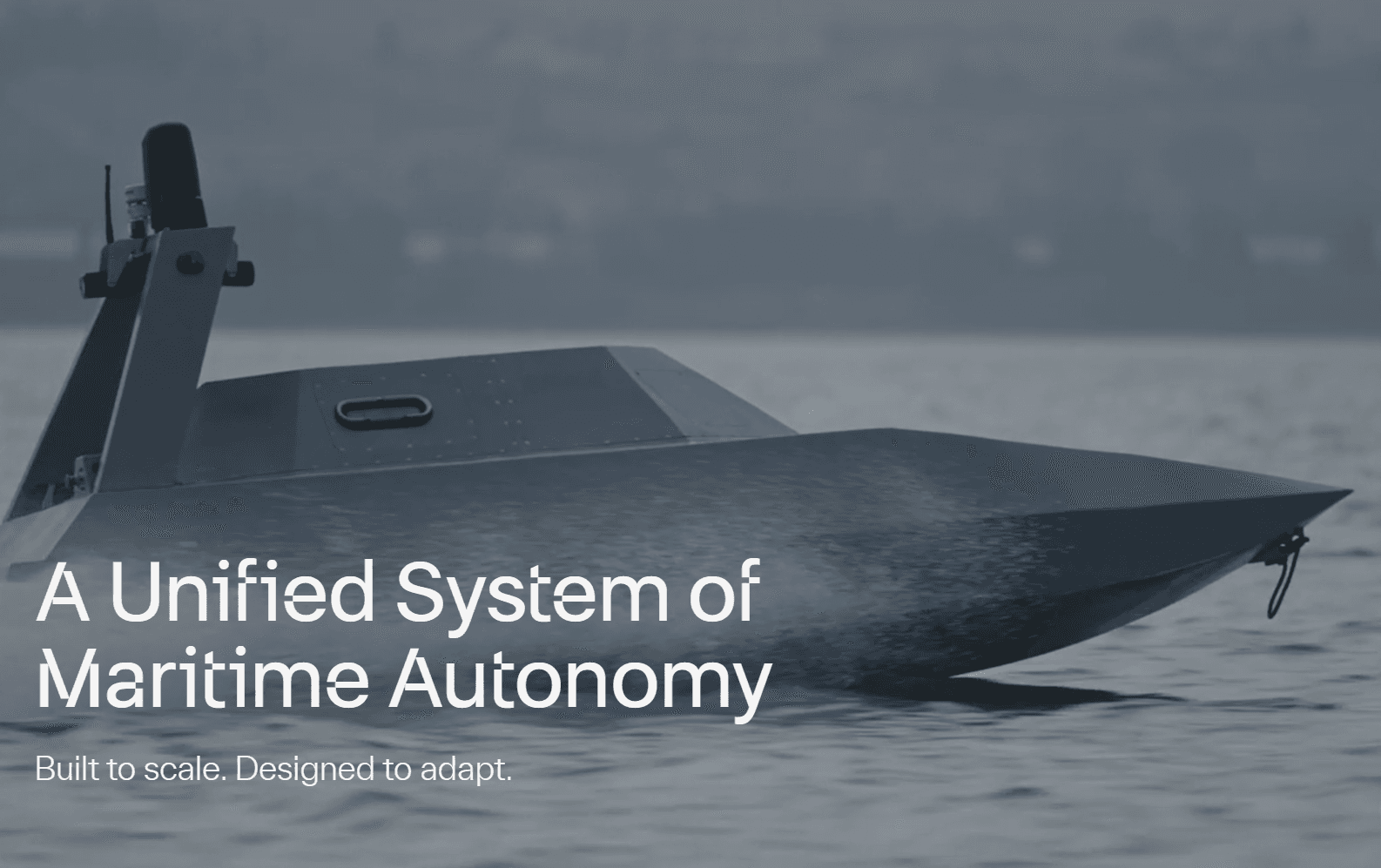
Skana Robotics, founded by Israeli naval special-operations veterans and robotics engineers, is building a unified, software-defined maritime autonomy ecosystem intended to transform how modern navies deploy unmanned assets. Rather than treating surface, subsea, and amphibious vehicles as separate categories, Skana integrates all platforms into a single operational architecture powered by two proprietary software layers: SeaSphere™ for mission planning and fleet-level coordination, and Vera™ for real-time autonomous execution. This approach allows a heterogeneous fleet of autonomous vessels to behave as a coordinated, distributed system in both permissive and contested maritime environments.
SeaSphere operates as the high-level command, control, and coordination engine. It accepts mission objectives, allocates tasks across all vessels, optimizes resource usage, and synchronizes execution among mixed-platform fleets. Vera, built on a ROS-2 foundation, translates these high-level directives into local autonomy, enabling each platform to navigate, collaborate, and adapt even under degraded communications or GPS-denied conditions. This pairing of centralized intent with decentralized execution is the core architectural principle behind Skana’s maritime system-of-systems.
Skana applies this autonomy stack across three primary unmanned platforms—an autonomous surface vessel (ASV), an autonomous underwater vehicle (AUV), and an amphibious vehicle (AAV). Their roles, specifications, and hardware capabilities are summarized below:
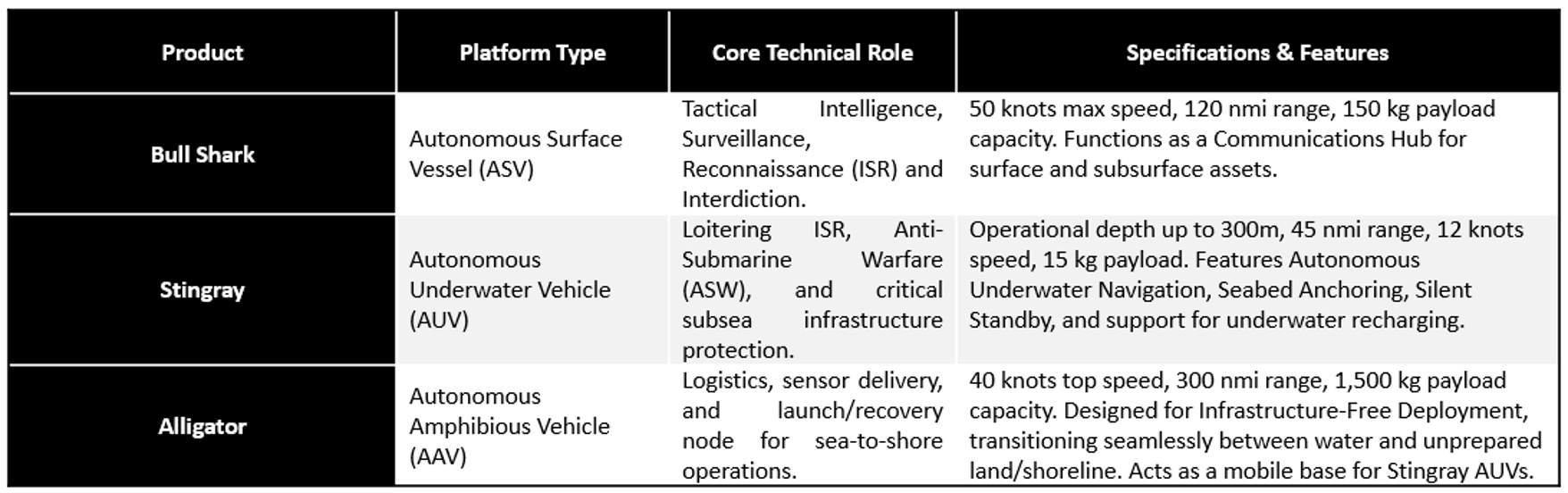
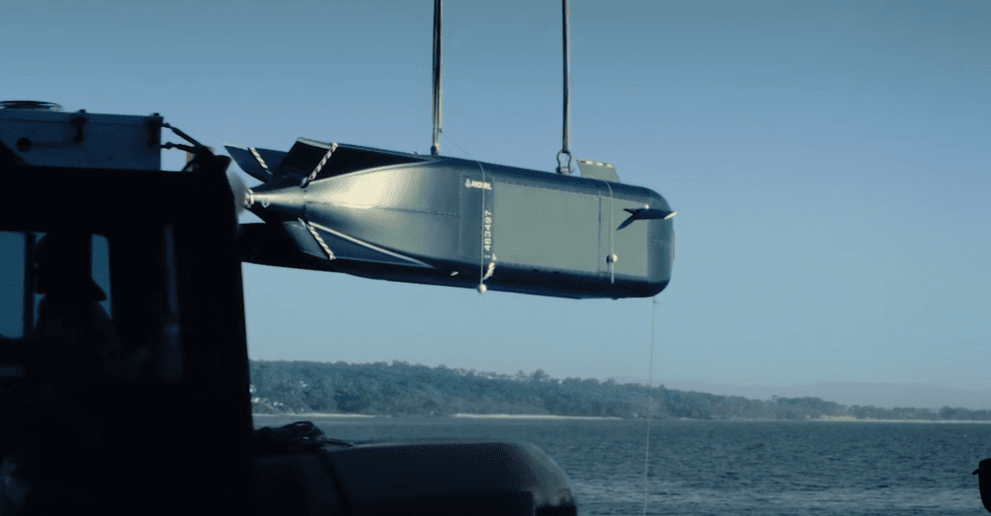
Skana positions these platforms as interoperable nodes in a maritime mesh that can extend naval sensing, interdiction, and logistics reach without the manpower or maintenance burden of traditional vessels. The Bull Shark serves as a high-speed ISR and communications hub, enabling wide-area situational awareness and providing network continuity for underwater assets. Stingray focuses on low-signature subsea operations, including anti-submarine surveillance, critical infrastructure monitoring, and long-duration loitering missions. Alligator is designed to bridge the gap between sea and shore, delivering equipment, sensors, and AUVs into environments where no port infrastructure exists.
The company’s early commercial focus centers on modern navies and national security agencies looking to expand unmanned capabilities at scale. Skana’s system enables distributed ISR, harbor and choke-point protection, subsea cable and pipeline monitoring, and littoral logistics in denied or degraded environments. The integrated software architecture is intended to reduce operator workload dramatically while making autonomous fleets more scalable and cost-effective than existing unmanned solutions.
Operational Considerations
Despite its technically coherent architecture, Skana faces several structural constraints typical of early-stage defense robotics companies. As of late 2025, the company is described as an unfunded startup, which presents difficulty when competing with well-capitalized entities such as Anduril or established defense primes. Its current platforms emphasize ISR and logistics, and while weaponized configurations are planned, they are not yet standard. The Stingray AUV, like all battery-powered underwater systems, remains bound by endurance limitations, with mission complexity competing directly with available onboard energy. Finally, the company must still overcome the fundamental challenges of underwater autonomy—communication blackouts, unpredictable ocean dynamics, and the long certification cycles required for integration into naval fleets.
Competitive Positioning
Skana enters a crowded maritime autonomy field that includes roughly sixty identified competitors ranging from defense giants like Boeing and Rafael to newer autonomy-driven companies such as Anduril, Saildrone, and Saronic. What differentiates Skana is not a single breakthrough in vehicle design but its unified software-defined architecture, which treats air, surface, and subsurface robots as components of one coordinated operational system. Whether this architectural advantage translates into procurement momentum will depend not only on technical performance but also on Skana’s ability to scale manufacturing, secure sustained funding, and demonstrate reliability in real naval deployments.










Leave a comment