

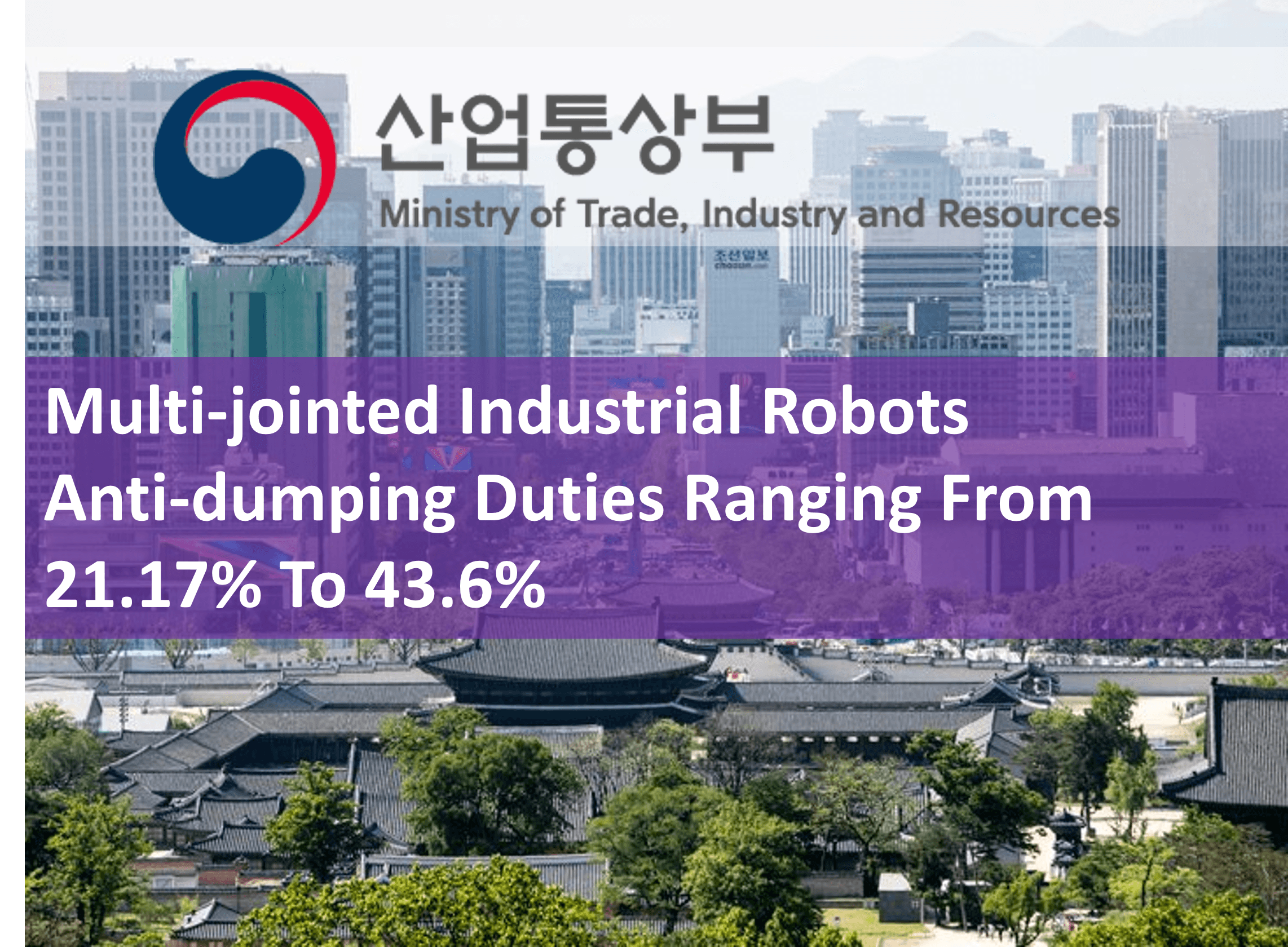
South Korea has opened its first anti-dumping investigation in two decades, targeting multi-joint industrial robots imported from China and Japan. The Ministry of Trade, Industry and Energy (MOTIE) imposed provisional duties of 21.17 % – 43.6 %, effective 21 November 2025 through 20 March 2026, while a full investigation proceeds.
Local robot makers allege foreign “predatory pricing” that undercuts domestic producers.
The case could reshape Asia’s robotics-trade landscape as Korea defends its automation ecosystem amid global protectionism and accelerates policies to boost domestic robot-part production and regulatory independence.
Korea’s First Anti-Dumping Case in Robotics
In November 2025, MOTIE launched South Korea’s first anti-dumping investigation in 20 years, focusing on multi-joint industrial robots with four or more axes imported from Japan and China.
According to Aju Press, Korean manufacturers claim these imports were sold 28 – 44 % below fair market value, causing material injury to domestic producers. MOTIE set provisional tariffs of 21.17 % – 43.6 %, effective from 21 November 2025 to 20 March 2026, pending the ministry’s final determination expected by March 2026.
Background: A Strategic Market Under Pressure
Korea’s robotics market reached ₩6 trillion (≈ US $4 billion) in 2024, with industrial robots accounting for roughly half of total sales.
The nation hosts over 2,500 robotics firms, 567 of which specialize in industrial automation.
Facing tariff pressures on steel and tech products from the U.S. and EU, policymakers increasingly see robotics as a strategic industry vital to manufacturing resilience and a response to labour shortages.
Government and Industry Reactions
Industry Minister Bang Moon-Kyu called robotics “a key lever to increase productivity and address demographic changes,” confirming plans to invest ₩3.2 trillion (≈ US $2.3 billion) by 2030 to scale the sector.
HD Hyundai Robotics and other domestic firms welcomed the investigation, arguing that “Chinese companies appear to be dumping their products into the Korean market to reduce inventories.”
President Lee Jae-myung linked the move to Korea’s broader economic strategy, warning that:
“The rapid changes in the global order — rising protectionism and supply-chain restructuring — pose a threat to our very survival.”
Regulatory Turning Point
The investigation aligns with Korea’s Fourth Intelligent Robot Basic Plan (2024 – 2028), which aims to:
- Raise the local-manufacturing ratio of core robot parts from 44 % to 80 % by 2030.
- Eliminate 51 regulatory barriers that limit R&D and commercialization.
- Classify robotics as a strategic export-control industry, alongside semiconductors and batteries.
This anti-dumping action embodies a new “protection + innovation” hybrid policy model — tighter import control paired with domestic regulatory liberalization.
U.S. Policy Trigger: Section 232 and Global Trade Signals
The timing of Korea’s action coincides with a broader policy shift in the United States. On 2 September 2025, the U.S. Department of Commerce initiated a Section 232 national-security investigation under the Trade Expansion Act of 1962, examining imports of robotics and industrial machinery to assess whether foreign dependence poses national-security risks.
The investigation — formally recorded in the Federal Register (Docket No. XRIN 0694-XC138) — covers industrial robots, CNC machining centres, machine tools, and programmable mechanical systems.
Stakeholders were asked to comment on import reliance, supply-chain vulnerability, and potential “weaponisation” of robotics by foreign states. While no tariff decision has yet been made, the move places robotics alongside steel, aluminium, and semiconductors as a strategic trade category subject to national-security review. Korea’s anti-dumping probe is thus not an isolated event but part of a global re-wiring of robotics regulation — a policy response to the same supply-chain pressures now shaping U.S. and EU industrial policy.
Implications for the Robotics Market
If dumping is confirmed and long-term tariffs ensue, foreign suppliers — particularly from China — could lose their cost advantage, spurring local manufacturers to scale production and integrate supply chains faster.
Expected market shifts include:
- Localization of key components (harmonic reducers, servo drives, motion-control chips).
- Consolidation of mid-tier robot integrators seeking domestic market share.
- Price normalization across Asia’s robotics exports, possibly triggering reciprocal measures in China or Japan.
Experts note that short-term production costs may rise under tariff protection, but long-term competitiveness should improve through higher domestic R&D content.
MOTIE’s final decision in March 2026 will determine whether these provisional tariffs become permanent.
Whatever the outcome, the message is clear: robotics now stands alongside semiconductors, batteries, and shipbuilding as a nationally protected industry.
As President Lee noted, Korea must “transform from a follower into a rule-maker” — and this first robotics trade-defence case may be the opening act.







Leave a comment